

Commercial Retaining Walls: 10 Powerful Benefits in 2025
Understanding Commercial Retaining Walls: Structure, Purpose & Performance
Commercial retaining walls are engineered structures designed to hold back soil and create level areas on otherwise sloped terrain. They provide critical support for commercial properties while maximizing usable space.
| Key Aspects of Commercial Retaining Walls | Description |
|---|---|
| Primary Purpose | Hold back soil to prevent erosion and create usable space |
| Typical Heights | 3-20+ feet (taller than residential walls) |
| Common Materials | Concrete blocks, precast panels, poured concrete, limestone, gabion |
| Load Capacity | Engineered for heavy commercial loads (vehicles, buildings) |
| Cost Factors | Height, material, soil conditions, accessibility, engineering requirements |
| Lifespan | 40-100+ years depending on material (concrete sleepers: 60 years) |
Commercial retaining walls differ significantly from residential installations in terms of scale, engineering requirements, and construction methods. While residential walls might be built for aesthetic purposes or minor grade changes, commercial walls must withstand substantial earth pressures, potential vehicle loads, and sometimes even building foundations.
The right retaining wall system can transform unusable slopes into valuable commercial space while providing long-term stability and safety. Whether you’re developing a shopping center with maximized parking, creating terraced outdoor spaces for a multi-family complex, or stabilizing a steep embankment along a roadway, commercial retaining walls offer engineered solutions to challenging terrain.
Modern commercial retaining wall systems include innovations like hollow-core blocks that use 40% less concrete than solid systems while maintaining structural integrity. Large-format blocks can cover up to 8 square feet per unit, dramatically reducing installation time and labor costs on large commercial projects.
I’m Sal Musto, founder of SalCorp Landscaping & Construction, with extensive experience designing and installing commercial retaining walls across Massachusetts for projects ranging from shopping centers to corporate campuses. My team and I specialize in selecting the optimal retaining wall system based on your specific site conditions, engineering requirements, and aesthetic goals.
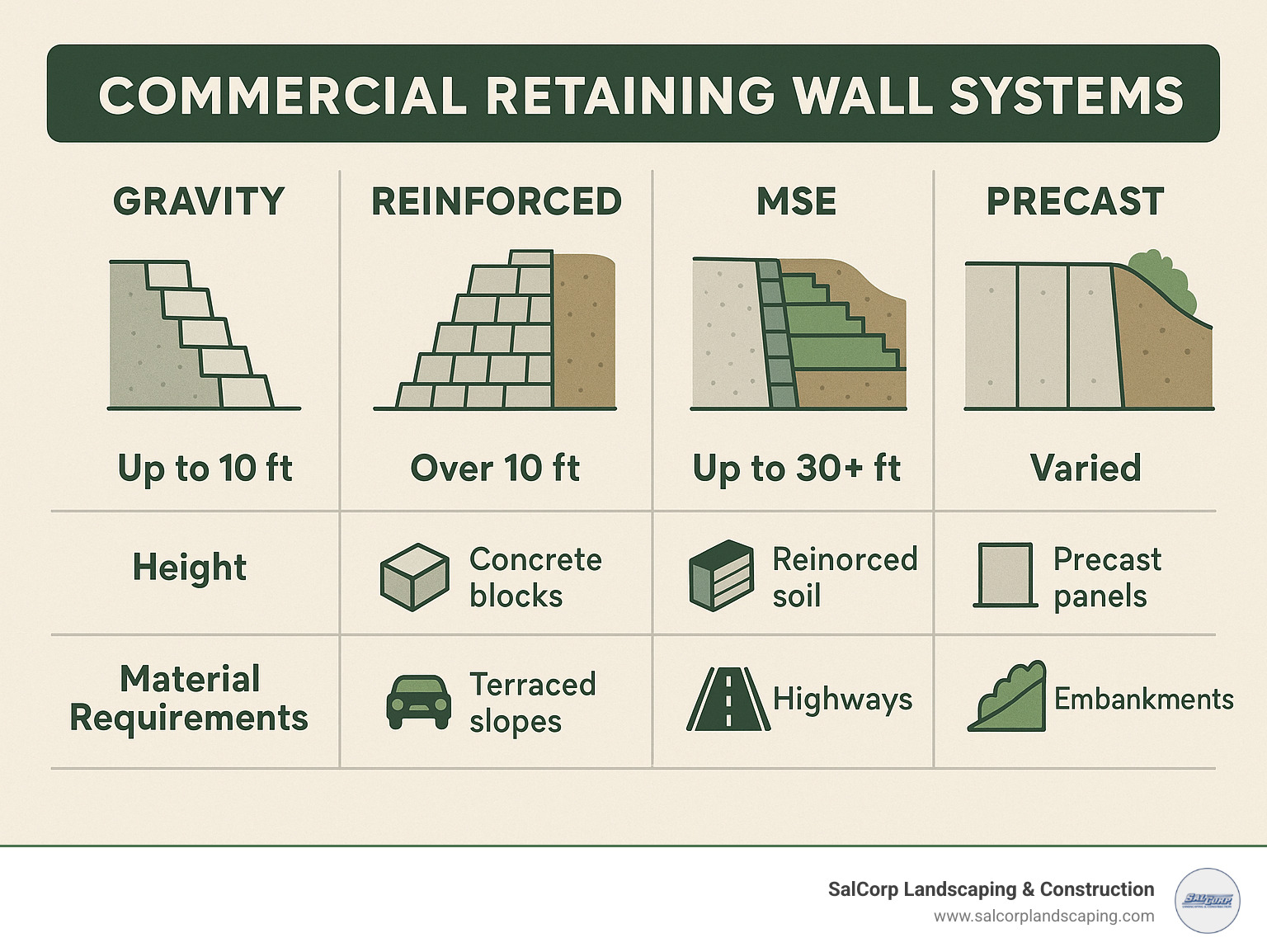
Commercial retaining walls terms made easy:
– commercial hard landscaping
– commercial landscape design
– commercial landscape contractors
Commercial Retaining Walls 101
Commercial retaining walls are engineered structures designed to resist the lateral pressure of soil when there’s a desired change in ground elevation that exceeds the soil’s natural angle of repose. Unlike their residential counterparts, commercial walls are built to withstand significantly higher loads, accommodate greater heights, and comply with strict commercial building codes.
The fundamental difference between commercial and residential retaining walls lies in scale and engineering complexity. While a residential wall might reach 3-4 feet in height, commercial retaining walls routinely extend to 10, 20, or even 30+ feet. This difference in scale necessitates more robust engineering, deeper foundations, and often specialized construction equipment.
At SalCorp Landscaping & Construction, we approach every commercial retaining wall project with a thorough understanding of both the aesthetic requirements and the critical structural demands. Our owner-operated approach means that we oversee every aspect of the project personally, ensuring that the engineering specifications are followed precisely.
More info about retaining wall basics
Primary Applications and Benefits of Commercial Retaining Walls
Commercial retaining walls serve numerous crucial functions across various commercial and public settings:
- Parking Lot Expansion: By retaining soil on sloped sites, walls can dramatically increase the footprint of level parking areas, maximizing the number of spaces available for customers or employees.
- Roadway Embankments: Along highways and commercial access roads, retaining walls provide critical support for liftd roadbeds and prevent erosion of surrounding slopes.
- Waterfront Protection: In coastal commercial developments, specialized retaining walls help prevent shoreline erosion while creating usable waterfront space.
- Green Roof Support: On commercial buildings with rooftop gardens or recreational spaces, specialized retaining systems help contain soil and manage drainage.
- Erosion Control: In areas prone to soil erosion, commercial walls provide a permanent solution that protects valuable property and infrastructure.
- Usable Space Creation: Perhaps the most significant benefit is the ability to transform otherwise unusable sloped land into valuable commercial real estate.
In Massachusetts communities like Boston, Newton, and Framingham, where developable land comes at a premium, the ability to maximize usable space through effective retaining wall systems can significantly improve property value.
How Commercial Retaining Walls Differ from Residential Builds
The differences between commercial and residential retaining walls extend far beyond mere size:
- Higher Load Capacity: Commercial retaining walls must be engineered to support not just soil pressure but often additional surcharge loads from nearby buildings, parking lots, or heavy equipment.
- Taller Heights: Commercial walls frequently exceed the 4-foot threshold that typically triggers engineering requirements, with heights of 10-20+ feet being common.
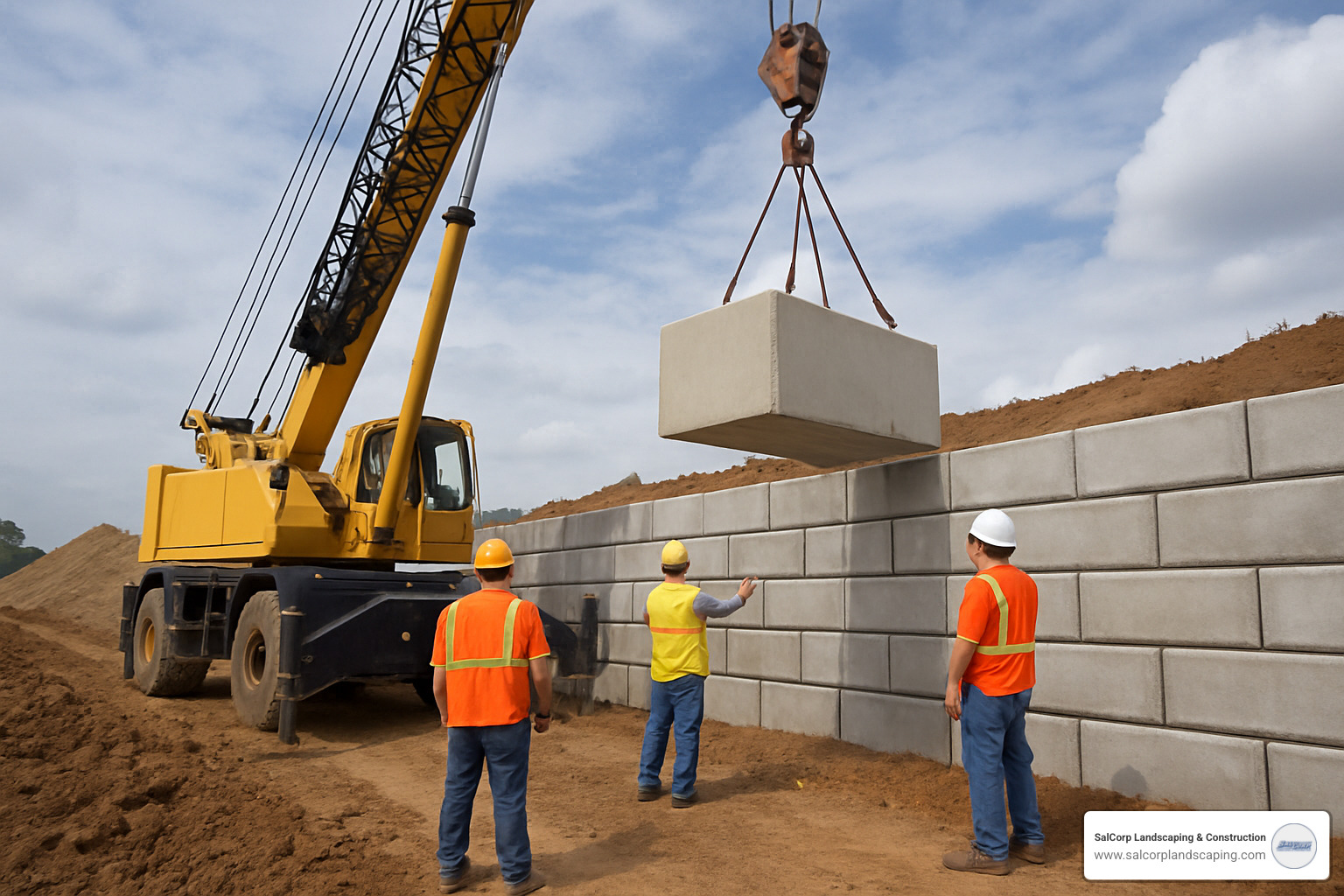
- Construction Equipment: While residential walls might be built with minimal equipment, commercial projects typically require heavy machinery like excavators, cranes for placing large blocks, and specialized compaction equipment.
- Permitting Complexity: Commercial projects involve more extensive permitting processes, often requiring detailed engineering plans, soil reports, and multiple approvals from local authorities.
- Inspection Requirements: Commercial walls are subject to rigorous inspection protocols during construction, with multiple checkpoints to verify compliance with engineered specifications.
- Material Specifications: Materials for commercial applications must meet higher standards for compressive strength, freeze-thaw durability, and long-term performance.
At SalCorp, our experience with the permitting processes across Massachusetts communities gives us valuable insight into navigating these requirements efficiently, saving our clients both time and frustration.
Types & Materials of Commercial Retaining Walls
The world of commercial retaining walls is incredibly diverse, with each system offering unique advantages for different situations. Whether you’re developing a shopping center parking lot or stabilizing a highway embankment, selecting the right wall type can make all the difference in your project’s success.
| Wall Type | Maximum Height | Installation Speed | Relative Cost | Best Applications |
|---|---|---|---|---|
| Gravity | Up to 14 ft (unreinforced) | Fast | Low-Medium | Low walls, decorative applications |
| Reinforced | 20+ ft | Medium | Medium | Most commercial applications |
| MSE | 50+ ft | Medium-Fast | Medium-High | Highway embankments, bridge abutments |
| GRS-IBS | 30+ ft | Fast | Low-Medium | Bridge abutments, approaches |
| Precast Panel | 30+ ft | Very Fast | High | Urban settings, highways |
| Segmental | 40+ ft | Medium | Medium | Versatile commercial use |
| Hollow-Core | 20+ ft | Fast | Medium | Cost-efficient large projects |
Gravity & Segmental Commercial Retaining Walls
Gravity walls are the workhorses of the retaining wall world—simple yet incredibly effective. These walls rely on their sheer mass to hold back soil pressure, much like a sturdy friend leaning back against a door to keep it closed.
Modern systems like Verti-Block have transformed what’s possible with gravity walls. These massive precast blocks create walls up to 14 feet tall without reinforcement, perfect for many commercial sites. The blocks stack in an interlocking pattern with a slight backward lean (or “batter”) that works with gravity, not against it.
I’ve seen Redi-Rock systems work wonders on tight commercial sites. These giant blocks can be stacked to create walls over 20 feet tall when properly engineered. The beauty? They require minimal excavation behind the wall—a huge advantage when you’re working with property line constraints.
Segmental retaining walls (SRWs) bring versatility to commercial landscapes. Their modular nature allows us to create gentle curves, sharp corners, and even integrated steps. When I’m designing a wall that needs to follow the contours of a challenging commercial site, SRWs often provide the perfect solution.
Reinforced & Mechanically Stabilized Earth (MSE) Systems
When a project demands serious height, reinforced earth systems become our go-to solution. These clever systems extend stabilizing elements into the soil behind the wall, creating what engineers call a “composite mass”—essentially turning the wall and soil into a single stable structure.
Geogrid reinforcement is something we use regularly at SalCorp for taller commercial walls. These high-strength polymer mesh layers extend from the wall face into the backfill soil, dramatically increasing stability and load-bearing capacity. Think of it as giving the soil a strong skeleton to prevent it from pushing against the wall.
Mechanically Stabilized Earth (MSE) walls represent the heavy-duty champions of this approach. Capable of supporting extreme loads and heights exceeding 50 feet, these systems frequently support highway embankments and bridge abutments throughout Massachusetts.
For bridge projects, the Federal Highway Administration’s Geosynthetic Reinforced Soil–Integrated Bridge System (GRS-IBS) has been revolutionary. This innovative approach can reduce construction costs by 25-60% compared to conventional methods, while often eliminating the need for deep foundations. It’s a perfect example of how modern retaining wall technology continues to evolve.
Precast, Hollow-Core, and Interlocking Innovations
Recent innovations in commercial retaining wall technology have focused on making installation faster and more cost-effective:
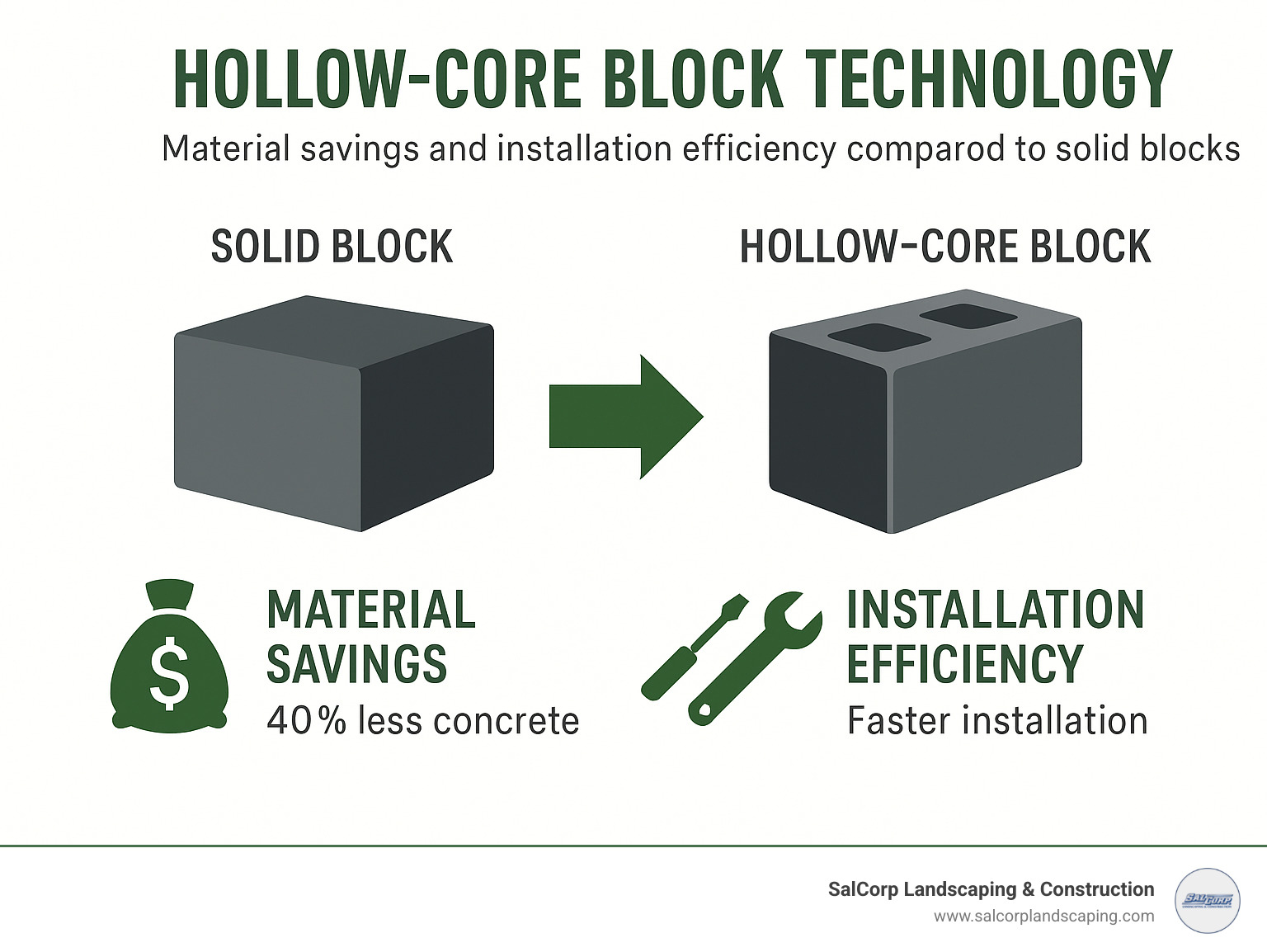
Hollow-core blocks like MagnumStone use 40% less concrete than solid systems while maintaining structural integrity. This not only reduces material costs but also makes blocks lighter to transport and handle. When you’re installing hundreds of blocks on a commercial project, this efficiency really adds up.
Large-format blocks have been a game-changer for our commercial projects. Modern precast blocks can cover up to 8 square feet per unit, dramatically reducing the number of pieces we need to place and align. This translates to faster installation and lower labor costs for our clients.
I’m particularly impressed with the advanced interlocking systems available today. The male-and-female connections reduce placement errors and ensure the correct setback without additional clips or pins. This means less time spent adjusting and re-adjusting during installation.
For projects where aesthetics are paramount, modular fascia panels like U-Cara allow us to customize textures and colors that mount to structural wall systems. This separation of structural and aesthetic functions gives our clients the best of both worlds—engineering integrity with design flexibility.
Material Selection for Commercial Retaining Walls
Choosing the right material for a commercial retaining wall significantly impacts its durability, appearance, and long-term performance:
Cast-in-place concrete offers best design flexibility but requires extensive formwork and longer construction time. We typically recommend this approach for complex geometries or when integrating with other concrete structures on site.
Large-block precast systems like Redi-Rock and Verti-Block provide the structural benefits of concrete with faster installation. These systems come in various textures that convincingly mimic natural stone, giving your commercial property a high-end appearance without the maintenance concerns of natural materials.
Limestone blocks provide exceptional aesthetics and durability for premier commercial properties. On large projects, experienced teams can install 300-400 limestone blocks daily, ensuring swift progress despite the premium material.
Concrete sleepers offer impressive longevity with a design life of up to 60 years, compared to just 15 years for treated pine alternatives. This makes them an excellent long-term solution for commercial sites where replacement would be disruptive and costly.
No-fines concrete serves as a specialized structural backfill that provides both support and drainage functions. This can eliminate the need for separate drainage systems in some applications, simplifying the construction process.
Here in Massachusetts, where freeze-thaw cycles and road salt exposure are facts of life, material selection requires careful consideration. At SalCorp, we prioritize materials engineered to a minimum compressive strength of 5000 PSI, exceeding industry standards for commercial durability in our challenging New England climate.
More info about retaining wall design
Design & Engineering Considerations
The success of commercial retaining walls hinges on thoughtful design and meticulous engineering. Unlike their residential counterparts that might follow general guidelines, commercial walls demand detailed analysis to ensure they’ll stand the test of time while keeping everyone safe.
Site Investigation & Soil Analysis
Before we break ground at SalCorp, we always start with a thorough site investigation. It’s like getting to know the personality of your land before deciding how to work with it.
The soil beneath your feet tells an important story. Through soil borings, we collect samples that reveal what’s happening below the surface. Is it dense clay that holds water? Sandy soil that drains quickly? Each soil type brings different challenges to the table.
Here in Massachusetts, we frequently encounter glacial till, stubborn marine clay, and unpredictable urban fill. Having worked with these local soil conditions for over two decades, we’ve developed a sixth sense for anticipating potential issues before they become problems.
The soil’s shear strength – its ability to resist sliding forces – is particularly crucial for wall stability. Equally important is understanding groundwater behavior, as water pressure can dramatically affect how a wall performs over time. We also analyze potential settlement to prevent future tilting or cracking that could compromise your investment.
Drainage, Waterproofing & Frost Protection
If there’s one thing I’ve learned in my years building commercial retaining walls, it’s that water is both your worst enemy and your most important consideration. Water trapped behind a wall can double or even triple the pressure against it – a recipe for disaster.
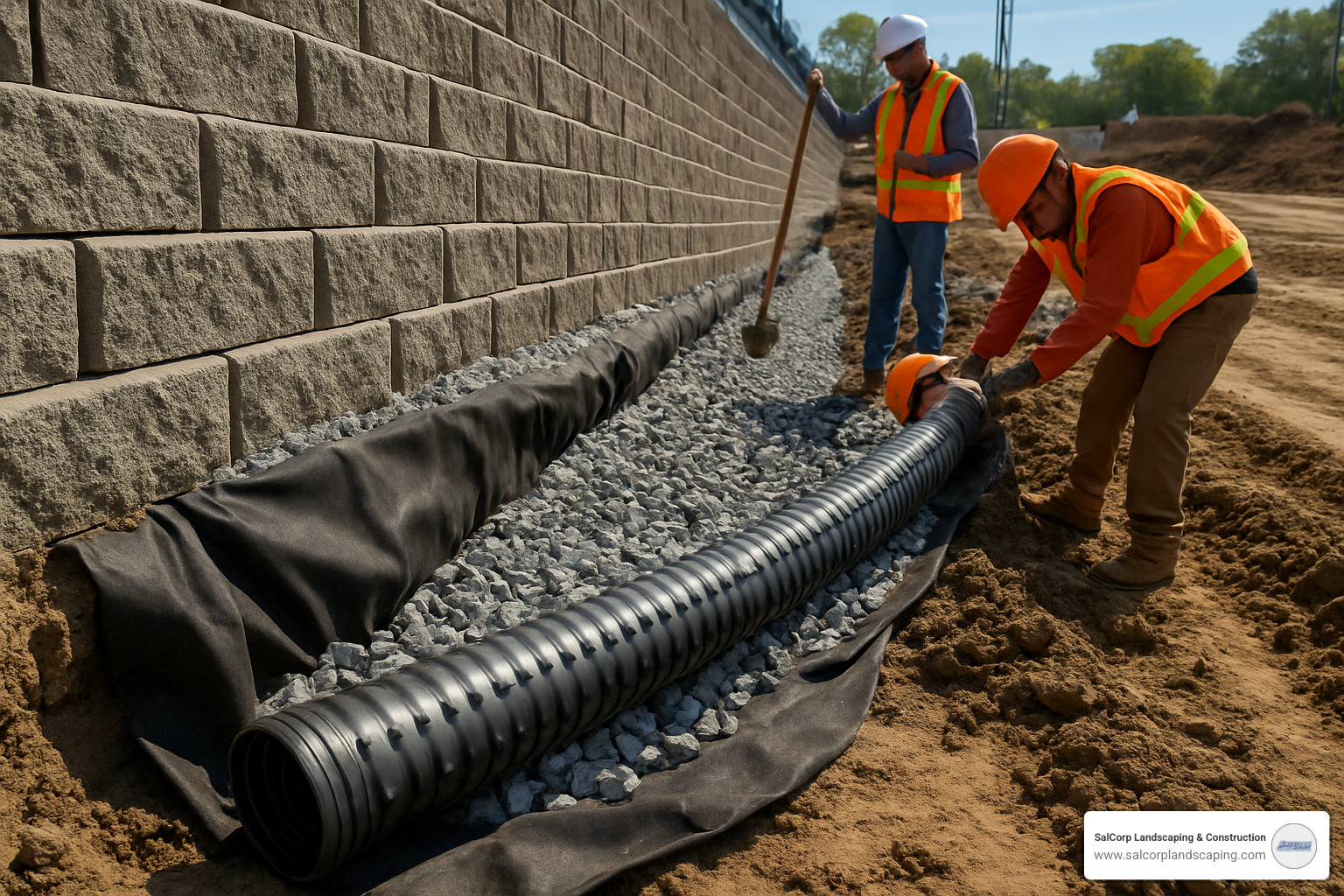
Effective drainage isn’t just important – it’s essential. We typically incorporate weep holes that allow water to escape through the wall face and install perforated drainage pipes at the base to collect and redirect water away from the structure. A layer of clean, crushed stone creates a drainage zone that prevents water buildup, while geocomposite drains offer a slim-profile solution that combines filtration and water collection.
Massachusetts winters bring another challenge: frost. Walls must extend below the frost line (typically 4 feet in our region) or include insulation strategies to prevent frost heave. I’ve seen too many beautiful walls damaged by the powerful freeze-thaw cycles we experience here – it’s not a corner you want to cut.
Load, Height & Safety Regulations for Commercial Retaining Walls
Building commercial retaining walls means navigating a complex regulatory landscape. The International Building Code sets minimum design standards, while OSHA guidelines govern construction safety. Local building codes often add requirements specific to our region’s unique conditions.
Your wall design must account for various forces: the constant pressure from retained soil, temporary loads from vehicles or pedestrians, additional weight from structures above, and in some regions, even seismic forces. Walls above certain heights typically require protective railings, and those near traffic areas need impact protection strategies.
At SalCorp, we partner with qualified structural engineers to ensure all designs meet or exceed these requirements while still achieving your aesthetic and functional goals. This collaborative approach ensures your wall is not just beautiful but built to last.
Sustainable & Aesthetic Design Improvements
Today’s commercial retaining walls can do so much more than hold back earth – they can become striking features that improve your property’s appeal while supporting sustainability goals.
Vegetated facings transform ordinary walls into living ecosystems that improve aesthetics while providing environmental benefits. Integrated LED lighting adds dramatic nighttime appeal while improving safety. Many systems offer varied textures that mimic natural stone, with options like Ledgestone offering up to 115 square feet of non-repeating surface area for a truly natural appearance even in large commercial applications.
We can design walls with integrated seating, planters, or other functional elements that make the most of your space. Some systems even incorporate recycled materials, reducing environmental impact without compromising performance.
These thoughtful design touches help commercial properties maintain a welcoming, high-quality appearance while solving practical engineering challenges – the perfect blend of form and function.
More info about retaining wall landscaping
Scientific research on geosynthetic reinforcement
Construction Process & Overcoming Challenges
Building commercial retaining walls is a bit like orchestrating a symphony – every element needs to come together at just the right time. At SalCorp, we’ve fine-tuned this process over years of getting our hands dirty across Massachusetts communities.
When we tackle a new wall project, we follow a methodical approach that starts with clearing the site and removing any vegetation or unsuitable soils. Next comes the careful excavation work, creating space for both the foundation and any reinforcement zones the engineer has specified. The base course installation is particularly critical – this crushed stone foundation needs to be perfectly level, as it sets the stage for everything that follows.
From there, we begin the actual wall construction, whether that’s placing massive precast blocks, setting up forms for poured concrete, or installing modular units. For reinforced walls, we carefully place geogrid or other reinforcement materials at precisely specified heights. The backfilling process happens in carefully compacted layers (we call them “lifts”), typically 6-8 inches at a time. Proper drainage installation follows, which is absolutely crucial for long-term success – I often tell clients that water pressure is the number one enemy of any retaining wall.
Throughout this dance, we’re navigating around existing utilities, dealing with tight access conditions, and sometimes battling unpredictable New England weather. It’s complex work that requires both technical precision and practical problem-solving skills.
Pre-Construction Planning & Permitting
Long before the first excavator arrives, we’re deep into planning mode. This pre-construction phase is where potential problems get solved on paper rather than in the field.
We start with detailed surveying to establish property lines and existing grades. A comprehensive grading plan shows exactly how the finished site will look. We develop erosion control strategies to keep soil in place during construction – particularly important in environmentally sensitive areas around Massachusetts.
Utility location is absolutely critical – there’s nothing that brings a project to a screeching halt faster than accidentally hitting an unmarked gas line or fiber optic cable. We carefully identify and mark all underground utilities before breaking ground.
The permitting process can be particularly complex for commercial retaining walls in Massachusetts. Depending on the project, we might need building permits, grading permits, environmental permits, and stormwater management approvals. When projects are near wetlands – which is common in our region – we often coordinate with local conservation commissions. Having steerd these waters in communities from Boston to Framingham, we’ve developed relationships that help streamline this process for our clients.
Step-by-Step Commercial Retaining Wall Installation
While each wall system has its quirks, the fundamental installation steps follow a reliable pattern. We begin by excavating a level trench to the specified depth – in Massachusetts, this typically extends at least 6 inches below frost depth to prevent winter heaving.
Next comes the leveling pad – a crushed stone base typically 6-12 inches thick that extends beyond the wall units themselves. The first course placement is where our experienced crews really shine. This initial row must be perfectly level and aligned, as even tiny errors here multiply as the wall rises.
As construction progresses, we constantly verify vertical alignment using string lines, levels, and other tools. For reinforced walls, we install geogrid layers at specific heights, ensuring proper orientation and tension. The drainage system goes in according to design specs – typically including drainage aggregate and perforated pipe wrapped in filter fabric.
The backfill process requires both the right materials and proper compaction. We add approved material in thin lifts, compacting each to about 95% of standard Proctor density – a technical way of saying “very firm.” Finally, we secure the top course with adhesive or mechanical connections for a finished appearance.
For larger projects, we bring in specialized equipment like cranes to place massive precast units. Having our own machinery gives us flexibility to adapt to challenging site conditions without waiting on subcontractors.
Common Challenges and Mitigation Strategies
Every commercial retaining wall project seems to come with its own unique puzzle to solve. When we encounter soft soils – more common than you might think in parts of Massachusetts – we might replace them with engineered fill, extend foundations to more competent soil, or use stabilization techniques like cement mixing.
Urban sites often present space constraints that require creative solutions. We might use structural backfill with no-fines concrete, implement soil nail walls that need minimal behind-wall access, or install temporary shoring systems to maintain site stability.
Groundwater can be particularly troublesome, requiring dewatering systems during construction and improved permanent drainage designs. For projects near roadways, we develop comprehensive traffic control plans, carefully schedule deliveries, and strategically stage materials to minimize disruption.
Larger projects often require phased construction approaches that maintain site stability throughout the process. This might include temporary bracing or carefully designed transition details between phases.
What sets SalCorp apart is that when these challenges arise, you won’t be dealing with a project manager who needs to “check with the boss.” As an owner-operated company, experienced supervisors are always on-site to make decisions quickly, preventing costly delays and ensuring quality results.
More info about hiring a retaining wall contractor
Selecting the Right Contractor & System
Choosing the right partner for your commercial retaining wall project is as important as selecting the right wall system. Look for contractors with specialized experience in commercial-scale walls, proper licensing and insurance, and familiarity with local soil conditions and regulations.
A strong project portfolio speaks volumes – ask to see completed projects of similar scale and complexity, and don’t hesitate to request references from commercial clients. Engineering support is crucial, whether in-house or through established partnerships. The right contractor should understand complex loading scenarios and be able to suggest value engineering alternatives that might save you money without compromising performance.
Clear warranty terms covering both materials and workmanship provide peace of mind, especially when backed by manufacturer support for proprietary systems. The best contractors balance initial cost against long-term performance, offering creative solutions to site-specific challenges.
At SalCorp Landscaping & Construction, we pride ourselves on transparent communication throughout the selection process. We’ll help you understand the trade-offs between different systems and approaches, identifying solutions that balance performance, aesthetics, and budget for your unique project. Our decades of experience throughout Massachusetts communities means we’ve likely solved challenges similar to yours before.
Cost, Maintenance & Future Trends
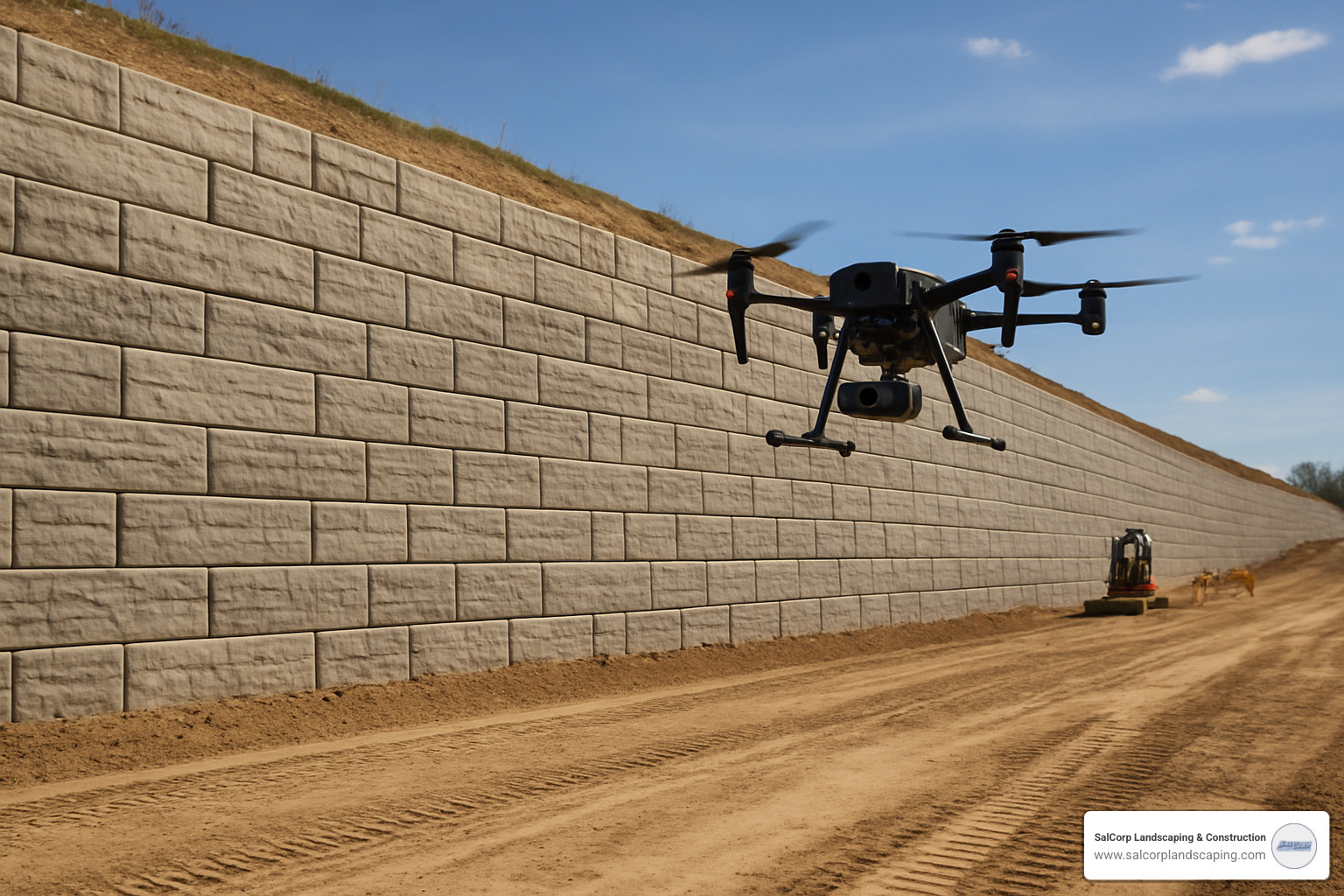
When it comes to commercial retaining walls, understanding the financial investment, ongoing care requirements, and emerging technologies can help you make choices that pay off for decades to come. Let’s explore what you can expect in terms of costs, maintenance needs, and exciting innovations on the horizon.
Budgeting & Average Pricing for Commercial Retaining Walls
“How much will my commercial retaining wall cost?” It’s often the first question clients ask me, and the answer always starts with “It depends.” Based on internet research (not SalCorp’s specific pricing), commercial retaining walls typically range from $50 to $300 per square foot fully installed.
Why such a wide range? Your wall’s cost will be influenced by several key factors. Material selection plays a major role—gravity block systems might start around $20 per square foot, while specialized systems like living walls or gabion structures can reach $150 per square foot or more.
Labor intensity varies dramatically between systems too. While large block systems require fewer individual pieces, they demand heavier equipment. Segmental systems involve more pieces but can sometimes be installed with lighter machinery. Cast-in-place concrete walls require formwork, reinforcing, and concrete placement—each adding to the labor equation.
Site access can make or break your budget. Limited working space often requires specialized equipment, while urban sites might need traffic control measures. Remote locations face increased transportation costs for materials and equipment.
Don’t forget to account for design and engineering fees (typically 5-20% depending on complexity) and a contingency budget of 10-15% for unexpected conditions. I’ve seen too many projects hit snags with surprise utility relocations or weather delays—having that buffer makes all the difference.
It’s worth noting that innovative approaches like the GRS-IBS system developed by the Federal Highway Administration can reduce construction costs by 25-60% compared to conventional methods for certain applications. This demonstrates how important system selection can be to your bottom line.
More info on wall cost factors
Longevity, Maintenance & Inspection Best Practices
A well-built commercial retaining wall isn’t a “set it and forget it” structure—it requires ongoing attention to ensure decades of reliable service. Think of it like maintaining a commercial vehicle—regular check-ups prevent costly breakdowns.
Regular inspections form the backbone of any maintenance program. I recommend visual inspections at least annually, with professional structural assessments every 3-5 years. After extreme weather events—particularly heavy rains or freeze-thaw cycles common in Massachusetts—immediate inspection is essential.
Drainage system maintenance might be the single most important factor in wall longevity. Clear weep holes and outlets regularly, inspect drainage pipes for blockages, and monitor surface water patterns, especially after landscape changes nearby. I’ve seen otherwise solid walls fail simply because drainage was neglected.
In Massachusetts, our freeze-thaw cycles create unique challenges. Monitor for frost heave, address drainage issues before winter sets in, and repair even small cracks that could allow water infiltration. Water that freezes in cracks can exert enormous pressure, turning minor issues into major repairs.
Vegetation management requires finding the right balance. Remove large roots that could damage the wall and control invasive species that might compromise drainage. If you have a vegetated wall system, select appropriate plants and maintain them according to design specifications.
Don’t overlook joint and facing repairs. Reseal cracked or deteriorated joints promptly, replace damaged facing units before problems spread, and address any concrete spalling before it compromises structural integrity.
When selecting materials, consider the long-term value. Concrete sleeper retaining walls, for instance, can have a design life of up to 60 years, compared to just 15 years for treated pine sleepers. The upfront investment in durable materials often pays dividends through reduced maintenance and replacement costs.
Emerging Innovations Shaping Commercial Retaining Walls
The world of commercial retaining walls is evolving rapidly, with exciting innovations that promise improved performance, sustainability, and cost-effectiveness. As someone who’s spent decades in this industry, I’m particularly excited about several developments.
Advanced geosynthetic integration is changing what’s possible with reinforced walls. New geogrid materials offer improved tensile strength while geosynthetic-reinforced soil systems reduce excavation requirements. We’re also seeing composite materials that combine drainage and reinforcement functions, simplifying installation while improving performance.
For projects requiring exceptional height, modular extreme-height systems now offer specialized blocks designed for walls exceeding 30 feet. These systems feature integrated connection technologies for improved seismic performance and often use hollow-core designs that reduce weight while maintaining strength.
Sustainability is increasingly driving innovation in our industry. We’re seeing exciting developments in recycled content for concrete and reinforcement, carbon-reduced concrete formulations, and pervious concrete options that improve stormwater management. These approaches reduce environmental impact while often enhancing wall performance.
Perhaps the most transformative developments involve smart monitoring technologies. Embedded sensors can now detect movement or pressure changes before they’re visible to the human eye. Remote monitoring systems provide early warning of potential issues, while drone-based inspection protocols make it easier to assess difficult-to-access walls safely and efficiently.
Looking further ahead, 3D printing applications show tremendous promise for creating custom-designed wall components with unique architectural features. On-site printing capabilities could eventually reduce transportation costs, while optimized geometries might maximize strength while minimizing material use.
The integration of Internet of Things (IoT) technology is opening new possibilities for connected drainage systems that report flow rates and potential blockages, automated monitoring of soil moisture and pressure, and integration with building management systems for comprehensive site oversight.
At SalCorp Landscaping & Construction, we stay at the forefront of these innovations, carefully evaluating new technologies to provide our Massachusetts clients with retaining wall solutions that combine proven reliability with forward-thinking performance. Our approach is never to adopt technology simply because it’s new, but rather to thoughtfully incorporate innovations that deliver real value to our clients.
Frequently Asked Questions about Commercial Retaining Walls
What engineering documents are required for a commercial retaining wall?
Building a commercial retaining wall isn’t as simple as stacking some blocks and calling it a day. The paperwork is almost as substantial as the wall itself!
Every commercial project requires a comprehensive geotechnical report that analyzes your specific soil conditions. This isn’t just bureaucratic red tape – it’s essential information that determines how your wall needs to be designed. The report examines bearing capacity, soil composition, and makes specific recommendations based on actual soil samples from your site.
You’ll also need detailed structural calculations prepared by a licensed engineer. These calculations prove that your wall design can safely resist overturning, sliding, and bearing pressures according to building codes. Think of this as the mathematical proof that your wall won’t fail.
The construction drawings are where the rubber meets the road – these detailed plans show every dimension, reinforcement detail, and drainage provision. They’re essentially the blueprint that transforms engineering theory into practical construction guidance.
Here in Massachusetts, all these documents must be prepared by a licensed Professional Engineer and submitted during permitting. I’ve guided many clients through this process, and while it might seem overwhelming at first, having proper documentation protects everyone involved and ensures a safe, long-lasting structure.
How tall can commercial retaining walls be built safely?
“How high can we go?” is one of the most common questions we get at SalCorp, and the answer always begins with “it depends.” The safe height for commercial retaining walls varies dramatically based on the system you choose and your site conditions.
Traditional gravity walls that rely solely on their weight can typically reach 3-4 feet with standard blocks. But specialized systems like Verti-Block push this limit to around 14 feet without reinforcement – pretty impressive for a gravity system!
When we add proper geogrid reinforcement to the equation, the possibilities expand dramatically. Standard reinforced segmental walls can safely reach 20-30 feet, while sophisticated MSE (Mechanically Stabilized Earth) systems with precast panels can extend to 50+ feet when properly engineered.
I’m particularly impressed with the Redi-Rock system, which uses massive precast blocks that can create gravity walls over 20 feet tall. With reinforcement, they can go even higher, making them perfect for those challenging commercial projects where space is at a premium.
For truly ambitious heights, we often recommend tiered systems – multiple walls with horizontal offsets between them. When properly designed, these can achieve virtually unlimited total height while creating an attractive, terraced appearance.
The bottom line? With proper engineering and construction (two things we never compromise on at SalCorp), modern commercial wall systems can safely reach heights that would have been unthinkable just a few decades ago.
How often should commercial retaining walls be inspected?
Even the most well-built commercial retaining wall needs regular check-ups to ensure it continues performing as designed. Think of it like maintenance for your car – regular inspections catch small issues before they become expensive problems.
For new walls, we recommend quarterly visual inspections during the first year. This is when a wall is most likely to show signs of settlement or adjustment. After that first year, semi-annual inspections are typically sufficient for routine monitoring.
However, Mother Nature doesn’t follow our schedules! Any time you experience significant rainfall (more than 2 inches in 24 hours) or any seismic activity, it’s worth taking a quick look at your wall for signs of distress.
Beyond these routine checks, I strongly recommend having a professional comprehensive inspection at the end of the first year and every 2-3 years thereafter. These more detailed evaluations look for subtle signs that might escape notice during casual observation.
During these inspections, we’re looking for several key indicators: any wall movement or rotation, cracking or spalling of facing materials, how the joints between units are holding up, and whether the drainage systems are functioning properly. We also check the stability of both the retained and foundation soils, as well as any attached features like railings.
At SalCorp, we can establish customized maintenance schedules for the walls we install. I’ve found that this proactive approach not only extends the life of your investment but also provides peace of mind knowing that your wall is being properly monitored. After all, when it comes to retaining walls, an ounce of prevention truly is worth a pound of cure!
Conclusion
Commercial retaining walls represent so much more than just functional structures—they’re critical investments that transform challenging landscapes into valuable assets for businesses throughout Massachusetts. When thoughtfully designed and expertly built, these engineering marvels deliver both practical benefits and aesthetic appeal that can improve any commercial property.
After exploring commercial retaining walls together, several key insights stand out:
Engineering excellence isn’t just important—it’s absolutely essential. Unlike residential walls where simpler approaches might suffice, commercial retaining walls demand professional engineering to ensure safety, code compliance, and decades of reliable performance. This investment in proper design pays dividends through the entire life of your wall.
The wall system you choose makes all the difference. Whether you opt for a gravity system, reinforced structure, MSE wall, or another approach should reflect your specific site conditions, height requirements, visual goals, and budget considerations. At SalCorp, we take the time to help you steer these choices with clarity.
Nothing impacts wall longevity more than proper drainage. I can’t emphasize this enough—even the most impressive engineering will fail if water pressure builds up behind your wall. Thoughtful drainage design and implementation protect your investment from its greatest threat.
The quality of construction determines real-world performance. A beautifully engineered wall exists only on paper until it’s built with precision. Proper base preparation, correct reinforcement placement, and meticulous backfill compaction aren’t just construction details—they’re the difference between success and failure.
Regular maintenance preserves your investment for decades. Simple routine inspections and timely repairs can dramatically extend the life of your commercial retaining wall while preventing costly failures down the road.
At SalCorp Landscaping & Construction, we bring over 20 years of hands-on experience to every project. Our owner-operated approach means you’ll never be handed off to inexperienced crews—we personally oversee each phase to ensure the attention to detail your project deserves.
When you work with us, you’re getting a truly comprehensive approach that includes thorough site evaluation, collaboration with qualified engineers, precise construction using our own specialized equipment, clear communication from start to finish, and ongoing support long after the project is complete.
Whether you’re developing a new commercial property, expanding an existing facility, addressing erosion issues, or solving challenging slope stability problems, we have the knowledge and capabilities to deliver retaining wall solutions that stand the test of time—and look great doing it.
The slopes and grades that once limited your property’s potential can become its most distinctive assets with the right commercial retaining wall solution. We’d love to show you how.
More info about our commercial landscaping services
