

Hose Sprinkler: Best Ultimate Guide 2025
Why Choosing the Right Hose Sprinkler Matters for Your Massachusetts Lawn
A hose sprinkler is a portable device that attaches to a garden hose to water your lawn or garden. Choosing the right one is key to maintaining a healthy lawn in Massachusetts, where hot summers and local water restrictions present unique challenges.
Best Hose Sprinklers by Lawn Type:
- Oscillating Sprinklers – Best for rectangular lawns (3,000-4,500 sq. ft.)
- Pulsating (Impact) Sprinklers – Best for large circular areas (4,000-5,000 sq. ft.)
- Revolving Sprinklers – Best for small to medium circular lawns (1,200-1,500 sq. ft.)
- Stationary Sprinklers – Best for small areas or flower beds (900 sq. ft.)
- Traveling Sprinklers – Best for large, irregular lawns (up to 15,000 sq. ft.)
Key factors to consider: lawn size and shape, water pressure, and desired coverage area.
Proper watering is the foundation of lawn care. With dozens of sprinkler types available, it’s easy to feel overwhelmed. Some are for small flower beds, while others can tackle over 5,000 square feet. Some work with low water pressure, and others need a strong flow. The right model saves water, covers your lawn evenly, and fits your yard’s layout, while the wrong choice leads to dry spots and water waste.
Hose-end sprinklers keep your landscape investment healthy without the cost of an in-ground irrigation system. They offer a flexible and affordable way to protect your property’s curb appeal.
I’m Sal Musto, owner of SalCorp Landscaping & Construction. For over 20 years, I’ve helped Massachusetts homeowners select effective watering solutions. My experience across communities from Boston to Westwood has shown me which hose sprinklers deliver results in our New England climate.

Choosing the Best Hose Sprinkler for Your Yard
While permanent irrigation systems are convenient, a hose sprinkler offers flexibility and affordability. The main advantages are portability to target specific areas, ease of use for any homeowner, and a low price point compared to in-ground systems. Modern sprinklers also promote water conservation with adjustable patterns that put water only where it’s needed. However, success depends on matching the sprinkler to your lawn’s size, shape, and your home’s water pressure.
Types of Hose-End Sprinklers
Walking through the sprinkler aisle can be overwhelming. Here’s a breakdown of what each type does and where it shines.
| Sprinkler Type | Coverage Shape | Best For | Pros | Cons |
|---|---|---|---|---|
| Oscillating | Rectangular/Fan | Standard lawns, rectangular areas | Even coverage, adjustable width/distance, good for larger areas | Can be affected by wind, prone to clogging, less precise for irregular shapes |
| Pulsating (Impact) | Circular, adjustable arc | Large open areas, tough grass, new seed | Long throw distance, robust, good penetration | Noisy, can be harsh on delicate plants, uneven near sprinkler |
| Revolving (Whirling) | Circular | Small to medium circular lawns, flower beds | Gentle water distribution, quiet, good for uniform coverage | Limited coverage area, can mist in windy conditions |
| Stationary | Fixed patterns (circular, square, strip) | Small, specific areas, flower beds, gardens | Very simple, inexpensive, precise for small spots | No moving parts means fixed coverage, not for large areas |
| Traveling | Follows hose path | Large, irregular lawns, sports fields | Automated movement, consistent coverage over long distances | Requires hose layout, slower watering, more expensive, larger footprint |
Oscillating sprinklers sweep back and forth in a fan shape, making them ideal for rectangular lawns up to 4,500 sq. ft. Most allow you to adjust the spray width and distance to avoid watering sidewalks. Keep the nozzles clean to ensure an even spray.
Pulsating (impact) sprinklers shoot a powerful, rotating stream of water, perfect for large, circular areas up to 5,000 sq. ft. Their long reach and deep soil penetration are great for established lawns, but the strong spray can be too harsh for delicate plants.
Revolving sprinklers use spinning arms to create a gentle, circular spray. They are quiet and provide uniform watering for small to medium circular lawns (1,200-1,500 sq. ft.) and garden beds.
Stationary sprinklers spray in a fixed pattern from one spot. They are an inexpensive and simple solution for small, specific areas like flower beds or patching dry spots, typically covering around 900 sq. ft.
Traveling sprinklers move along the path of your hose, automating the watering process for large or irregular lawns up to 15,000 sq. ft. They are more expensive but save significant time and effort on large properties.
Key Features to Consider
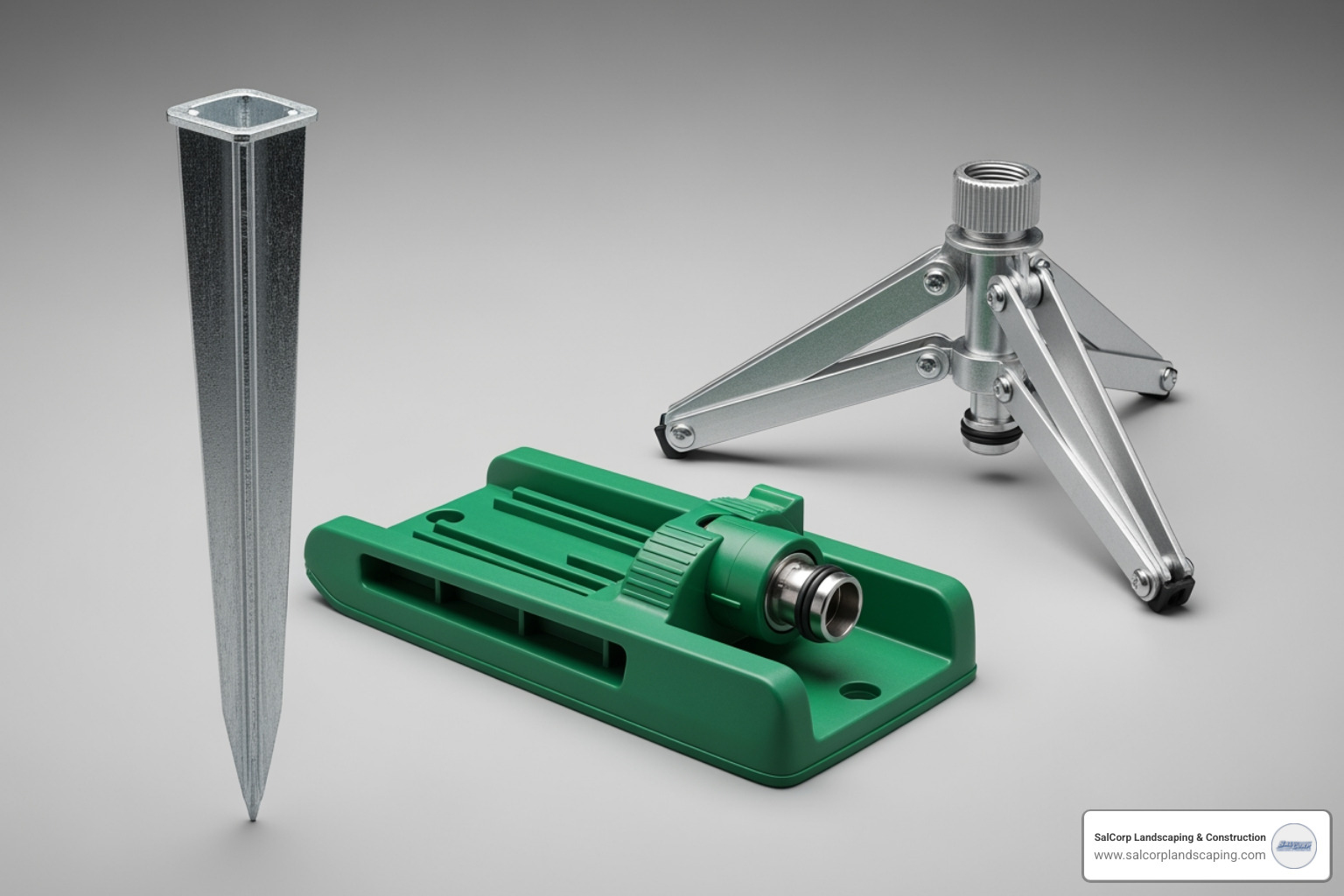
Beyond the basic type, look at these features:
- Material: Plastic models are lightweight and affordable but can crack over time. Metal sprinklers with brass or zinc components cost more but offer superior durability for Massachusetts weather.
- Coverage Area: Check the square footage rating on the packaging and measure your lawn to ensure a good match. Listed coverage often assumes ideal water pressure.
- Adjustability: Features like adjustable nozzles, flow control, and variable spray patterns give you control to water your lawn without soaking the driveway. This flexibility is key to efficient watering.
- Base Type: A spike base offers stability in the ground, a sled base is easy to drag to a new spot, a tripod provides extra height for wider coverage, and wheeled bases offer easy rolling mobility.
Matching a Hose Sprinkler to Your Lawn

Finding the right hose sprinkler is about matching the tool to the job. A small yard under 1,000 sq. ft. may only need a simple stationary or revolving sprinkler. For large lawns over 3,000 sq. ft., an oscillating, pulsating, or traveling model is more efficient. Consider your lawn’s shape—rectangular, circular, or irregular—and choose the sprinkler type designed for that pattern. Also, be mindful of your home’s water pressure; some sprinklers are designed for low-pressure systems, while others need strong flow to perform optimally. For a permanent, automated solution, we also design and install custom irrigation systems.
Smart Options and Automation
Even hose-end watering can be automated. A simple hose-end timer attaches to your faucet and lets you set a watering schedule. For more control, smart hose bib timers connect to Wi-Fi, allowing you to manage watering from a phone app. Many smart models use local weather data to automatically skip watering on rainy days or increase it during a heatwave, which saves time, conserves water, and helps comply with local restrictions. You can find examples of advanced hose-end products from major brands that bring this technology to your garden hose.
Setup, Use, and Maintenance Tips
To get the most from your hose sprinkler, follow these best practices:
- Placement: Position the sprinkler to water your lawn, not sidewalks or driveways. Adjust the spray pattern to fit the area.
- Time of Day: Water in the early morning (before 9 AM) to reduce evaporation and prevent fungal diseases.
- Duration: Aim for deep, infrequent watering (e.g., 30-60 minutes, 3-4 times per week in summer) to encourage deep root growth. This is better than short, daily watering.
- Runoff: If water starts pooling, split your watering into shorter cycles with a break in between to allow the soil to absorb the water.
- Maintenance: Regularly clean nozzles to remove clogs from dirt or mineral buildup. Check connections for leaks, which waste water and reduce pressure.
- Winter Storage: Before the first freeze, disconnect, drain all water from the sprinkler, and store it indoors to prevent cracking.
For more information on establishing a healthy lawn from the ground up, see our guide on lawn installation.
Typical Cost of a Hose Sprinkler
There’s a hose sprinkler for every budget. Based on average costs from internet data (not SalCorp Landscaping’s pricing), you can expect to spend anywhere from $10 to over $150.
- Budget-friendly ($10 – $30): Basic stationary, revolving, or simple oscillating models. Good for small yards or supplemental watering.
- Mid-range ($30 – $80): More durable oscillating and pulsating models with better materials (metal parts) and more adjustment features.
- Premium ($80 – $150+): Includes traveling sprinklers, heavy-duty tripod sprinklers, and smart hose timers. You’re paying for automation, superior construction, and maximum coverage.
The price is influenced by material (metal costs more than plastic), features (adjustability, smart tech), and brand reputation. While a higher price often means better durability, the best value comes from matching the sprinkler’s cost and features to your lawn’s specific needs.
Professional Watering Solutions for a Perfect Lawn
We’ve covered how to choose the right hose sprinkler by matching it to your lawn’s size, shape, and your budget. For many Massachusetts homeowners, a portable sprinkler is an affordable and flexible solution that gets the job done. They are perfect for smaller properties, targeted watering, or those just starting their lawn care journey.
However, there comes a time when dragging hoses and repositioning sprinklers becomes a chore. If you’re tired of managing dry spots or simply want a hands-off solution, it may be time to consider a professional in-ground sprinkler system.
An in-ground system offers best benefits:
- Convenience: Automated, zone-specific watering means your lawn is perfectly cared for without you lifting a finger.
- Efficiency: A well-designed system uses less water by eliminating overspray and delivering precise amounts to each area. Smart controllers can even adjust for rainfall.
- Property Value: A professionally installed irrigation system is an attractive feature for future buyers, demonstrating a well-maintained property.
At SalCorp Landscaping & Construction, we specialize in designing and installing irrigation systems custom to Massachusetts properties. With over 20 years of experience in communities from Walpole to Boston, we understand our local climate, soil types, and water restrictions. As an owner-operated business, I personally ensure every system is built to last and perform reliably.
Whether a hose sprinkler is your tool of choice or you’re ready to upgrade, our goal is to help you achieve a great-looking lawn without the hassle. If you’re ready to explore a permanent watering solution, learn about our professional sprinkler system setup and see how we can transform your lawn care routine.
