

Brick Garden Stairs: Envy-Worthy 2025
Why Brick Garden Stairs Are the Perfect Blend of Beauty and Function
Brick garden stairs offer the perfect combination of timeless elegance and practical functionality for any outdoor space. Whether you’re looking to steer a sloped yard or create a stunning entrance to your home, these durable structures provide both safety and curb appeal that lasts for decades.
Quick Overview of Brick Garden Stairs:
- Standard Dimensions: 6-7 inches for the rise and 10-14 inches for the tread depth.
- Solid Foundation: Requires an 8-inch excavated base with compacted gravel and a concrete footing.
- Estimated Costs: Material costs can range from $4-$12+ per square foot, with professional installation costs varying widely based on complexity. Please note: These are national averages and do not represent actual pricing from SalCorp Landscaping & Construction.
- Installation Timeline: Typically involves one day of active work, with a total project time of about a week to allow for proper curing.
- Maintenance Needs: Low; requires regular cleaning and occasional repointing of mortar joints.
- Expected Lifespan: Can last from 20 to over 100 years with proper installation and care.
Brick garden stairs transform ordinary slopes into architectural features that improve your property’s value while providing safe, reliable access between different levels of your landscape. The natural texture of brick offers excellent traction in wet conditions, while the variety of colors and laying patterns allows you to match any design style from traditional to contemporary.
One homeowner in Walpole, Massachusetts found this when they added brick stairs leading to their new porch. The stairs didn’t just provide functional access – they became a focal point that made their backyard a favorite gathering spot for family events.
The key to successful brick garden stairs lies in proper foundation preparation and material selection. Unlike temporary solutions, well-built brick stairs can withstand Massachusetts’ harsh freeze-thaw cycles while maintaining their beauty and structural integrity.
As Sal Musto, owner of SalCorp Landscaping & Construction, I’ve spent over two decades helping Massachusetts homeowners create stunning outdoor spaces with brick garden stairs that combine safety, durability, and timeless appeal. My hands-on approach ensures every project meets the highest standards, from initial excavation through final joint finishing.

The infographic above breaks down the essential components of a well-built brick staircase, from the deep foundation to the finished tread. Understanding these elements is the first step toward creating a beautiful and lasting addition to your landscape.
Why Choose Brick for Your Garden Stairs?
When you’re planning your outdoor space, choosing the right materials can make or break your project. Brick garden stairs offer something special that other materials just can’t match – they’re built to last while looking absolutely beautiful doing it.
Think about it this way: your garden stairs aren’t just functional pieces. They’re part of your home’s first impression, and they need to perform reliably for decades. Brick delivers on both fronts with impressive durability and weather resistance that keeps your investment protected year after year.
The classic aesthetic of brick never goes out of style. Whether your home is a traditional colonial or a sleek modern design, brick adapts beautifully. The versatility in color variety and texture options means you can create exactly the look you want. Plus, well-built brick stairs actually boost your property value – they’re the kind of quality feature that potential buyers notice and appreciate.
Here’s what really sets brick apart: it requires surprisingly low maintenance while providing excellent safety through its natural good traction. Even when wet, brick surfaces give you the grip you need to steer confidently. And if you care about the environment, you’ll love that brick is made from eco-friendly materials like clay and water.
For more details about choosing the right hardscape material for your project, we’ve got you covered. You can also see some stunning examples of how brick creates beauty and functionality for years.
The Enduring Charm and Strength of Brick
There’s something deeply satisfying about brick’s timeless look. While trendy materials come and go, brick just keeps getting better with age. It withstands freeze-thaw cycles like a champ – crucial here in Massachusetts where winter can be brutal on outdoor structures.
What I love about brick is how it complements various home styles without trying too hard. It doesn’t compete with your home’s architecture; it improves it. And as brick ages gracefully, developing that beautiful patina over time, your stairs actually become more attractive, not less.
The repairability factor is huge too. If something happens to damage a section, you can often handle single brick replacement without tearing apart the whole staircase. Try doing that with poured concrete! This flexibility makes brick a smart long-term choice for homeowners who want to avoid major reconstruction projects down the road.
If you’re weighing your options, check out our detailed comparison of brick and concrete steps to see how these materials stack up.
Integrating Stairs with Your Landscape
Brick garden stairs shine when they become part of your landscape story rather than just an afterthought. They create that seamless transition between different areas of your yard, guiding visitors naturally through your outdoor space.

The magic happens when your stairs connect different garden levels while creating natural focal points. Picture brick stairs flanked by built-in planters bursting with seasonal flowers, or steps that curve gently to follow your garden’s natural contours. This isn’t just functional design – it’s outdoor artistry.
When your property has slopes, brick stairs pair beautifully with retaining walls to create terraced spaces that turn challenging terrain into garden gold. These combinations transform unusable hillsides into stunning multi-level landscapes that add both beauty and usable space to your property.
Ready to explore how stairs can transform your outdoor space? Take a look at our retaining wall landscaping services and our comprehensive landscaping solutions to see what’s possible for your yard.
Inspiring Brick Garden Stair Designs
When it comes to brick garden stairs, the design possibilities are truly endless. That’s what makes working with brick so exciting – whether you’re drawn to timeless elegance or cutting-edge contemporary style, brick adapts beautifully to your vision. Over my two decades in the landscaping business, I’ve helped homeowners create everything from grand formal entrances to charming cottage-style pathways.
The beauty of brick lies in its versatility. You can achieve dramatically different looks simply by changing the laying pattern, brick color, or combining it with other materials. For a comprehensive look at what’s possible, browse through these 99 Brick Stairs and Entranceways ideas in 2025 – you’ll find inspiration for every taste and home style.
Classic and Traditional Styles
There’s something deeply satisfying about classic brick stair designs. They create that sense of permanence and welcome that makes a house feel like a true home. These styles have stood the test of time because they simply work – both functionally and aesthetically.

The herringbone pattern remains one of my favorite choices for traditional brick garden stairs. The interlocking zigzag pattern creates incredible visual interest while providing excellent structural stability. When you see wide, welcoming steps laid in herringbone leading to a front porch, there’s an immediate sense of craftsmanship and attention to detail.
For a slightly different look, the basket-weave pattern offers similar sophistication with a more geometric feel. Both patterns require skilled installation, but the results are worth every effort. The running bond pattern provides a cleaner, more uniform appearance that works beautifully with colonial and traditional home styles.
Don’t overlook the power of curved and flared steps in traditional designs. Instead of stark straight lines, gentle curves and bottom steps that flare outward create a more inviting approach. These organic touches make the stairs feel like a natural extension of your garden rather than an imposed structure.
These classic approaches do more than just look good – they significantly boost your property value and curb appeal. If you’re considering extending this traditional aesthetic to other areas, explore our brick patio design ideas for complementary features.
Modern and Contemporary Twists
Who says brick can’t be cutting-edge? Modern brick garden stairs prove that this ancient material fits perfectly into contemporary design. The key is embracing sleek lines and minimalist forms while letting brick’s natural texture provide warmth.
Contemporary designs often feature contrasting materials that create striking visual impact. Picture dark-colored bricks paired with light mortar joints – the contrast is sharp and sophisticated. Add metal railings or glass panels, and you’ve got stairs that look like they belong in an architectural magazine.
One of the most exciting modern touches is integrated LED lighting. Recessed lights in the risers or along the step edges transform your stairs into a dramatic nighttime feature. It’s not just about looks either – the lighting significantly improves safety for evening use.
The beauty of contemporary brick design is how it honors the material’s heritage while pushing creative boundaries. For more innovative approaches to outdoor spaces, check out our collection of hardscape ideas.
Rustic and Naturalistic Brick Garden Stairs
Sometimes the most beautiful brick garden stairs are those that look like they’ve always been part of the landscape. Rustic and naturalistic designs celebrate brick’s earthy character while creating features that seem to grow naturally from the garden itself.
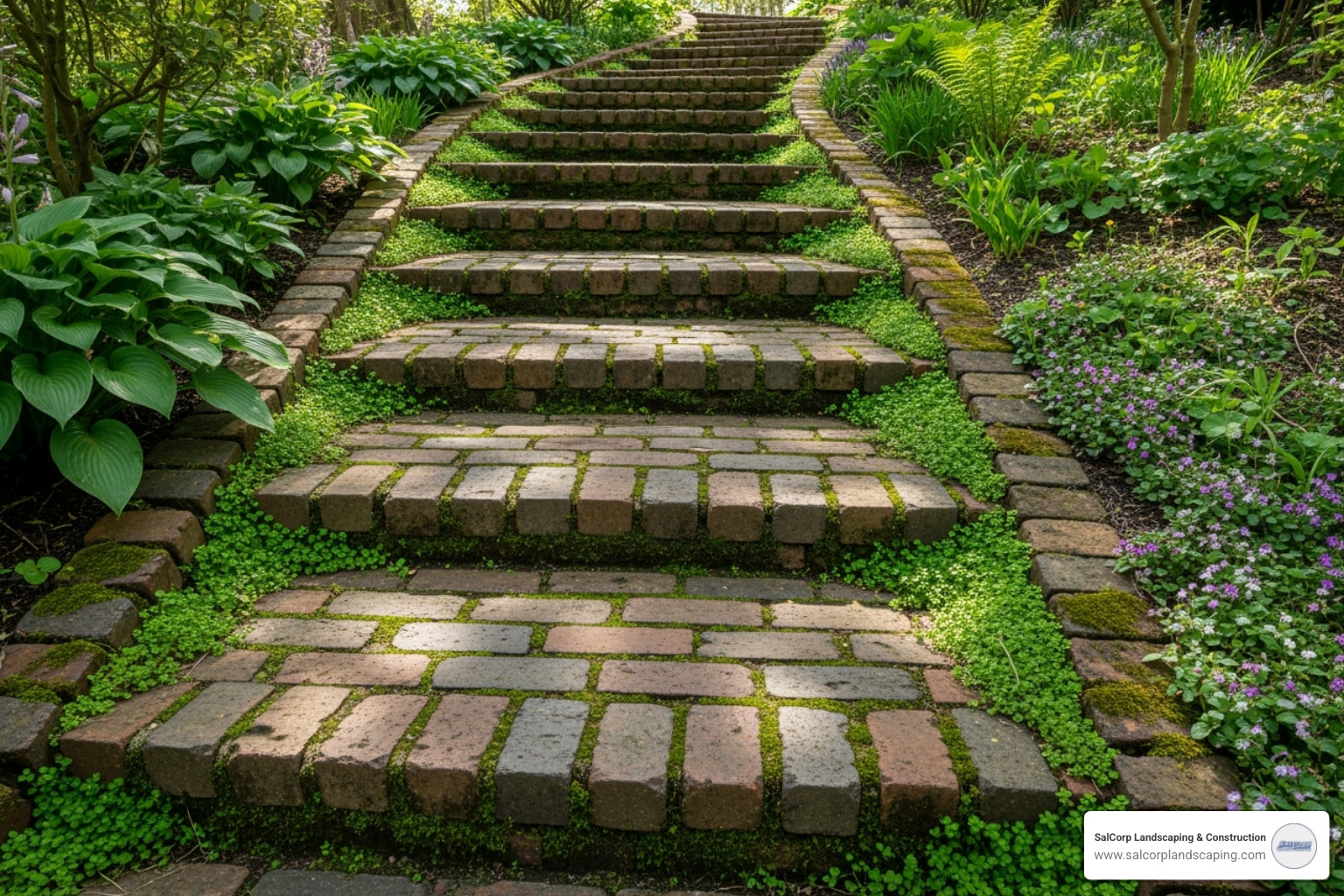
Reclaimed brick is the star of rustic designs. Each weathered brick tells a story through its imperfections and patina. When you use reclaimed materials, your stairs immediately feel like they’ve been part of the property for generations rather than a recent addition.
Irregular edges and organic shapes work beautifully in naturalistic designs. Instead of perfectly straight lines, these stairs might follow the natural contours of a slope or incorporate gentle curves that feel more like a woodland path than formal architecture.
The magic really happens when you combine brick with natural stone. Gravel treads between brick risers provide excellent drainage while softening the overall appearance. Wood retainers can frame the steps, adding to that natural, almost rustic cabin feel.
My favorite touch in naturalistic designs is encouraging moss and groundcover to establish in the gaps and edges. This living element makes the stairs feel integrated into the ecosystem of your garden. The weathered brick steps shown above, with moss growing naturally in the gaps, demonstrate how beautiful this approach can be.
These designs work particularly well on slopes where you want the stairs to feel like a natural part of the terrain. For more inspiration on slope installations, browse through these Brick Garden Steps on a Slope ideas.
The Blueprint for Building Durable Brick Garden Stairs
Building brick garden stairs that stand the test of time isn’t just about stacking bricks – it’s about creating a solid foundation and following proven construction methods. After two decades in the business, I’ve learned that the difference between stairs that last five years and those that last fifty comes down to one thing: proper preparation and execution from day one.
The secret to successful brick garden stairs lies in understanding that what you can’t see is just as important as what you can. A beautiful set of stairs built on a poor foundation is like a house of cards – it looks great until the first freeze-thaw cycle hits. That’s why at SalCorp, we never cut corners on the foundation work, even when clients can’t see the value in those “invisible” steps. Learn more about our approach to hardscape construction.

Planning and Measuring for Safety and Comfort
Before we even think about ordering bricks, we spend considerable time with our measuring tape and calculator. Getting the dimensions right isn’t just about aesthetics – it’s about creating stairs that feel natural and safe to walk on.
The magic numbers for comfortable stairs are 6-7 inches for the rise (how high each step is) and 10-14 inches for the tread depth (how deep each step is). These measurements aren’t arbitrary – they’re based on the average human stride and what feels most natural when climbing. When stairs fall outside these ranges, people instinctively know something feels “off,” even if they can’t put their finger on what.
We always assess the slope carefully before finalizing our measurements. A gentle slope might only need three or four steps, while a steeper grade could require eight or more. The key is maintaining consistency – every step should be exactly the same height and depth. Even a half-inch variation can create a tripping hazard.
Local building codes also play a crucial role in our planning process. Here in Massachusetts, any stairway with more than two risers typically requires handrails, and there are specific requirements for foundation depth to prevent frost heave. We always check these requirements early in the planning phase to avoid costly surprises later. For detailed guidance on proper step construction, resources like How to build garden steps provide excellent technical information.
Laying a Rock-Solid Foundation
Here’s where many DIY projects go wrong – skipping or skimping on the foundation work. I’ve seen beautiful brick garden stairs that cost thousands of dollars completely destroyed after one winter because someone thought they could save money by laying bricks directly on dirt.
Our foundation process starts with excavation to a depth of 8 inches, though we often go deeper in areas where frost penetration is a concern. In Massachusetts, that frost line can go down 4 feet or more, so we make sure our foundation extends well below where frost can affect it.
The foundation itself is built in layers, like a cake. First comes a 4-inch layer of compacted gravel – we use MOT Type 1 or similar crushed stone that provides excellent drainage and stability. This isn’t just dumped in place; we compact it thoroughly with a tamper to eliminate any voids or soft spots.
Next, we add a 1-2 inch layer of sand that’s carefully leveled and screeded smooth. This gives us a perfect bedding surface for our concrete footing. Finally, we pour a 2-inch concrete footing that provides the rigid, stable platform our bricks need.
Proper preparation at this stage truly makes the difference between stairs that last decades and those that fail within a few years. The concrete needs at least 24 hours to cure before we start laying bricks, and we’re always willing to wait for proper curing rather than rush the job.
Essential Materials and Tools for the Job
Selecting quality materials is just as important as proper installation technique. We use clay paver bricks specifically designed for outdoor applications, typically in the standard size of 2 1/4″ x 3 3/4″ x 8″. These aren’t the same as interior wall bricks – they’re engineered to handle freeze-thaw cycles and heavy foot traffic.
For mortar, we always specify Type M mortar mix, which provides the high compressive strength (2500 psi) needed for outdoor stairs. The standard mix includes Portland cement, lime, and sand in precise ratios that we never deviate from. Consistency in the mortar mix is crucial for both strength and appearance.
Our tool kit includes the basics like mason’s line and stakes for layout, a spirit level for keeping everything plumb and true, and various trowels and jointing tools for applying and finishing the mortar. We also keep a mortar bag handy for filling joints cleanly, and a rubber mallet for gentle adjustments without damaging the bricks.
One tip I always share with homeowners: using whole bricks wherever possible not only saves time but creates a cleaner, more professional appearance. While cutting bricks is sometimes necessary, planning the layout to minimize cuts always results in a better-looking finished product.
Brick vs. Concrete Stairs: A Head-to-Head Comparison
When you’re weighing your options for outdoor stairs, the choice often comes down to brick versus concrete. Both materials have their strengths, but they serve different needs and budgets. Having worked with both materials for over two decades, I can tell you that each has its place in the right project.
Initial cost is usually where homeowners start their comparison. Concrete stairs typically cost less upfront, making them attractive for budget-conscious projects. Brick garden stairs, while requiring a higher initial investment, often provide better long-term value when you factor in their longevity and timeless appeal.
Long-term durability is where brick really shines. While concrete can crack over time, especially during Massachusetts’ harsh freeze-thaw cycles, brick maintains its integrity for decades. Individual bricks can be replaced if damaged, whereas concrete repairs often require patching that never quite matches the original surface. Brick’s natural flexibility allows it to handle ground movement better than rigid concrete.
The aesthetic appeal comparison isn’t even close in my opinion. Concrete offers a clean, modern look that works well in contemporary settings, but it can’t match the warmth and character of brick. Brick garden stairs develop a beautiful patina over time, actually becoming more attractive with age. Concrete, unfortunately, tends to show stains and wear more obviously.
Maintenance and repair favor brick significantly. Concrete stairs require regular sealing to prevent water damage and can develop unsightly cracks that are difficult to repair invisibly. Brick stairs need occasional joint repointing, but this maintenance actually extends their life considerably. When a brick does get damaged, you can replace just that one brick rather than dealing with a large concrete patch.
Installation complexity varies depending on your project. Poured concrete requires forms, proper mixing, and timing for weather conditions. Brick installation is more methodical but allows for adjustments as you work. Both require proper foundation preparation – there’s no shortcut there regardless of material choice.
| Criteria | Brick Stairs | Concrete Stairs |
|---|---|---|
| Initial Cost | Higher upfront investment | Lower initial cost |
| Long-Term Durability | 50-100+ years with maintenance | 20-30 years typical lifespan |
| Aesthetic Appeal | Timeless, warm, improves with age | Modern, clean, can show wear |
| Maintenance & Repair | Individual brick replacement, joint repointing | Sealing required, difficult crack repairs |
| Installation Complexity | Methodical, allows adjustments | Requires forms, weather-dependent |
The bottom line? If you’re looking for a long-term investment that adds character and value to your property, brick garden stairs are hard to beat. Concrete makes sense for certain modern designs or when budget constraints are the primary concern.
