Commercial Landscape Supplies: 10 Essential Best Picks 2025
Why Commercial Landscape Supplies Are Critical for Business Success
Commercial landscape supplies are specialized materials, plants, and equipment designed to meet the demanding requirements of business properties, municipalities, and large-scale outdoor projects. Unlike residential supplies, these products must withstand heavy foot traffic, extreme weather conditions, and intensive maintenance schedules while maintaining professional aesthetics.
Key Commercial Landscape Supply Categories:
– Bulk soil mixes and amendments – engineered topsoil, compost blends, specialty growing media
– Aggregates and hardscapes – gravel, sand, pavers, retaining wall blocks, concrete slabs
– Professional-grade plants – specimen trees, native perennials, commercial turf varieties
– Heavy-duty equipment – commercial mowers, fleet management tools, autonomous systems
– Infrastructure materials – irrigation components, lighting systems, geotextile fabrics
The commercial landscape supply industry has evolved significantly, with platforms like LandscapeHub reporting over 173,000 site visitors and 112 million plants quoted in 2021 alone. Modern procurement methods can reduce sourcing time by up to 80%, while bulk purchasing provides substantial cost savings and project consistency.
Quality matters more in commercial applications because failed plantings, inadequate drainage, or substandard hardscapes can create liability issues, damage brand reputation, and require expensive replacements. Professional-grade supplies are engineered to specific performance standards, often lasting 3-5 times longer than residential alternatives.
I’m Sal Musto, owner of SalCorp Landscaping & Construction, and over two decades of hands-on experience has taught me that selecting the right commercial landscape supplies can make or break a project’s success and long-term value. Smart sourcing, quality materials, and reliable suppliers are the foundation of every professional landscape installation we complete.
Basic commercial landscape supplies vocab:
– commercial landscaping equipment
– commercial hard landscaping
– commercial edging for landscaping
Understanding Commercial Landscape Supplies
Think of commercial landscape supplies as the heavy-duty cousins of what you’d find at your local garden center. These aren’t your weekend warrior materials – they’re engineered to handle the punishing demands of business properties, shopping centers, and municipal projects where failure simply isn’t an option.
The scale difference is immediately obvious when you see a commercial project in action. We’re talking truckloads instead of bags, specifications measured in tons rather than cubic feet, and materials that need to perform flawlessly for decades, not just a few seasons.
Durability becomes non-negotiable when you’re dealing with constant foot traffic, delivery trucks, and maintenance equipment. Commercial supplies undergo rigorous testing for everything from load-bearing capacity to slip resistance. These aren’t just nice-to-have features – they’re often required by building codes and insurance policies.
Performance standards in commercial applications are typically 3-5 times more demanding than residential requirements. A decorative paver that works perfectly in a backyard might crumble under the weight of delivery trucks at a retail center. That’s why commercial-grade materials cost more upfront but deliver superior long-term value through reduced maintenance and replacement costs.
Compliance requirements add another layer of complexity that residential projects rarely face. Municipal projects often require specific certifications, environmental impact assessments, and safety ratings that standard materials simply don’t provide.
What Sets Commercial Landscape Supplies Apart?
Volume discounts represent just the tip of the iceberg when it comes to commercial advantages. Yes, buying in bulk can reduce costs by 30-50%, but the real value lies in accessing materials that aren’t even available in smaller quantities.
Engineering specifications for commercial supplies read like technical manuals. Heavy-duty soil blends are formulated with precise drainage rates, specific organic content percentages, and compaction resistance that you won’t find in standard topsoil. These aren’t marketing gimmicks – they’re measurable performance characteristics that directly impact project success.
Safety ratings become crucial when liability is on the line. Commercial hardscape materials undergo slip resistance testing, freeze-thaw cycle evaluations, and load-bearing certifications. A property owner facing a slip-and-fall lawsuit will quickly appreciate the value of properly rated materials.
The supply chain itself operates differently for commercial projects. Vendors understand the importance of consistent delivery schedules and material specifications. When you’re coordinating multiple trades on a tight timeline, having suppliers who understand commercial requirements makes all the difference.
Why Quality Matters in Commercial Landscape Supplies
Plant survival rates tell the whole story about why quality matters. In our experience, premium soil mixes and amendments can improve establishment success by 40-60% compared to standard products. When you’re installing hundreds of trees or thousands of square feet of landscaping, those percentages translate to significant savings in replacement costs.
Liability reduction might not be the most exciting topic, but it’s absolutely critical for commercial properties. A failing retaining wall, unsafe walkway, or poorly draining landscape can create expensive legal issues that dwarf the initial material costs. Quality commercial landscape supplies provide insurance against these scenarios.
Your brand image is literally planted in the ground with every landscape installation. Dying plants, cracking pavers, or faded mulch send a message about your business standards. Premium materials maintain their appearance longer and require less frequent replacement, protecting your professional reputation.
Maintenance savings compound over time with quality materials. Commercial-grade mulch breaks down more slowly and maintains color longer. Professional soil blends require fewer amendments and support healthier plant growth. Heavy-duty hardscapes resist staining, cracking, and settling. These benefits add up to substantial cost savings over the life of the installation.
Core Categories of Commercial Landscape Supplies
The breadth of commercial landscape supplies encompasses everything from specialized soil amendments to autonomous maintenance equipment. Understanding each category helps contractors and property managers make informed decisions that balance upfront costs with long-term performance.
| Material Type | Bulk vs. Bagged Cost Comparison | Coverage | Best Applications |
|---|---|---|---|
| Topsoil | Bulk: 40-60% savings | 1 yard = 324 sq ft @ 1″ | Large installations |
| Mulch | Bulk: 50-70% savings | 1 yard = 162 sq ft @ 2″ | Commercial beds |
| Gravel | Bulk: 30-50% savings | 1 yard = 108 sq ft @ 3″ | Drainage, paths |
Soil, Mulch & Organics
Engineered topsoil blends form the foundation of successful commercial plantings. These custom formulations typically combine screened loam with compost, sand, and specific amendments to achieve optimal drainage and nutrient profiles. The research shows that quality organic blends can optimize plant health and soil structure far beyond what standard topsoil provides.
Cedar mulch and dyed hardwood options serve both functional and aesthetic purposes in commercial applications. Cedar naturally repels insects and resists decomposition, making it ideal for high-maintenance areas. Dyed mulches maintain consistent color throughout the growing season, ensuring professional appearance with minimal touch-ups.
Compost blends deserve special attention in commercial applications. High-quality compost improves soil structure, water retention, and provides slow-release nutrients that reduce fertilizer requirements. We’ve seen well-amended soils reduce irrigation needs by 20-30% while improving plant establishment rates.
Rock, Sand & Aggregates
Rip rap and engineered stone provide essential erosion control and structural support in commercial landscapes. These materials must meet specific gradation requirements and durability standards that residential products often lack. Recycled concrete aggregate has gained popularity as a sustainable alternative that provides excellent drainage while reducing environmental impact.
Decomposed granite offers an attractive, permeable surface for walkways and patios that requires minimal maintenance. The key is sourcing material with proper binder content to prevent excessive erosion while maintaining permeability for stormwater management.
Gravel selection varies significantly based on application. Drainage applications require clean, angular stone with specific size gradations, while decorative applications prioritize color consistency and rounded edges for safety.
Hardscapes & Structural Elements
Retaining wall systems represent one of the most critical categories of commercial landscape supplies. Modern segmental block systems offer engineered solutions for walls up to 30 feet high when properly designed with geogrid reinforcement. The research indicates that some systems, like the Techo Skyscraper Wall Base, use half-ton blocks that can stack at great heights without requiring geo-grid reinforcement.
Concrete slabs provide excellent thermal performance for commercial applications. Research shows that concrete reflects solar radiation better than many alternatives, making it more comfortable for bare feet around pools and recreational areas. The key is selecting products with low porosity and appropriate slip resistance ratings for the intended use.
Load-bearing specifications become critical in commercial applications where heavy equipment, emergency vehicles, or large crowds may traverse hardscape surfaces. Professional-grade pavers and slabs undergo testing for compressive strength, freeze-thaw resistance, and abrasion resistance that far exceeds residential standards.
Live Plants & Turf
Specimen trees and native perennials require careful selection for commercial success. Container sizes, root structure, and genetic provenance all impact establishment success and long-term performance. Native selections typically provide better drought tolerance and require fewer inputs once established.
Commercial turf varieties are bred for durability and rapid recovery from traffic stress. Sod installation provides immediate results but requires proper soil preparation and irrigation management for successful establishment. The research shows that quality matters significantly in plant material selection, with over 6,400 plant varieties sold through professional platforms in 2021.
Water-wise plant selections have become increasingly important as municipalities implement water restrictions and businesses seek to reduce operating costs. Drought-tolerant species can reduce irrigation requirements by 50-70% while maintaining attractive landscapes.
Power & Hand Equipment for Pros
Commercial-grade equipment represents a significant investment but provides the reliability and efficiency that professional operations demand. Fleet management systems now offer remote monitoring and maintenance scheduling that can optimize equipment utilization and reduce downtime.
Autonomous mowing solutions are revolutionizing commercial maintenance. Latest research on autonomous mowing shows that robotic systems like Husqvarna’s Automower® can cover up to 16,000 square feet, while their CEORA™ system handles up to 18 acres. These systems can substantially reduce operational costs while freeing up valuable man-hours for detailed maintenance tasks.
Battery-powered equipment continues to gain market share due to reduced noise, zero emissions, and lower operating costs. The key is selecting systems with sufficient runtime and rapid charging capabilities to meet commercial workload demands.
Smart Sourcing & Logistics for Commercial Projects
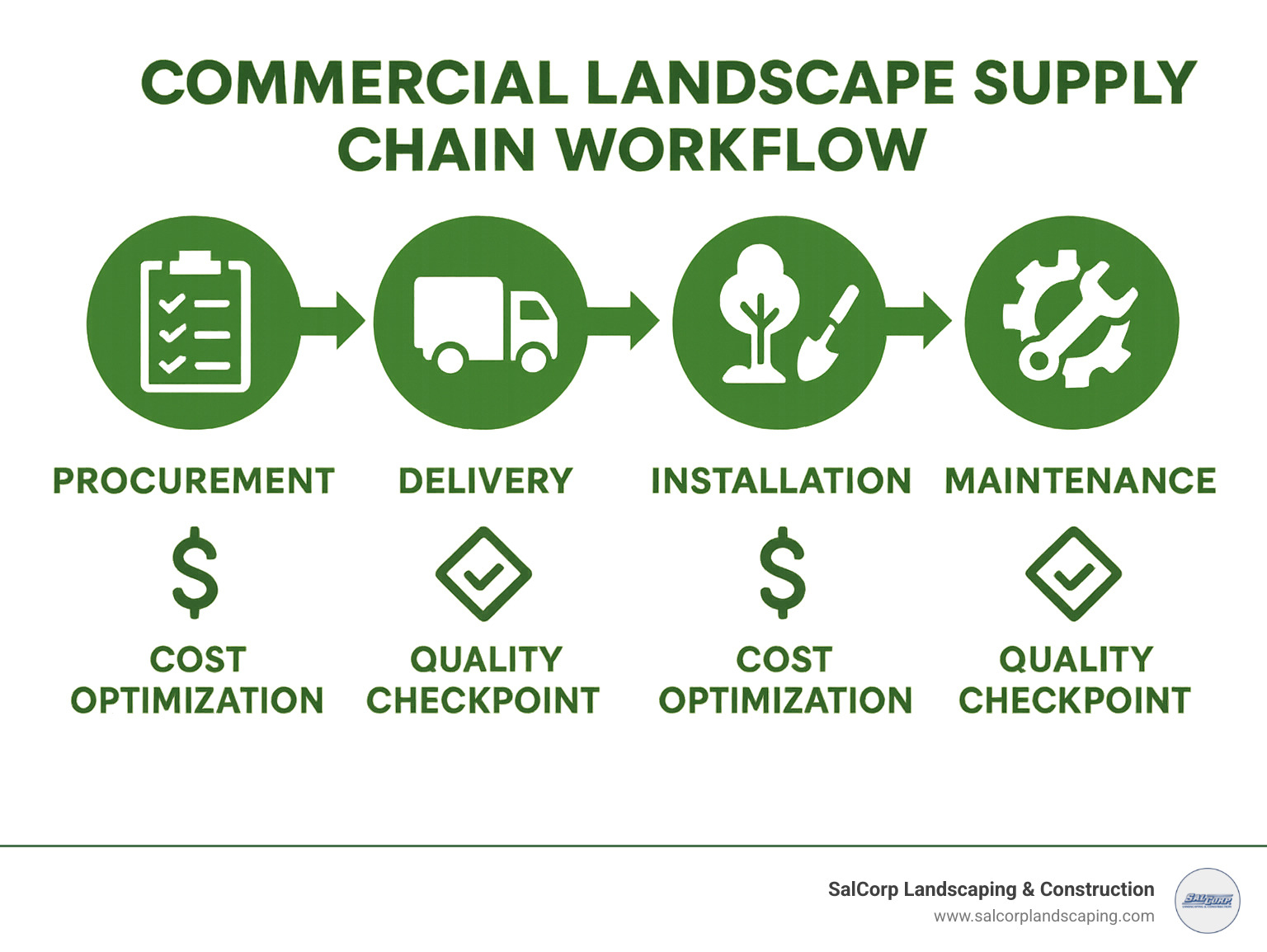
Getting the right commercial landscape supplies to your job site when you need them doesn’t have to be a headache. After two decades in this business, I’ve learned that smart procurement is really about three things: finding reliable suppliers, leveraging technology to save time, and planning deliveries like a chess master thinking three moves ahead.
The landscape supply industry has been revolutionized by digital platforms that connect contractors with hundreds of suppliers in real-time. What used to take days of phone calls and waiting for quotes can now happen in minutes. Modern procurement systems can reduce sourcing time by up to 80%, which means more time actually building beautiful landscapes instead of chasing down materials.
Vendor vetting becomes absolutely critical when you’re ordering truck loads of materials instead of bags. Quality suppliers don’t just deliver products – they provide material certifications, delivery guarantees, and technical support that can save your project when things get complicated. And trust me, things always get complicated at some point.
Local sourcing often provides the flexibility you need for commercial projects. While you might not always find exactly what you want locally, the benefits of shorter delivery times, lower transportation costs, and suppliers who understand your regional climate conditions usually outweigh having to ship materials from across the country.
More info about Commercial Landscape Contractors can help you understand how professional teams approach large-scale procurement challenges.
Benefits of Buying in Bulk
The cost savings from bulk purchasing are obvious – we’re talking about reductions of 30-50% compared to buying smaller quantities. But the hidden benefits often matter more for commercial projects. When you order everything at once, you get perfect color and texture matching across your entire installation. No more awkward conversations with clients about why the mulch in the front entrance looks different from the mulch around the back patio.
Consistency extends beyond appearance to performance characteristics. That bulk soil blend you ordered will have the same drainage properties and nutrient content throughout your project. Your plants will establish more evenly, and your irrigation system will work as designed instead of fighting soil variations.
Waste reduction through bulk purchasing isn’t just good for your budget – it’s good for the environment. Less packaging, fewer delivery trips, and more efficient transportation all add up to a smaller carbon footprint. Plus, bulk suppliers typically provide material calculators and technical support that help you order exactly what you need instead of guessing and ending up with expensive leftovers.
Schedule control becomes much easier when you’re working with bulk suppliers. They understand commercial timelines and can often work around your installation schedule instead of forcing you to work around their delivery availability.
Streamlining Orders with Technology
Real-time inventory systems have completely changed how we source materials for commercial projects. Instead of calling around to see who has what in stock, you can search hundreds of suppliers instantly and see exactly what’s available. Platforms like LandscapeHub have made this kind of transparency standard in our industry.
Digital request-for-quote systems streamline the bidding process for large orders. You submit your requirements once and get competitive bids from multiple suppliers without playing phone tag for a week. Scientific research on supply chain speed shows how these technology improvements reduce procurement time while improving accuracy and reducing costly ordering errors.
Fleet tracking technology helps coordinate deliveries with your installation schedule. When you know exactly when that truck will arrive, you can have your crew ready and your equipment positioned. No more expensive downtime waiting for materials or scrambling to find somewhere to store an unexpected early delivery.
The time savings statistics are impressive, but what really matters is how this translates to better project management. When you can source materials efficiently, you spend more time focusing on quality installation and client satisfaction.
Delivery & On-Site Handling Tips
Site access planning prevents the kind of disasters that become legendary job site stories – and not in a good way. Large delivery trucks need adequate turning radius and stable ground conditions. I’ve seen too many projects delayed because nobody checked whether a fully loaded concrete truck could actually reach the installation area.
Pre-delivery site visits might seem like extra work, but they save enormous headaches later. Your supplier can help identify potential access issues and develop alternative delivery strategies before problems arise. Sometimes that means scheduling smaller trucks or arranging for materials to be transferred to different equipment.
Off-hour deliveries can be a game-changer for urban commercial projects. Delivering materials early in the morning or late in the evening reduces traffic disruption and often provides much better site access. Just make sure you have security and weather protection planned for materials that arrive outside normal working hours.
Moisture protection for sensitive materials like mulch and soil amendments requires some forethought. A sudden rainstorm can turn your premium topsoil blend into expensive mud if it’s not properly covered. Simple tarps and proper staging areas protect your investment.
Equipment pairing ensures you have the right tools available when materials arrive. Bulk deliveries often require skid steers, excavators, or specialized conveyors to move materials efficiently from delivery trucks to their final placement. Having the wrong equipment available is like trying to eat soup with a fork – technically possible, but unnecessarily frustrating.
Trends Shaping Commercial Landscape Supplies in 2024

The landscape supply industry is evolving rapidly, and 2024 has brought some exciting changes that are reshaping how we approach commercial projects. After two decades in this business, I’ve never seen innovation move this fast or sustainability become such a driving force.
Climate-adaptive materials have moved from “nice to have” to absolutely essential. We’re seeing more unpredictable weather patterns every year, which means the old playbook doesn’t always work. Drought-tolerant plants that can handle both water restrictions and sudden downpours are becoming the standard. Permeable hardscapes help manage stormwater while reducing runoff issues that can create expensive problems down the road.
The shift toward recycled aggregates and sustainable materials is being driven by more than just environmental concerns. Corporate clients are increasingly focused on ESG requirements, and their landscape choices need to align with company sustainability goals. Recycled concrete aggregate performs just as well as virgin materials while telling a better environmental story. Bio-based soil amendments and reclaimed stone options give us ways to build beautiful, functional landscapes that also support sustainability initiatives.
Battery-powered tools have finally reached the point where they can handle serious commercial work. The technology improvements over the past few years have been remarkable. Zero-emission equipment helps properties meet their environmental goals while cutting down on noise complaints from neighboring businesses. The maintenance savings alone make these tools attractive, even before considering the environmental benefits.
Autonomous mowers are probably the most exciting development we’re seeing. These systems can handle massive areas with minimal supervision, freeing up crews for detailed work that requires human expertise. The consistency is impressive – no missed spots, no variations in cutting patterns, just reliable results day after day.
Data-driven maintenance is changing how we think about ongoing care. Smart irrigation systems use weather data and soil sensors to optimize watering schedules automatically. We’re seeing water consumption drop by 30-50% while plant health actually improves because the timing and amounts are so precise. The dashboard systems give property managers real-time insights into their landscape performance.
Local sourcing has become more important as transportation costs rise and environmental concerns grow. Supporting regional suppliers reduces our carbon footprint while often providing better delivery flexibility. The challenge is ensuring consistent quality and availability, especially for specialized materials. We’ve had to build stronger relationships with local suppliers and sometimes maintain backup options for critical materials.
These trends aren’t just passing fads – they’re fundamentally changing how we approach commercial landscape supplies. The properties that accept these innovations are seeing real benefits in reduced operating costs, improved environmental performance, and improved property value.
Frequently Asked Questions about Commercial Landscape Supplies
How do regional climate and soil affect material choice?
Your local climate and soil conditions make a huge difference when selecting commercial landscape supplies. Here in Massachusetts, where we’ve been working for over 20 years, I’ve learned that what works in Florida definitely won’t survive our brutal winters.
Freeze-thaw cycles are the biggest challenge we face. Hardscape materials need specific durability ratings to handle our temperature swings without cracking or shifting. I’ve seen beautiful stone installations fail after just one winter because someone chose materials rated for warmer climates.
Soil conditions vary dramatically even within our state. The sandy soils on Cape Cod drain completely differently than the heavy clay we encounter in western Massachusetts. Sandy soils need organic amendments to hold moisture and nutrients, while clay soils require drainage improvements and structure-building materials.
Plant hardiness zones determine which species will actually survive your winters. Materials and plants that thrive in Zone 7 climates often become expensive mistakes in our Zone 6 conditions. Native plants adapted to your specific region typically perform better and require fewer inputs once established.
Your local suppliers understand these regional quirks better than national distributors. They’ve seen what works and what fails in your specific climate, which saves you from costly trial-and-error learning.
What challenges do pros face when sourcing large quantities?
Quality consistency across large orders keeps me awake at night sometimes. You order 50 yards of mulch expecting uniform color, but different production batches can look completely different when installed side by side. Nothing screams “amateur job” like a patchwork landscape with mismatched materials.
Stone and aggregate matching presents similar challenges. Natural materials vary by quarry location and extraction timing. Smart contractors order extra material from the same lot to handle future repairs and additions.
Delivery logistics get complicated fast with commercial quantities. Urban job sites often lack space for large trucks, and residential neighborhoods have weight restrictions that can prevent access entirely. I’ve had to coordinate multiple smaller deliveries when the original plan wouldn’t work.
Storage becomes a real issue with bulk orders. Moisture-sensitive materials like soil amendments and mulch can deteriorate quickly without proper protection. Theft protection also matters more when you have valuable materials sitting on-site overnight.
Equipment requirements for handling large quantities often get overlooked during planning. Bulk deliveries require proper machinery to move materials efficiently from delivery trucks to final locations. Hand-moving 20 yards of stone is nobody’s idea of fun.
How can I verify a supplier’s sustainability credentials?
Don’t just take marketing claims at face value when evaluating sustainability. Third-party certifications like LEED compliance and recycled content verification provide independent validation of environmental claims. Quality suppliers readily provide documentation to support their sustainability statements.
Transportation distance significantly impacts environmental footprint. Local suppliers often provide lower-impact options, though material selection may be more limited. We prioritize local sourcing when possible, but sometimes specific project requirements demand materials from farther away.
Ask suppliers about their sourcing practices and environmental policies. Companies genuinely committed to sustainability openly share information about material origins, processing methods, and waste reduction efforts. Vague responses or reluctance to provide details should raise red flags.
Recycled content in aggregates and manufactured products reduces environmental impact while often providing cost savings. Recycled concrete aggregate performs excellently in many applications while diverting waste from landfills.
Look for suppliers who practice what they preach. Equipment fleets using alternative fuels, waste reduction programs in their operations, and employee training on environmental practices indicate genuine commitment beyond marketing messages.
Perfect sustainability rarely exists in commercial applications. Focus on suppliers making measurable improvements and transparent about their environmental impact rather than those making unrealistic claims about being completely green.
Conclusion
After two decades in the commercial landscaping business, I’ve learned that project success starts with smart decisions about commercial landscape supplies. The difference between a project that thrives for years and one that requires constant repairs usually comes down to choosing quality materials from reliable suppliers.
The landscape supply industry has transformed dramatically with technology making procurement faster and more efficient. Digital platforms now cut sourcing time by up to 80%, while bulk purchasing strategies can deliver substantial savings when planned properly. But remember, the wide price ranges mentioned throughout this guide are internet averages – actual costs vary significantly based on your location, project size, and specific requirements.
Smart sourcing isn’t just about finding the lowest price. It’s about balancing upfront costs with long-term performance. Quality commercial landscape supplies might cost more initially, but they typically last 3-5 times longer than budget alternatives. When you factor in replacement costs, maintenance savings, and liability protection, premium materials often provide superior value.
The trends we’re seeing – from drought-tolerant plants to autonomous equipment – point toward more sustainable and efficient solutions. Climate-adaptive materials help properties weather unpredictable conditions, while battery-powered equipment reduces both operating costs and environmental impact.
Choosing the right supplier partner matters as much as selecting quality materials. The best suppliers don’t just deliver products – they provide technical expertise, problem-solving support, and the reliability that keeps projects on schedule. After working with hundreds of suppliers over the years, I can tell you that this relationship often determines project success.
At SalCorp Landscaping & Construction, we’ve built our reputation on understanding exactly what commercial landscape supplies work best for Massachusetts conditions. Our owner-operated approach means you get personal attention to every detail, from material selection through final installation. More info about our commercial landscaping services
The commercial landscape supply industry continues evolving toward smarter, more sustainable solutions. Staying informed about these developments and partnering with experienced contractors helps ensure your property gets materials that perform for years to come. More info about Commercial Landscape Contractors
Whether you’re planning a small courtyard renovation or a major commercial development, investing time in proper material selection and supplier relationships pays dividends in project success and long-term satisfaction.