

Commercial Lawn Maintenance: 7 Powerful Tips for Success 2025
The Impact of Professional Commercial Lawn Maintenance
Commercial lawn maintenance involves the regular care of business properties’ outdoor spaces to create positive impressions, ensure safety, and protect property value. If you’re managing commercial property, here’s what you need to know:
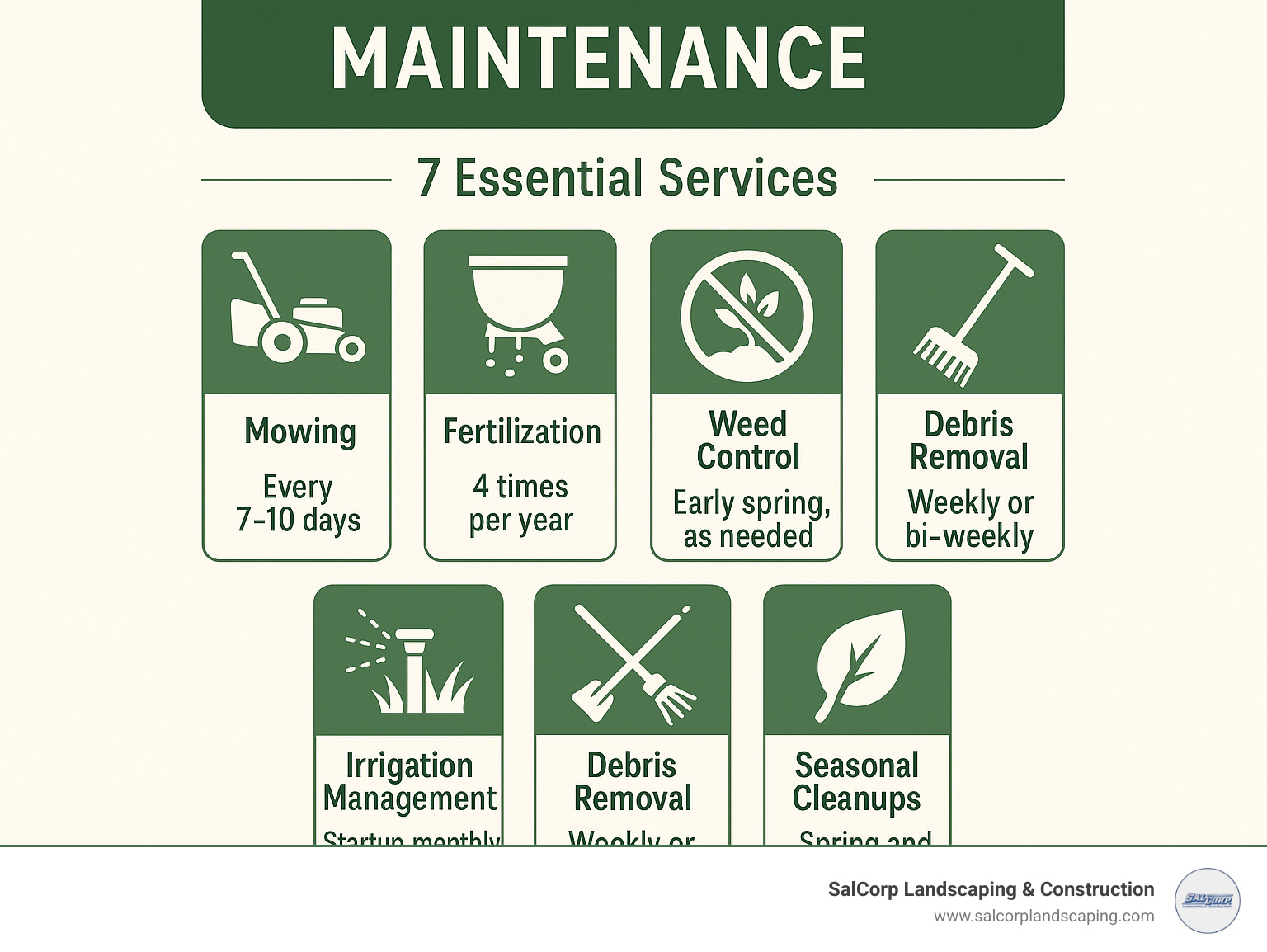
Core components of commercial lawn maintenance:
– Regular mowing (typically every 7-10 days during peak season)
– Fertilization (4 times annually between spring and fall)
– Weed control (pre-emergent in early spring, post-emergent as needed)
– Aeration and overseeding (spring and fall)
– Irrigation management (spring startup, monthly inspections, fall winterization)
– Trash and debris removal (weekly or bi-weekly)
– Seasonal cleanups (spring and fall)
Your landscape creates the first impression when customers, tenants, or facility users arrive at your location. A well-maintained commercial lawn does more than just look attractive—it plays a crucial role in environmental health by reducing runoff, cleaning the air, minimizing erosion, and neutralizing pollutants.
Unlike residential lawns, commercial properties typically cover larger areas (often measured in acres rather than square feet), require specialized equipment, face stricter regulations, and demand more consistent attention to maintain a professional appearance year-round.
I’m Sal Musto, owner of SalCorp Landscaping & Construction, with over two decades of experience providing comprehensive commercial lawn maintenance services throughout Massachusetts, ensuring businesses maintain pristine outdoor spaces that improve their professional image while meeting safety and environmental standards.
Quick commercial lawn maintenance terms:
– commercial landscape maintenance near me
– commercial grounds maintenance
– commercial edging for landscaping
What Is at Stake?
When it comes to commercial lawn maintenance, there’s much more at stake than just aesthetics:
Property Value: Professional landscaping can increase property values by up to 15%. For commercial real estate, this translates to higher rental rates and better tenant retention.
Safety: Overgrown grass can hide hazards like holes or debris that could cause injuries. Regular commercial lawn maintenance helps identify and address these safety concerns before they become problems.
Brand Image: Your outdoor space is an extension of your brand. That first impression is difficult to overcome, no matter how impressive your indoor facilities might be.
Understanding Commercial vs. Residential Care
When it comes to keeping outdoor spaces looking their best, commercial properties play by a different set of rules than your home lawn. Having maintained countless business properties over the past two decades, we at SalCorp Landscaping & Construction have seen how these differences shape our approach.
Key Differences in Commercial Lawn Maintenance
Think of commercial lawn care as residential care’s bigger, more complex cousin. While your home lawn might be measured in square feet, commercial lawn maintenance often deals with acres – sometimes lots of them!
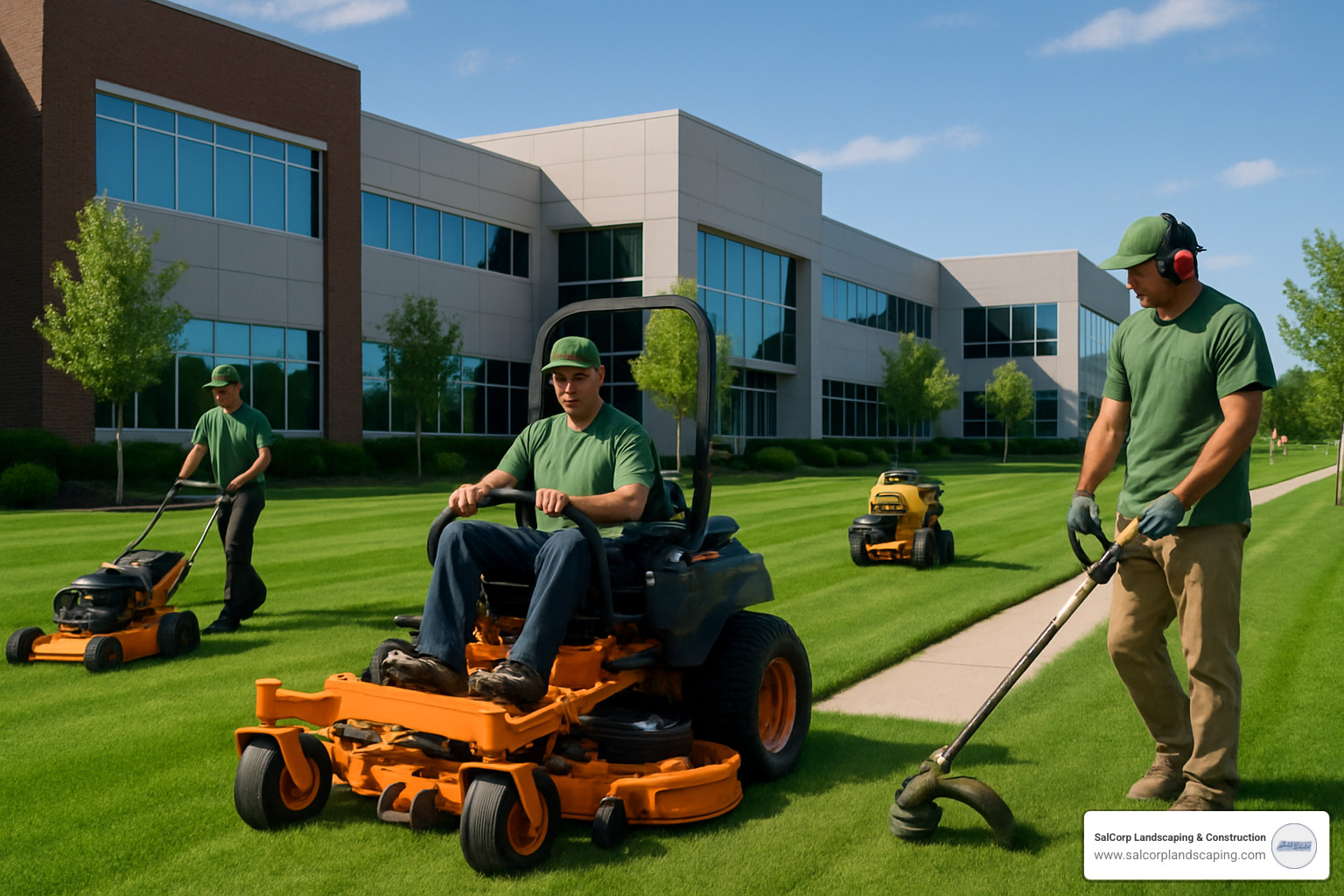
When we maintain a business property, we’re not just bringing bigger mowers (though our 50-70″ commercial mowers that cover 3-5 acres per hour certainly help). We’re bringing a different mindset altogether. Our commercial crews are specially trained to handle the unique challenges of larger acreage while maintaining consistent quality.
Equipment size matters tremendously in commercial settings. We’ve invested in professional-grade machinery specifically designed for efficiency on large properties – because when you’re maintaining several acres, every minute counts.
Liability concerns also take center stage in commercial settings. With higher foot traffic and more people potentially affected by property conditions, our commercial lawn maintenance protocols include regular safety inspections to identify and address hazards.
Noise ordinances and scheduling windows become crucial considerations for commercial properties. We carefully plan our maintenance activities to minimize disruption to your business operations, often working during off-hours when possible.
Even the grass itself is different! Commercial properties benefit from specialized turf-type blends that stand up to heavier foot traffic while requiring less water.
Why Regular Care Matters for Businesses
Regular commercial lawn maintenance isn’t just about aesthetics – it’s a strategic business decision.
Customer perception starts forming before anyone walks through your door. Studies show that 70% of first-time retail sales are influenced by curb appeal. When clients see a carefully maintained landscape, they subconsciously extend that impression to your business practices.
Smart business owners also recognize the risk management benefits of regular maintenance. Our proactive approach identifies potential hazards before they cause accidents or injuries, preventing costly lawsuits and insurance claims.
Consistent care is always less expensive than rehabilitation. Regular maintenance is like preventive healthcare for your landscape – regular checkups prevent major surgeries.
For property managers, well-maintained grounds directly impact tenant satisfaction and retention. Happy tenants renew leases and recommend your property to others, keeping vacancy rates low and your reputation high.
Commercial Lawn Maintenance Fundamentals
Let’s talk about what really makes commercial lawn maintenance work. It’s not just about cutting grass—it’s about creating a complete system that keeps your property looking its best year-round.
At SalCorp, we’ve developed our approach over 20+ years of caring for Massachusetts commercial properties. Here’s what we’ve learned makes the biggest difference:
Mowing & Trimming Frequency for Commercial Lawn Maintenance
The backbone of any commercial lawn maintenance program is consistent mowing. Most of our Massachusetts commercial clients need:
Weekly Mowing (Peak Season): From mid-April through early November, your grass is in active growth mode and typically needs weekly attention. This usually works out to about 24 mowings annually.
We follow the “one-third rule”—never cutting more than a third of the grass blade in a single mowing. For most commercial properties, that means keeping your turf at a healthy 3.5-4 inches tall, which helps it resist drought and outcompete weeds.
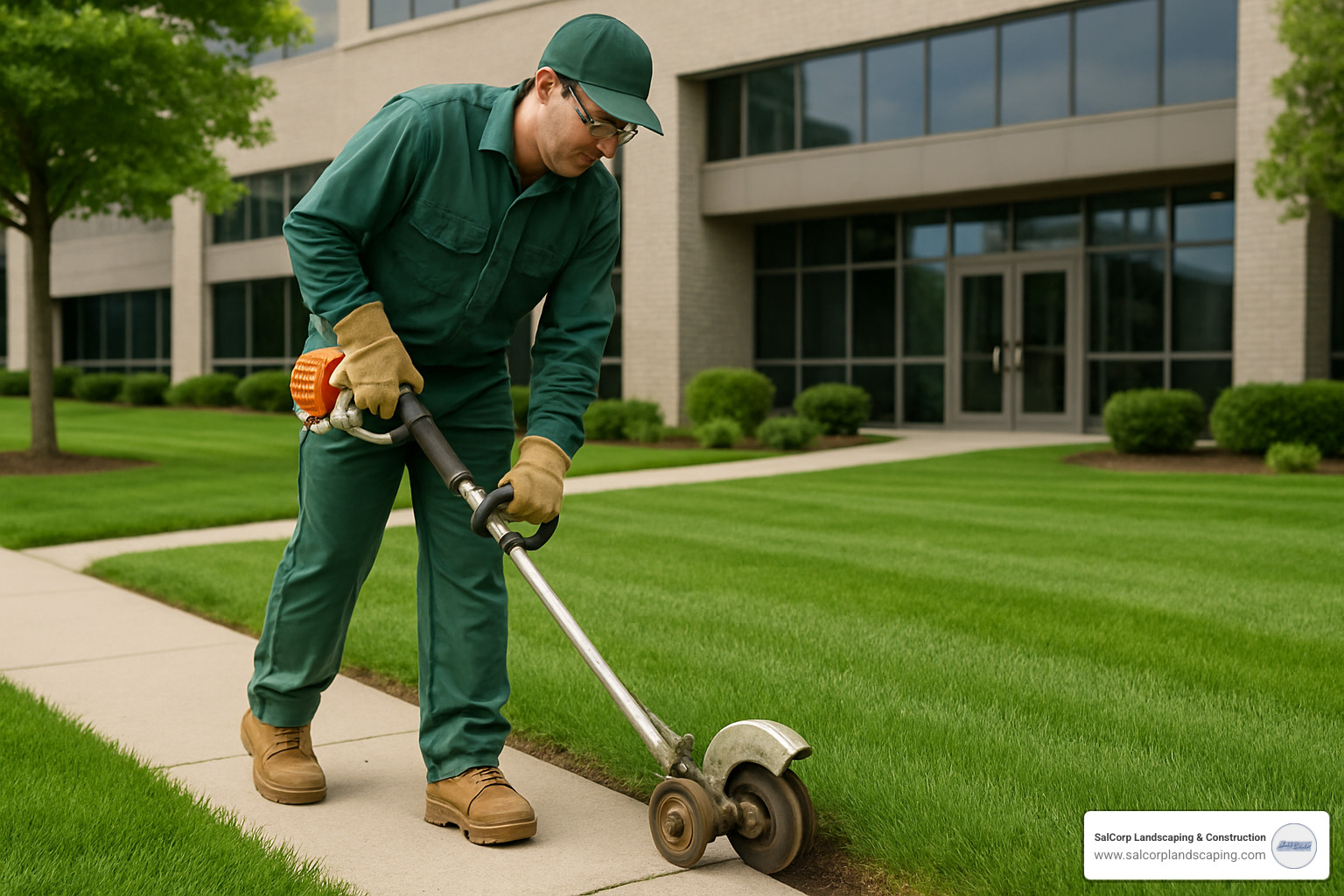
Professional edging creates defined lines that make your whole property look more polished. We include this with every mowing visit because those details matter for commercial spaces.
Time is money in commercial maintenance—our professional crews can typically mow an acre in about 15-30 minutes, depending on obstacles and terrain. That efficiency is why most businesses find professional services make more financial sense than trying to handle maintenance in-house.
Soil Health & Aeration
You can’t have a great lawn without healthy soil underneath. Two key aspects we focus on:
pH Balance: Most commercial turfgrasses thrive when soil pH sits between 5.5 and 7.0. When pH falls outside this range, your grass struggles to absorb nutrients—even if you’re fertilizing regularly.
We recommend annual soil testing. If we find your pH is too low, a lime application can bring things back into balance.
Compaction Management: Commercial properties face unique challenges from foot traffic and vehicles constantly compressing the soil. Core aeration is one of the most valuable services we provide. By removing small plugs of soil across your lawn, we create pathways for water, oxygen, and nutrients to reach the root zone.
For most commercial properties, especially those with heavy foot traffic, we recommend aeration twice yearly—typically spring and fall.
Comparison of Aeration Methods:
| Aspect | Core Aeration | Liquid Aeration |
|---|---|---|
| Process | Removes soil plugs | Chemical application |
| Depth | 2-3 inches | Surface level initially |
| Immediate Results | Visible holes | No visible change |
| Best For | Severely compacted soils | Maintenance between core aeration |
| Cost Efficiency | Higher initial cost | Lower cost per application |
| Frequency Needed | 1-2 times per year | 3-4 times per year |
For most commercial properties, we typically recommend core aeration for its more immediate and thorough results.
Want to learn more about our complete approach to commercial property care? Check out our Commercial Landscaping Maintenance page for additional details on contract essentials and service schedules.
Seasonal Best Practices & Scheduling
The changing seasons in Massachusetts demand a thoughtful, year-round approach to commercial lawn maintenance. After two decades of caring for business properties throughout the region, I’ve learned that timing is everything when it comes to keeping commercial landscapes looking their best.
Spring & Summer Commercial Lawn Maintenance Tasks
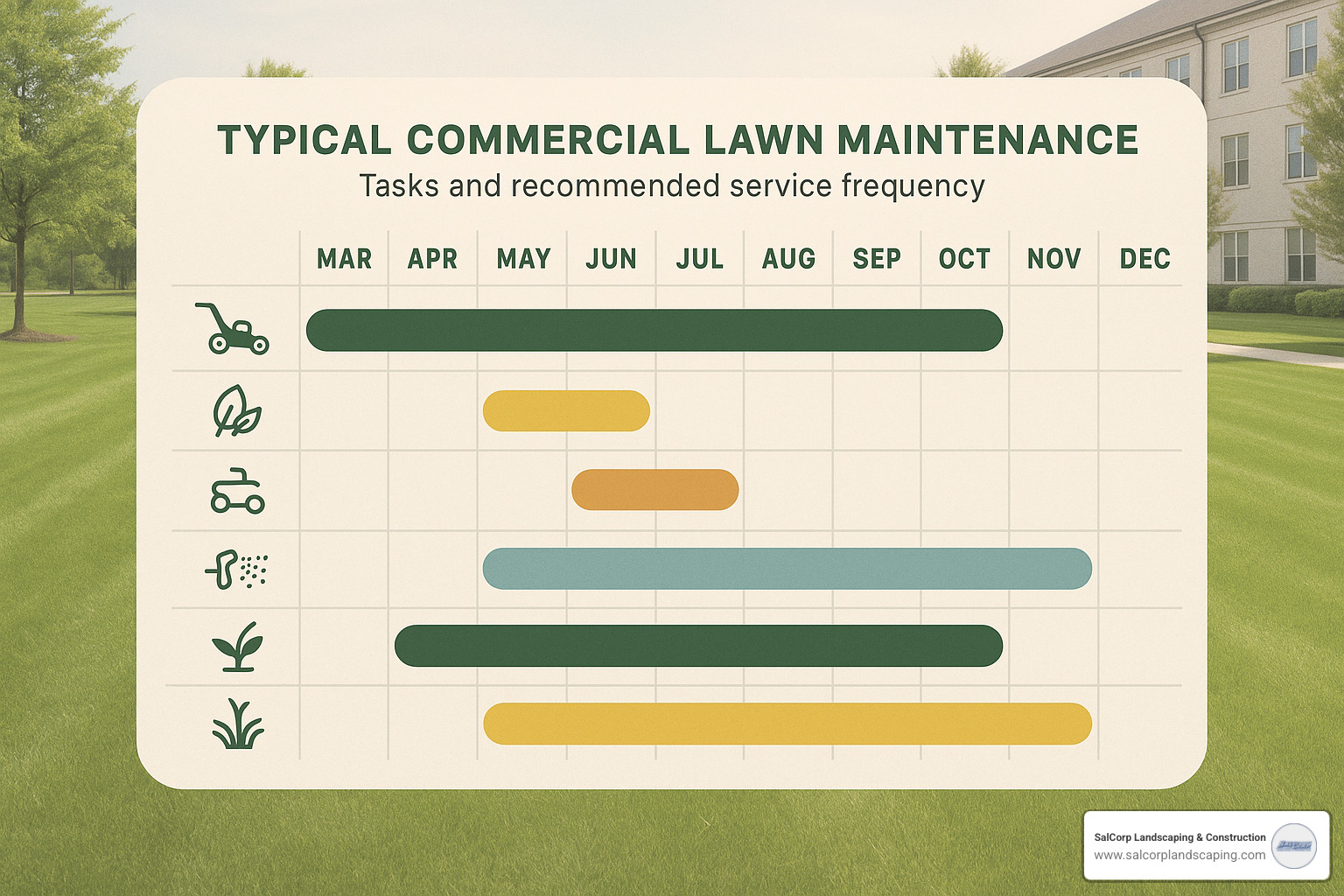
In early spring (March-April), we focus on renewal with a thorough spring cleanup to clear away winter debris. Mid-March to early April is the critical window for applying pre-emergent herbicides. This is also when we conduct soil testing and apply lime if needed.
By mid-April, most commercial properties are ready for their first mowing when grass reaches about 3-4 inches tall. This is also the perfect time for spring aeration and overseeding bare patches.
As we move into late spring and early summer (May-June), we establish that consistent weekly mowing schedule. The first round of slow-release fertilizer goes down during this period, and we’ll spot-treat any weeds that managed to sneak past our pre-emergent barrier.
During mid-summer months (July-August), we’ll continue weekly mowing but often raise the cutting height slightly during hot periods to reduce stress on the grass. Any fertilizer applications during this time are lighter to avoid burning.
Fall & Winter Focus Areas
Fall is arguably the most critical season for establishing healthy commercial turf for the following year.
During early fall (September-October), we maintain regular mowing while applying fall fertilization with higher phosphorus content. We’ll overseed any thin areas and perform fall aeration to combat compaction. As leaves begin to drop, we start the gradual process of fall cleanup.
Late fall (November-December) brings the final preparations for winter dormancy. We’ll perform a final mowing at a slightly lower height and complete leaf removal. A final application of winterizer fertilizer helps strengthen roots during dormancy. Before the first freeze, we’ll shut down and winterize your irrigation system.
During winter (December-February), our focus shifts to snow and ice management while also performing winter pruning of dormant trees and shrubs.
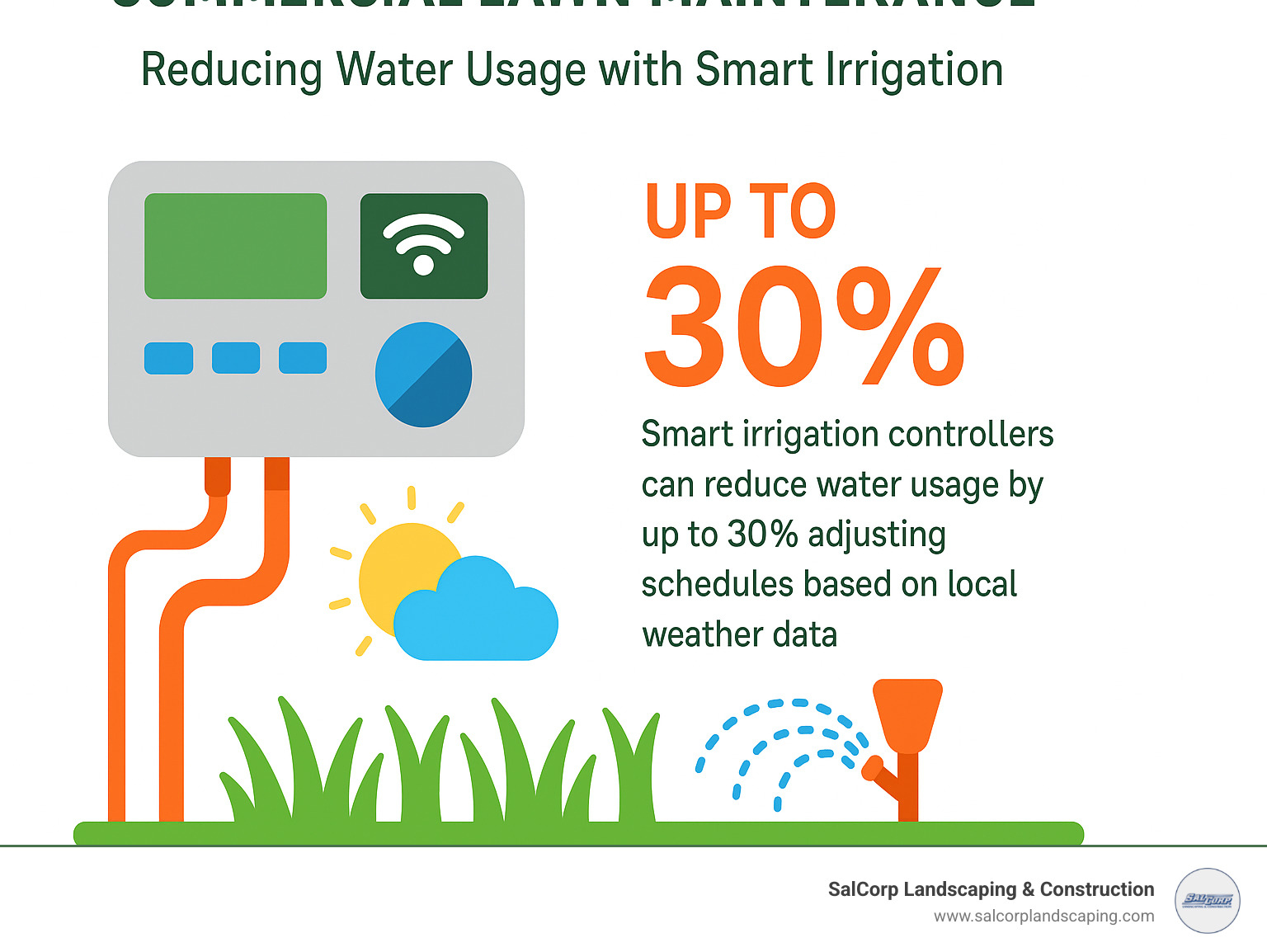
With climate change bringing more unpredictable weather patterns, having a solid drought protocol has become essential. When dry conditions hit, we implement several strategies: deep, infrequent watering to encourage deeper root growth; raising mowing height; limiting foot traffic on vulnerable areas; applying wetting agents; and leveraging smart irrigation controllers that automatically adjust based on real-time weather conditions.
At SalCorp, we provide each commercial client with a detailed annual maintenance calendar outlining exactly what services to expect throughout the year. This proactive approach ensures your property maintains its curb appeal through every season while helping you budget more effectively.
Budgeting, Pricing & Contract Tips
Let’s talk money—because we all know that’s what you’re really wondering about when it comes to commercial lawn maintenance! While every property has its own unique needs (which is why we don’t list specific pricing for SalCorp services), I can share some industry insights to help you budget effectively.
Most commercial property managers are surprised by the range of costs in the industry. Based on what we’ve seen, mowing services for smaller properties under 5 acres typically run between $50-$150 per acre per visit. Larger properties over 5 acres benefit from economies of scale, with rates often between $25-$60 per acre per visit. If you’re looking at comprehensive monthly maintenance packages that include everything your property needs, industry averages suggest $800-$1,600 per acre.
These figures represent industry averages based on internet data and not actual costs for SalCorp Landscaping. The actual investment for your property might vary significantly based on several factors.
What drives these price differences? Your property’s unique features matter—things like terrain complexity, obstacles like ponds or extensive landscaping beds, and service frequency. A property with lots of trees, flower beds, and walkways simply takes more time to maintain properly than an open field.
Choosing a Commercial Lawn Maintenance Provider
Finding the right partner for your commercial lawn maintenance needs is about much more than just finding the lowest bid. Think of it as a long-term relationship.
Start by checking the basics: proper licensing and insurance (including liability insurance and workers’ compensation). Look for industry certifications like Massachusetts Certified Landscape Professionals and membership in professional associations.
Equipment matters too! A professional outfit should have modern, well-maintained equipment specifically designed for commercial properties. At SalCorp, we’ve invested in a fleet that allows us to handle properties of all sizes efficiently.
I always recommend asking potential providers about their sustainability practices. Do they offer organic or reduced-chemical options? What about water conservation strategies?
Perhaps most importantly, check their references and portfolio. A reputable company should be happy to share testimonials from similar properties and before/after photos of their work.
What to Include in Your Contract
A solid commercial lawn maintenance contract protects both parties and ensures everyone’s on the same page. Here’s what should be covered:
First, demand a detailed scope of work that spells out exactly which services are included, how often they’ll be performed, and which areas of your property will be maintained. A property map is incredibly helpful here.
Service standards matter too. Your contract should specify mowing heights, edging and trimming standards, cleanup requirements after service, and quality control measures.
Clear communication protocols can make or break your maintenance experience. How will the provider report completed work? Who should you contact with questions or concerns?
The terms and conditions section should cover payment schedules, contract duration, renewal options, and cancellation policies. It should also address weather-related adjustments and any service guarantees.
Finally, outline how additional services are handled. Your contract should explain how to request these services, how they’re priced, and what response time you can expect.
More info about How to Price Lawn Care Services
Powered byGDPR Cookie Compliance
Sustainability & Regulatory Compliance
Going green isn’t just good for the planet—it’s becoming essential for commercial lawn maintenance. At SalCorp Landscaping, we’ve watched the industry evolve over our 20+ years serving Massachusetts businesses, and we’re excited about blending beautiful landscapes with environmental responsibility.
Eco-Friendly Innovations in Commercial Lawn Maintenance
The days of gas-guzzling mowers and chemical-heavy treatments are fading fast. Today’s sustainable approaches actually create healthier, more resilient commercial landscapes while boosting your company’s environmental credentials.
Battery-powered equipment has transformed how we maintain commercial properties. These quieter machines reduce noise pollution and eliminate exhaust emissions. When we use our propane-powered mowers, we’re producing 80% less carbon than traditional gas equipment.
Water conservation has become particularly crucial in Massachusetts. Commercial lawn maintenance now includes smart irrigation controllers that can slash water usage by up to 30% by automatically adjusting to weather conditions. We’re also big fans of soil moisture sensors that prevent wasteful overwatering.
The fertilization revolution has been just as impressive. Modern slow-release nitrogen fertilizers provide steady feeding with dramatically reduced runoff into local waterways. For businesses looking to eliminate chemicals entirely, organic options have improved tremendously.
Even our basic cultural practices have evolved. Grasscycling—leaving those tiny clippings right on the lawn—returns valuable nutrients to the soil naturally. And those slightly higher mowing heights we recommend promote deeper root systems that require less irrigation and better resist drought stress.
Navigating Local Regulations & Reporting
The regulatory landscape for commercial lawn maintenance has become increasingly complex, especially in Massachusetts. Staying compliant isn’t just about avoiding fines—it’s about being a responsible community member.
Pesticide restrictions continue to expand across our service area. Many Massachusetts municipalities have enacted partial or complete bans on certain lawn chemicals. As your maintenance partner, we stay current on these changing rules so your property remains both beautiful and compliant.
Water use regulations have also tightened as climate patterns shift. Many towns now implement seasonal water bans, and some require specific permits for commercial irrigation systems. We help our clients steer these requirements while still maintaining healthy landscapes through smart water management techniques.
Noise ordinances affect when and how we can perform maintenance on your property. We carefully plan our commercial lawn maintenance visits to respect these regulations while minimizing disruption to your business operations.
Green space requirements have become more common in local zoning codes. Many communities now mandate minimum percentages of unpaved area for commercial developments, along with specific stormwater management practices. We help our clients understand these requirements and maintain their landscapes accordingly.
At SalCorp Landscaping & Construction, we don’t see these regulations as obstacles—they’re opportunities to demonstrate our commitment to responsible commercial lawn maintenance.
More info about Commercial Property Maintenance
Frequently Asked Questions about Commercial Lawn Maintenance
How often should a commercial lawn be fertilized?
For Massachusetts properties, we’ve found that a four-application approach works best throughout the year:
In early spring (typically April), we start with a balanced fertilizer that includes pre-emergent weed control. This gives your grass the nutrients it needs to wake up from winter while preventing those early weeds.
By late spring (around June), we apply a lighter nitrogen treatment with broadleaf weed control. This helps maintain steady growth without promoting excessive mowing needs.
When early fall arrives (September), we switch to a formula with higher phosphorus content. This is when your grass is focusing on root development rather than blade growth.
Finally, in late fall (November), we apply a winterizer formula that helps your turf store energy in its roots before dormancy.
This schedule aligns with Massachusetts regulations that limit nitrogen to 2 pounds per 1,000 square feet annually and restrict phosphorus use. The exact formulation should always follow soil testing results.
What are typical costs for a 10-acre office park?
When budgeting for a 10-acre office park, the range of maintenance costs can vary significantly based on service level and property complexity.
For basic mowing service on a property this size, industry averages suggest rates between $25-$60 per acre for properties over 5 acres. This means weekly mowing might range from $250-$600 per visit. Over a typical 24-week mowing season in Massachusetts, this translates to $6,000-$14,400 annually just for mowing.
If you’re looking at comprehensive maintenance packages, monthly costs typically range from $800-$1,600 per acre based on industry averages. For a 10-acre property, this could mean $8,000-$16,000 monthly or $96,000-$192,000 annually.
These figures represent industry averages based on internet data and not actual costs for SalCorp Landscaping. The wide range reflects significant differences in service levels, property complexity, and regional pricing variations.
Additional services like aeration ($130-$250 per acre), fertilization ($220-$440 per acre), and leaf removal ($400-$700 per acre) would either be factored into full-service packages or billed separately if not included.
How does soil pH influence turf quality?
Soil pH might be the unsung hero of commercial lawn care. While everyone talks about mowing and fertilizing, pH is quietly determining whether your grass can actually use the nutrients you’re providing.
Commercial lawn maintenance professionals understand that pH (which runs on a scale from 0-14) directly affects nutrient availability. Even if you’re regularly fertilizing, grass growing in soil with the wrong pH simply can’t access those nutrients.
For most commercial turf grasses, the sweet spot is a pH between 5.5 and 7.0. When soil becomes too acidic (below 5.5), your grass struggles to access nitrogen, phosphorus, potassium, calcium, and magnesium. When it’s too alkaline (above 7.0), iron, manganese, boron, copper, and zinc become less available.
pH also affects the beneficial soil microorganisms that break down organic matter and cycle nutrients. These microscopic helpers generally prefer near-neutral conditions.
At SalCorp, we include annual pH testing as part of our comprehensive commercial lawn maintenance programs. When corrections are needed, we make them gradually:
- For acidic soil (below 5.5), lime applications can raise pH
- For alkaline soil (above 7.0), sulfur applications can gradually lower pH
By monitoring and maintaining proper soil pH, we ensure your fertilization investments yield maximum results and your commercial property maintains that vibrant, healthy appearance.
Conclusion
The investment in quality commercial lawn maintenance delivers far more than just an attractive landscape. It creates a lasting first impression that speaks volumes about your business values, attention to detail, and commitment to excellence.
Throughout this guide, we’ve explored how commercial properties face unique challenges that require specialized approaches. The difference between mediocre and outstanding commercial grounds often comes down to understanding these distinctions and implementing a comprehensive, year-round strategy.
When your commercial property receives proper care, you gain multiple benefits that directly impact your bottom line:
Improved curb appeal that attracts customers and tenants, creating that crucial positive first impression before anyone even enters your building.
A safer environment for everyone who visits your property. Well-maintained grounds reduce trip hazards, improve visibility, and create clearly defined pathways that guide visitors safely through your space.
Increased asset value that protects your real estate investment. Professional landscaping can boost property values by up to 15%, making quality commercial lawn maintenance one of the most cost-effective improvements you can make to your commercial property.
At SalCorp Landscaping & Construction, we understand that maintaining commercial properties requires a different level of expertise and equipment than residential work. As an owner-operated business with over two decades of experience serving Massachusetts communities, we take pride in delivering personalized service with professional results.
Our comprehensive approach means you don’t need multiple vendors for different aspects of your property’s outdoor needs. From weekly mowing to seasonal cleanups, from irrigation management to snow removal, we provide a one-stop solution that simplifies property management and ensures consistent quality across all services.
The landscapes we create and maintain become living ambassadors for your brand. They communicate your values to everyone who visits your property, from potential clients to valued employees. With professional commercial lawn maintenance from SalCorp, you can be confident that your outdoor space is sending exactly the right message.
Ready to transform your commercial property with expert care? Visit our Commercial Landscaping page to learn more about our comprehensive services, or contact us today to discuss your specific needs. Your landscape deserves the SalCorp difference—where attention to detail meets decades of commercial expertise.
