

Cost for a patio: 10 Powerful Ways to Save Big in 2025
Planning Your Patio Investment: What to Expect
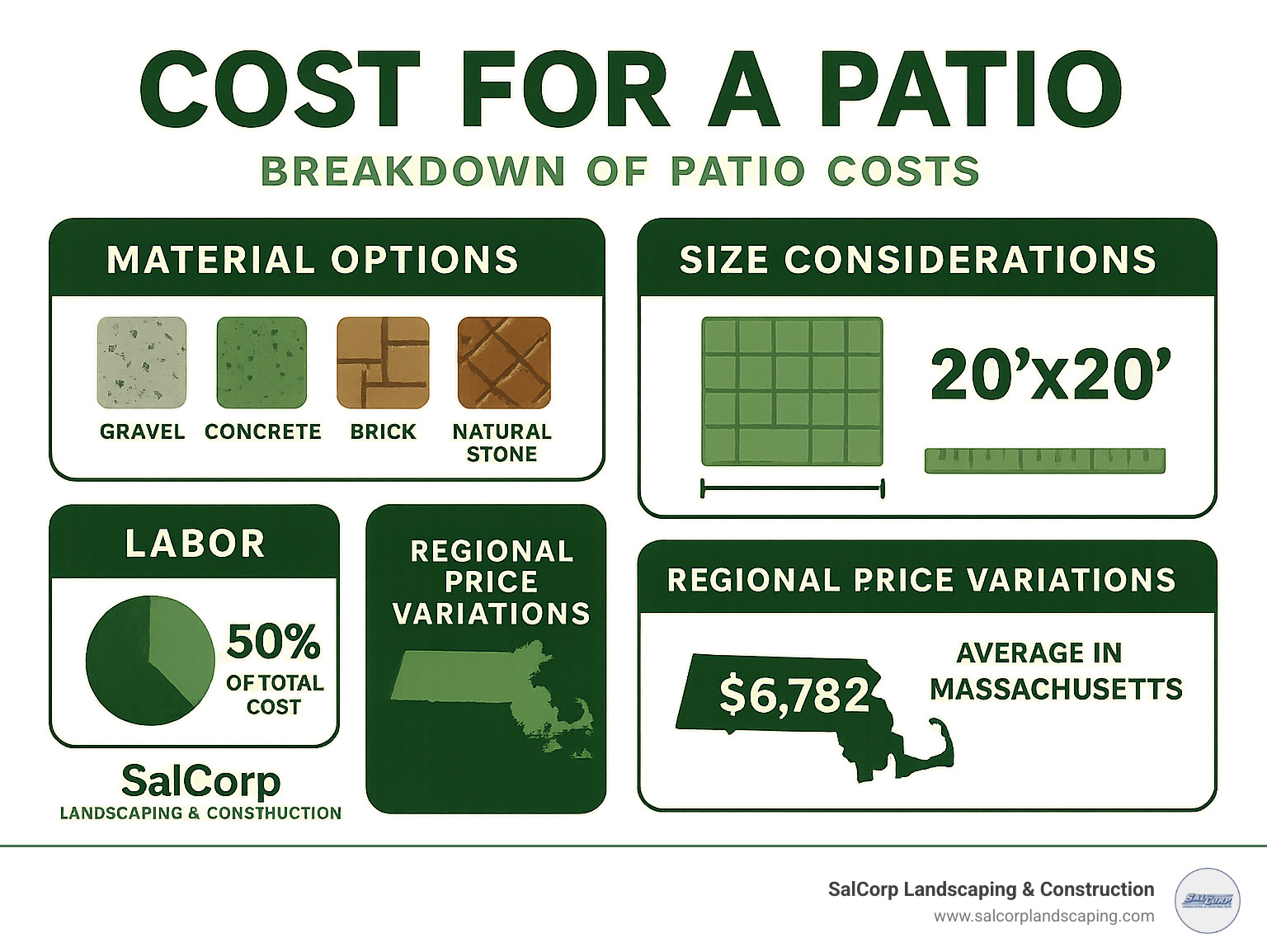
If you’re researching the cost for a patio, expect to pay between $2,000 and $14,000 for a standard 20’x20′ installation, with most homeowners spending around $3,952 nationally. Pricing typically ranges from:
- $5 to $35 per square foot installed (materials and labor)
- $1,000 to $7,000 for a 10’x20′ patio
- $2,000 to $14,000 for a 20’x20′ patio
A well-designed patio does more than just create an outdoor living space—it becomes an extension of your home and can deliver a 60-70% return on investment when it’s time to sell.
The cost for a patio varies widely based on several key factors that every homeowner should consider before finalizing their budget. Material choice represents the most significant cost variable, with options ranging from affordable gravel at less than $3 per square foot to premium natural stone that can exceed $35 per square foot installed.
Size, shape, site conditions, and regional labor rates also play crucial roles in determining your final investment. While the national average provides a helpful starting point, New England homeowners often face additional considerations like proper drainage for freeze-thaw cycles and deeper base preparations.
I’m Sal Musto, owner of SalCorp Landscaping & Construction, and over my two decades of installing patios throughout Massachusetts, I’ve helped countless homeowners steer the cost for a patio while creating outdoor spaces that stand the test of time and our challenging New England weather.
Basic cost for a patio terms:
– Patio Design
– outdoor living spaces
– brick patio design ideas
Understanding the Cost for a Patio in 2025
When planning your outdoor oasis, understanding the cost for a patio helps you set realistic expectations for your 2025 project. While the national average sits around $3,952, here in Massachusetts, we tend to pay a bit more due to our higher labor rates, material transportation costs, and the need for deeper foundations to handle our notorious freeze-thaw cycles.
Breaking down your patio budget is pretty straightforward – labor typically accounts for about half of your total cost for a patio. This might climb even higher if you’re dreaming of intricate designs or if your yard has challenging terrain. The rest of your budget goes toward materials, equipment, site prep, and those finishing touches that make the space truly yours.
Let’s look at what a typical 20’×20′ patio investment might look like:
| Cost Component | Budget Range | Percentage of Total |
|---|---|---|
| Materials | $1,000-$7,000 | 40-50% |
| Labor | $1,000-$7,000 | 40-50% |
| Site Prep | $200-$1,000 | 10-15% |
| Permits/Misc | $100-$500 | 5-10% |
Don’t forget about the return on your investment! A thoughtfully designed patio typically delivers a 60-70% ROI when you sell your home. That’s particularly valuable here in Massachusetts, where we cherish our beautiful (but all too brief) summer months and outdoor living spaces are highly prized.
Many homeowners debate between patios and decks. While both improve outdoor living, they differ significantly in cost and maintenance:
| Feature | Patio | Deck |
|---|---|---|
| Cost per sq ft | $5-$35 | $25-$50 |
| Lifespan | 25-100 years | 15-30 years |
| Maintenance | Low to moderate | Moderate to high |
| Permits | Sometimes required | Almost always required |
| ROI | 60-70% | 65-75% |
Average national range & regional swings
The cost for a patio varies dramatically depending on where you call home. While the national average runs $5-$35 per square foot installed, regional factors create significant price swings:
Here in the Northeast (including our beloved Massachusetts), expect to pay about 10-20% above the national average. Why? We face higher labor costs, stricter building codes, and need deeper frost-resistant foundations to withstand our winters.
By contrast, Midwestern homeowners often enjoy prices 5-10% below average thanks to lower labor costs and land values. Coastal dwellers face a premium of 15-25% due to higher demand, property values, and sometimes specialized materials needed to handle salt exposure.
As contractor Mitch Coluzzi wisely noted in our research, “Many DIY concrete projects require professional fixes due to common homeowner mistakes.” This rings especially true in New England, where our climate demands installation precision that many weekend warriors underestimate.
What the typical project timeline looks like
Planning your patio isn’t just about budget – timing matters too. Here’s what a typical 20’×20′ patio installation timeline looks like:
Site preparation takes 1-3 days for marking utilities, excavation, removing existing structures if needed, and creating proper grading. The base installation follows for 1-2 days, where we lay and compact the gravel base, install edge restraints, and set up drainage systems.
The actual patio installation takes 2-4 days, whether we’re laying pavers, pouring concrete, or setting stone. This includes cutting and fitting materials and installing any special features or patterns. Finishing work needs another 1-2 days for applying joint sand or grout, sealing if applicable, and thorough site cleanup.
For concrete patios specifically, you’ll need to add 7-10 days of curing time before placing furniture or heavy use. And remember, Massachusetts weather has its own ideas about schedules – spring rain and early fall frosts can extend these timeframes considerably.
At SalCorp, we’ve learned that being upfront about both costs and timelines leads to happier clients and more successful projects. After all, a patio isn’t just an investment in your property – it’s an investment in your lifestyle.
Key Factors That Influence Your Patio Budget
When planning your outdoor oasis, understanding what drives the cost for a patio helps you create a realistic budget without unwelcome surprises. Think of your patio project like putting together a puzzle – each piece affects the final picture and price.
Material selection typically takes the biggest bite out of your budget, but several other factors play equally important roles in determining your final investment. Your property’s unique characteristics and your design preferences will ultimately shape what you’ll spend.
That perfectly level, easily accessible backyard with good soil? You’re already ahead on the budget game. But if you’re dealing with slopes, clay soil, or limited access, your project might require a bit more financial padding.
As one of our Massachusetts clients recently told us, “Nobody likes a wavy patio or water pooling in its center.” This highlights why proper site preparation and drainage are non-negotiable – especially in our New England climate where freeze-thaw cycles can quickly damage improperly installed patios.
For a deeper dive into how we approach quality installations, visit our Patio Design and Installation page.
Material choice impact on dollars and durability
The materials you select not only determine your initial cost for a patio but also how long your investment will last and how much maintenance it will require.
Concrete offers versatility at $4-$25 per square foot. Basic concrete provides an economical entry point, while stamped or decorative options allow for customization at higher price points. With proper installation and maintenance, expect 25-50 years of enjoyment.
Pavers deliver both beauty and practicality at $8-$25 per square foot. Beyond their aesthetic appeal, pavers offer a practical advantage – if one becomes damaged, you can replace just that piece rather than refinishing the entire surface. Most quality paver installations last 30-50 years in our Massachusetts climate.
Natural stone represents the premium choice at $16-$35 per square foot. While the upfront investment is higher, these materials often last 50-100 years when properly installed. Many of our clients view stone as not just a patio but a legacy investment that improves their property for generations.
Gravel provides the most budget-friendly option at under $7 per square foot, but requires more frequent maintenance. It’s perfect for casual spaces or transitional areas where a more rustic look is desired.
As we often tell our Massachusetts clients, “Buy once, cry once.” Investing in quality materials suited to our climate pays dividends through reduced maintenance and longer lifespan.
Size & shape math: why curves cost more
When it comes to the cost for a patio, straight lines are simply more budget-friendly than curves. Those beautiful rounded edges and flowing designs you’ve pinned on Pinterest? They’ll add approximately 10-25% to your total investment.
Square or rectangular patios represent the most economical choice. They minimize material waste (fewer cuts needed) and require less specialized labor. Think of them as the budget-friendly classics.
Curved or circular patios add visual interest – and about $0.50-$1 per square foot to your budget. The graceful curves require precise cutting, generate more material waste, and demand more skilled labor hours.
Multi-level patios increase costs by $4-$15 per square foot due to additional materials and labor. However, they’re often worth considering on sloped properties where terracing creates usable outdoor space that might otherwise be challenging.
A practical compromise we often suggest: Consider a rectangular patio with decorative borders rather than full curves. This approach achieves visual interest without the premium price tag – giving you the best of both worlds.
Labor, site access & regional wage differences
Labor typically accounts for nearly half of the total cost for a patio, and this percentage climbs when site challenges enter the picture.
Massachusetts homeowners should be aware that our region’s landscaping and hardscaping labor rates run approximately 15-20% higher than the national average, according to Bureau of Labor Statistics data. This regional wage difference directly impacts your patio budget.
Ever tried carrying a 50-pound paver through a narrow garden gate? Site access challenges like this significantly impact labor costs:
Narrow access points often mean materials must be hand-carried instead of machine-moved, potentially increasing labor hours by 25-50%. As one of our crew members colorfully put it, “Moving heavy pavers through a narrow, sloped walkway is like doing CrossFit while balancing dinner plates.”
Working around existing landscape features you want to preserve – like that beautiful maple tree or garden – requires careful, time-consuming work that adds to the labor investment but protects what you value.
Properties far from material suppliers might incur additional delivery fees. In Massachusetts, this particularly affects homes in more remote areas of Worcester, Franklin, or Hampshire counties.
Weather & soil conditions unique to Massachusetts
Our beautiful New England setting presents unique challenges that directly impact the cost for a patio in ways homeowners in milder climates don’t face.
Freeze-thaw cycles demand deeper base preparations – typically 12-18 inches versus the 4-6 inches needed in milder climates. This extra depth prevents frost heave but requires more excavation and materials.
Clay soil, common in many Massachusetts communities from Middlesex to Norfolk counties, drains poorly and often feels like “trying to shovel cured concrete,” as one of our clients aptly described it. Proper installation in clay soil requires additional excavation and drainage solutions.
Coastal considerations affect many Massachusetts properties, particularly on the Cape and North Shore. Salt exposure requires specific material choices to prevent deterioration, and oceanfront properties often need improved drainage systems.
Seasonal limitations mean our construction season typically runs April through November. This compressed timeline affects contractor availability and sometimes pricing, especially during peak summer months.
At SalCorp Landscaping & Construction, we’ve spent over 20 years developing specialized techniques for addressing these regional challenges. Our experience with Massachusetts’ unique conditions ensures your patio will stand up to our demanding climate for decades to come.
While proper preparation might increase your initial investment, it prevents the much higher cost of repairs or replacement down the road. As we like to say, “Pay for proper preparation now, or pay much more for repairs later.”
Patio Cost by Material: Concrete, Pavers, Stone & More
When planning your outdoor oasis, the materials you choose will have the biggest impact on the cost for a patio. Each option brings its own personality, durability factors, and of course, price tag to your project.
Looking at the latest 2025 figures, Massachusetts homeowners should expect these installed price ranges for different patio materials:
- Concrete: $4-$25 per square foot
- Pavers: $8-$25 per square foot
- Brick: $9-$21 per square foot
- Natural stone: $16-$35 per square foot
- Pea gravel: $0.85-$7 per square foot
I’ve had many clients initially drawn to concrete because, as one industry expert puts it, “Concrete patios are generally more affordable than other materials due to ease of installation.” But affordability doesn’t always mean best value—especially in our New England climate.
For more guidance on finding the perfect material for your specific needs and property, check out our detailed guide on How to Choose the Right Paver for Your Patio or Walkway.
According to our research, brick patios cost between $9 and $21 per square foot. Many of my Massachusetts clients gravitate toward brick for its timeless, quintessential New England charm that seems right at home alongside colonial architecture.
Concrete tiers: plain, stamped, stained
Concrete offers wonderful versatility at different price points, making it a popular choice for many budgets. The cost for a patio made with concrete varies significantly based on the finishing technique you choose.
At the entry level, plain concrete with a broom finish runs about $4-$10 per square foot. This is your most economical option with straightforward installation, though it offers minimal decorative appeal. Most installations use a standard 4-inch thickness that works well for typical residential use.
Moving up a tier, stained concrete ($7-$15 per square foot) adds beautiful color without changing the texture. I’ve had clients absolutely thrilled with how stained concrete can mimic the appearance of natural stone at a fraction of the cost. Just remember that it will need periodic resealing to maintain its look, especially with our harsh Massachusetts winters.
For the most impressive concrete option, stamped concrete ($8-$16 per square foot) imprints patterns that resemble brick, stone, or other textures. Premium designs with multiple colors and intricate patterns can reach $25+ per square foot but create truly stunning results. As one contractor told me, “stamped concrete can cost one-third less than natural stone or brick alternatives” while achieving a remarkably similar look.
In our Massachusetts climate, I always recommend fiber mesh reinforcement in concrete patios to prevent cracking. Those freeze-thaw cycles we endure each winter can be brutal on concrete surfaces without proper reinforcement.
Paver patio pricing spectrum
Pavers deliver excellent durability and design flexibility, though at a higher cost for a patio than basic concrete. The variety within this category gives you plenty of options to match both your aesthetic preferences and budget.
Standard concrete pavers ($8-$20 per square foot) come in countless shapes, sizes, and colors. They’re relatively straightforward to install and offer excellent durability in our freeze-thaw climate. One advantage I always point out to clients: if a paver gets damaged or stained, you can replace individual pieces without redoing the entire patio.
For environmentally-conscious homeowners, permeable pavers ($10-$30 per square foot) allow water to drain through the surface rather than running off. This option often reduces the need for additional drainage systems and may even qualify for environmental incentives in some Massachusetts communities.
Clay brick pavers ($9-$21 per square foot) deliver that classic, timeless appearance that many Massachusetts homeowners crave. I particularly love that the color remains consistent throughout the material, so even as they wear, they maintain their charm. There’s something about a brick paver patio that just feels right in New England.
When budgeting for a paver patio, don’t forget to include these essential components:
– Edge restraints ($2-$4 per linear foot)
– Polymeric sand for joints ($25-$40 per bag, covering approximately 75-100 square feet)
– Base materials ($0.50-$2 per square foot)
The pattern you choose affects labor costs too. While a basic running bond uses standard labor rates, a herringbone pattern adds a 10-15% labor premium, and custom or complex patterns can increase labor by 15-25%.
Natural stone & flagstone splurge
Natural stone sits at the premium end of the cost for a patio spectrum, but many of my Massachusetts clients feel the investment delivers best beauty and longevity that’s worth every penny.
Flagstone ($15-$30 per square foot) creates a rustic, natural appearance with its irregular shapes. Available in various colors from blues and reds to buffs and grays, flagstone patios can last 50-100 years when properly installed. The installation requires skilled craftspeople who understand how to work with the variable thicknesses and irregular shapes.
Bluestone, priced similarly at $15-$30 per square foot, has become something of a New England signature. Its deep blue-gray color complements traditional architecture beautifully. You can choose either cut patterns for a more formal look or natural cleft finish for rustic charm. Either way, bluestone handles our climate exceptionally well.
For a truly luxurious option, travertine ($20-$25 per square foot) offers natural variation and stays noticeably cooler underfoot during summer. While less common in Massachusetts, I’ve seen growing interest in travertine for pool surrounds and patios where barefoot comfort is a priority.
The higher cost for a patio made with natural stone comes from several factors. As one stone supplier explained to me, “Natural stone pieces must be individually leveled due to variable thickness,” making the installation more time-consuming. Add in the quarrying and transportation costs, specialized cutting tools, and more complex base preparation requirements, and you can see why these materials command premium prices.
Gravel & mixed-material hybrids
For budget-conscious homeowners, gravel delivers the lowest cost for a patio while still creating a functional outdoor space. I’ve also found that mixed-material designs can beautifully combine economy with visual interest.
Pea gravel ($0.85-$2.80 per square foot) ranks as the most economical patio material. Its excellent drainage properties make it practical for our rainy New England springs, and it comes in various colors to complement your home’s exterior. You’ll need proper edging to contain the material, and plan on occasional replenishment as the gravel can shift over time.
Decomposed granite ($1-$4 per square foot) compacts better than pea gravel, creating a firmer surface underfoot. Its natural appearance complements landscapes beautifully, especially in more rustic or natural settings. For an even more stable surface, stabilizing products can be added during installation.
Some of my favorite projects involve mixed-material designs that maximize both budget and aesthetics. For instance, concrete with gravel borders reduces overall cost while adding visual interest. Another approach I’ve used for budget-conscious clients is creating paver or stone “islands” within a gravel area, defining gathering spaces while keeping costs manageable.
One creative homeowner shared with me, “A patio extension was achieved cheaply by laying landscaping rocks next to the existing concrete slab.” This kind of thinking shows how versatile mixed-material approaches can be when you’re watching your budget but still want to expand your outdoor living space.
At SalCorp, we’ve become experts at helping homeowners find the perfect balance of materials to create beautiful patios that respect both their vision and their budget constraints.
Add-Ons, Upgrades, and Hidden Expenses
Your basic cost for a patio is just the starting point of your outdoor living journey. Most homeowners find they want to improve their new space with features that add both functionality and charm—though these extras will certainly impact your final budget.
When planning your patio, consider these popular additions and their typical price ranges:
Fire pits transform your patio into a year-round gathering space, ranging from simple wood-burning designs ($325-$1,000) to sophisticated gas-powered options with beautiful stone surrounds ($1,500-$3,000). As Massachusetts evenings can get chilly even in summer, a fire feature often becomes the heart of outdoor entertaining.
Pergolas provide that perfect balance of sun and shade while adding architectural interest, typically costing between $2,100-$6,000 depending on materials. Traditional wood constructions start around $2,100, while more maintenance-free vinyl or fiberglass options can reach $6,000.
For the serious outdoor entertainer, outdoor kitchens range from basic grill stations ($5,500-$8,000) to comprehensive cooking areas with countertops, sinks, and refrigeration ($12,000-$22,000). These investments significantly extend your living and entertaining space during our precious New England summers.
Thoughtful lighting transforms your patio from daytime-only to a 24-hour retreat. Basic path lighting starts around $500, while comprehensive systems with layered ambient, task, and accent lighting can reach $3,500 but create magical evening ambiance.
Sloped yards often require retaining walls, which add structural support and visual interest. A typical 30-foot wall ranges from $2,000-$4,500 for block construction to $4,000-$6,600 for natural stone.
“A patio is only a paved square until you add accessories to give it personality,” one of our clients recently commented. These personalizing elements transform a basic surface into a true outdoor living space that reflects your lifestyle.
For more inspiration on incorporating fire features, check out our page on fire pits.
Permit fees & HOA approvals you might overlook
When calculating the cost for a patio, many homeowners forget to account for permits and potential HOA requirements, which can add unexpected expenses and delays.
Building permits in most Massachusetts communities range from $50-$300, with larger or more complex projects typically falling at the higher end. Permanent structures like concrete patios almost always require permits, while smaller gravel installations might be exempt in some towns. Either way, detailed plans are typically required for submission.
Zoning considerations can significantly impact your design. Setback requirements from property lines, impervious surface limitations (particularly important in environmentally sensitive areas), and historical district restrictions common in many Massachusetts towns all affect what you can build and where.
If you live in a neighborhood with a Homeowners Association, expect additional problems. Design review fees can range from free to $250, and many HOAs have strict rules about acceptable materials, colors, sizes, and even landscaping requirements around your new patio.
“Permit requirements vary by location and project scope—urban areas often require permits, whereas rural open-level patios may not,” shared one homeowner in our research. I always recommend checking with your local building department before planning begins to avoid costly redesigns.
This is particularly important in Massachusetts historical districts like those in Concord, Waltham, and Boston, where additional requirements can significantly impact both your design options and the cost for a patio.
Site preparation surprises
Some of the most significant budget overruns I’ve seen in patio projects come from unexpected issues during site preparation—problems that only become apparent once digging begins.
Tree root removal can add $150-$500 per tree to your project cost, especially with mature specimens whose root systems are extensive. Ledge or large rock removal presents an even bigger challenge, potentially adding $500-$2,500 depending on size and equipment needs.
Poor soil conditions, common in many Massachusetts neighborhoods, often require additional base material at $0.80-$2 per square foot. Utility relocations can be particularly costly, ranging from $500-$2,000 depending on complexity. And in our region’s often wet conditions, drainage solutions for problematic sites might add $1,000-$3,000 to ensure your patio doesn’t become a swimming pool after heavy rains.
One contractor in our research humorously noted that “leveling clay can feel like trying to shovel cured concrete”—a challenge I’ve personally encountered in many Massachusetts communities with clay-heavy soils.
At SalCorp Landscaping & Construction, we conduct thorough site evaluations before providing estimates, helping to identify potential issues that might affect the cost for a patio before work begins. This extra step helps prevent those dreaded mid-project conversations about additional charges.
DIY vs Professional Installation: What’s Cheaper in the Long Run?

When considering the cost for a patio, many homeowners are tempted by the potential savings of a DIY approach. But before you grab that shovel and start digging, let’s compare the real numbers and considerations.
For a typical 200-square-foot patio, the math looks something like this: DIY materials will run you about $2-$10 per square foot (totaling $400-$2,000), plus approximately $745 for weekend equipment rentals. This brings your DIY investment to roughly $1,145-$2,745, not counting your most valuable resource—your time and energy over 2-4 weekends of labor.
By contrast, professional installation combines materials and labor at $5-$35 per square foot ($1,000-$7,000 total). While this appears higher on paper, professionals typically complete the job in just 3-7 days and include a 1-5 year workmanship warranty.
“I thought I was saving big money doing it myself,” shared one Massachusetts homeowner we worked with. “Three years later, I ended up paying twice—once for my DIY attempt and again for professionals to fix the drainage issues and settling that developed.”
This scenario is unfortunately common, especially in our New England climate where proper installation techniques aren’t just about aesthetics—they’re essential for durability. As one contractor in our research noted, “DIY can save initial costs, but professional contractors ensure better results that last decades, not just seasons.”
For more information about our professional installation approach, visit our Patio Companies page.
When the cost for a patio favors hiring a pro
There are several scenarios where skipping the DIY route actually saves money and headaches in the long run:
Complex designs require specialized skills that most homeowners simply haven’t developed. Those beautiful curved edges and intricate patterns you’ve pinned on Pinterest? They demand precision tools and techniques that professionals spend years perfecting.
Sloped yards present particular challenges in Massachusetts. What looks like a simple grade to an untrained eye can become a drainage nightmare after the first heavy rain. I’ve seen too many DIY patios turn into accidental swimming pools because the critical 1/4-inch-per-foot slope wasn’t properly established.
Large projects actually benefit from economies of scale when professionally installed. For patios over 300 square feet, the efficiency of professional crews with proper equipment starts to make the cost for a patio more competitive with DIY attempts.
Working with premium materials leaves little room for error. When you’re investing in beautiful natural stone at $25+ per square foot, the cost of mistakes can quickly erase any DIY savings. As one homeowner told us after attempting to install bluestone themselves: “After breaking my third piece of stone, I realized I was throwing money away.”
The equipment needs for proper installation are substantial. Professional-grade excavation equipment, plate compactors, and wet saws are expensive to rent and challenging to operate without experience. One homeowner in our research candidly shared that “after attempting DIY leveling and running into hard clay that felt like shoveling cured concrete,” they promptly called for professional help.
True DIY savings & common pitfalls
If you’re still considering the DIY path to reduce the cost for a patio, be aware of these common pitfalls that often erase those hoped-for savings:
Inadequate base preparation tops the list of DIY mistakes. In Massachusetts, frost penetration requires deeper base layers than many online tutorials suggest. When that base isn’t properly prepared, settling and cracking are almost inevitable within a year or two.
Drainage problems plague amateur installations. Water always finds the path of least resistance—and without proper slope and drainage planning, that path often leads to foundation issues or patio damage, especially during our freeze-thaw cycles.
Material miscalculations frustrate many DIYers who either run short mid-project (causing delays) or over-order (wasting money). Professional estimators have formulas that account for waste factors and pattern requirements.
Hidden equipment costs add up quickly. Beyond the basic rental fees, there’s often delivery charges, damage deposits, and fuel costs. Plus, there’s the learning curve of operating specialized equipment safely and effectively.
Time commitments are almost always underestimated. What professionals complete in days often stretches into weeks or even months of weekend work for homeowners, especially when weather delays or unexpected challenges arise.
No workmanship guarantees means any problems are entirely yours to fix. As one industry expert noted, “matching decorative concrete after a repair is often frustrating and expensive,” highlighting the long-term consequences of DIY mistakes.
If you’re still determined to tackle some of the work yourself, consider a hybrid approach: hire a professional consultant for a few hours to advise on layout and proper base preparation. This middle-ground can prevent costly errors while still reducing the overall cost for a patio.
At SalCorp Landscaping & Construction, we’ve helped many homeowners steer these decisions, sometimes after DIY attempts and sometimes before they begin. Either way, we’re happy to share our two decades of Massachusetts patio installation experience to help you make the choice that’s right for your project. Check out our Patio Build page for more information.
Ongoing Costs, Lifespan & Maintenance Planning
When you’re calculating the true cost for a patio, it’s important to look beyond just the initial price tag. Think of your patio as a relationship that needs ongoing care—not just a one-time purchase.
Your patio will need some TLC throughout its life, and different materials have their own maintenance personalities. Concrete patios need sealing every few years at about $1-$3 per square foot, while those inevitable cracks might set you back $3-$10 per linear foot to fix. A good power washing runs about $0.35-$0.77 per square foot annually—less than your morning coffee habit when you spread it out!
Paver patios are a bit more demanding but incredibly forgiving. You’ll need to refresh the joint sand every couple of years ($0.50-$1 per square foot), but the beauty is that if one paver cracks or stains, you can replace just that piece for about $5-$15. No need to tear up the whole patio like you might with concrete.
Natural stone is the low-maintenance luxury option. Yes, it costs more upfront, but as my grandfather used to say, “Buy once, cry once.” With a lifespan of 50-100 years and minimal maintenance beyond occasional repointing of joints every 5-10 years, stone patios often work out to be the most economical choice in the very long run.
As one contractor I spoke with put it, “Concrete patios are cheaper to maintain than wood decks,” making them a smart investment despite potentially higher initial costs. When you’re comparing the cost for a patio versus other outdoor options, remember to factor in these long-term considerations.
For more detailed information about our professional maintenance services, check out our Hardscaping Services page.
Material-specific maintenance schedules
Each patio material has its own maintenance rhythm that’s worth understanding before you make your choice. Here in Massachusetts, our seasonal extremes make proper maintenance even more important.
For concrete patios, a simple monthly sweep and rinse goes a long way. Keep an eye out for cracks, especially after winter—addressing them promptly prevents bigger problems. Every 3-5 years, apply a quality concrete sealer to protect against our harsh New England winters and frequent freeze-thaw cycles.
Paver patios benefit from the same monthly sweeping, but you’ll also want to check annually for any pavers that might have settled or shifted. Every 2-3 years, freshen up the joints with polymeric sand and consider applying a sealant to protect the surface. The beauty of pavers is that if winter frost heaves damage a section, you can simply reset that area rather than replacing the entire patio.
Natural stone patios are the marathon runners of the patio world. Monthly sweeping and an annual inspection of the mortar joints (if applicable) are usually all that’s needed. Every 5-10 years, you might need to repoint those joints, but the stone itself will likely outlast many of the other elements of your home.
Gravel patios need a bit more regular attention—monthly raking keeps everything even, and you’ll likely need to add fresh gravel every year or two as it inevitably migrates into your lawn or garden beds.
For Massachusetts homeowners specifically, I recommend a few seasonal maintenance tasks:
In spring, inspect for any frost heave damage and address it right away. Fall is the perfect time for a thorough cleaning and sealing before winter arrives. And when snow and ice come, reach for calcium chloride instead of rock salt—it’s gentler on your patio surfaces and less likely to cause pitting or spalling.
With proper maintenance, your patio will remain a beautiful, functional part of your home for decades—making the initial cost for a patio an investment that pays dividends in enjoyment and property value for years to come.
How to Save Money and Avoid Budget Mistakes

Let’s face it—we all want to stretch our dollar as far as possible when investing in our homes. The good news is that there are several smart ways to manage the cost for a patio without cutting corners on quality.
One of my favorite recommendations for budget-conscious homeowners is to consider a phased build approach. Start with the basic patio surface now, then add those dreamy features like a fire pit or pergola in the coming years. This strategy lets you spread the investment over time while still enjoying your outdoor space immediately.
Timing can make a real difference in your bottom line too. Many Massachusetts contractors (ourselves included) offer discounts of 10-15% during our slower seasons—typically early spring (March-April) or late fall (October-November). The summer months bring higher demand and, naturally, higher prices. As one homeowner told me last year, “I saved nearly $1,200 just by scheduling my installation in April instead of June!”
Design simplicity is another budget-friendly secret. Those gorgeous curved edges and intricate patterns you see in magazines? They’re beautiful, but they come with a price tag. Straight lines require less cutting, create less waste, and take less time to install—all factors that directly impact the cost for a patio. Consider adding visual interest through furniture and landscaping rather than complex hardscape designs.
I’ve also found that bundling projects can lead to significant savings. If you’re considering a patio along with other hardscaping needs like a walkway or retaining wall, tackle them simultaneously. When we bring our equipment and crew to your property just once, we can often offer better pricing than if projects are scheduled separately.
Don’t overlook the potential of existing materials, either. Sometimes we can repurpose base material from an old patio or incorporate reclaimed stone or brick into a new design. Not only does this approach reduce the cost for a patio, but it also adds character and supports environmental sustainability.
For more details about our approach to cost-effective patio installation, check out our Patio Build page.
Top mistakes that inflate the cost for a patio
After two decades of installing patios throughout Massachusetts, I’ve seen certain mistakes repeatedly lead to unnecessary expenses. Avoiding these pitfalls can save you thousands.
Perhaps the most costly mistake is skipping permits. I understand the temptation—who wants to pay extra fees or wait for approvals? But this shortcut can result in steep fines and even forced removal of your new patio. Worse yet, unpermitted work can create headaches when selling your home. The $50-$300 permit fee is a small price compared to the potential consequences.
Underestimating base preparation is another budget-buster I see frequently. In our Massachusetts climate, with its freeze-thaw cycles, a proper base isn’t optional—it’s essential. While it might be tempting to save on excavation depth or gravel quantity, inadequate base preparation is the number one cause of patio failure. As I often tell clients, “Pay for proper preparation now, or pay much more for repairs later.”
Drainage issues can turn your dream patio into a nightmare. Every patio needs a slight slope (about 1/4 inch per foot) away from your home’s foundation. Some properties also require additional drainage solutions like French drains or dry wells. Ignoring these requirements might save money initially, but water damage to your patio—or worse, your home’s foundation—will cost far more to fix.
I’ve seen many homeowners fall into the lowest-bid trap. While getting multiple quotes is smart, automatically choosing the lowest figure rarely is. Take time to verify that all bids include the same scope of work, materials, and preparation standards. One contractor might offer a significantly lower cost for a patio simply because they’re planning a thinner base or lower-grade materials.
Finally, don’t overlook long-term maintenance costs when selecting materials. That beautiful natural stone might cost more upfront than concrete pavers, but it might require less maintenance over its lifetime. Conversely, that budget-friendly gravel patio will need regular replenishment. The true cost for a patio includes not just installation but upkeep over its lifespan.
As one of my clients wisely noted after getting several suspiciously low bids: “If it sounds too good to be true, it probably is.” This wisdom is particularly relevant in New England, where proper installation techniques aren’t just about aesthetics—they’re essential for creating outdoor spaces that can withstand our challenging climate.
Getting Accurate Quotes and Choosing the Right Contractor
Finding the right contractor can be just as important as choosing the right materials when planning your patio project. After all, even the best materials won’t deliver lasting results without proper installation – especially in our challenging New England climate.
To ensure you’re getting accurate estimates for the cost for a patio, I recommend requesting quotes from 3-5 different contractors. This approach gives you a realistic sense of market rates and helps identify any suspiciously low bids that might signal corner-cutting. Plus, having multiple quotes creates some healthy competition that might work in your favor during negotiations.
Before you even request those quotes, though, take time to verify each contractor’s credentials. In Massachusetts, this means checking for Home Improvement Contractor (HIC) registration, confirming they carry at least $1 million in liability insurance, and verifying they have proper workers’ compensation coverage. As one homeowner told me recently, “I learned the hard way that checking credentials upfront saves huge headaches down the road.”
Ask to see detailed portfolios of similar projects they’ve completed – and not just freshly finished work. You want to see patios that have withstood several Massachusetts winters, so you can gauge how their craftsmanship holds up over time.
When it comes to the estimates themselves, don’t settle for a single bottom-line number. Request line-item breakdowns that detail material quantities, labor hours, equipment costs, site preparation, and cleanup fees. This transparency makes it easier to compare quotes and identify where differences originate.
Payment schedules matter too. The industry standard typically involves a 30% deposit, with progress payments tied to completion milestones, and a final 10-15% payment after you’ve had a chance to inspect and approve the finished work. Be wary of contractors requesting full payment upfront – that’s almost never a good sign.
If you need help finding qualified patio contractors in your area, check out our guide to Hardscape Patio Contractors Near Me.
Questions to ask before signing
Before you sign on the dotted line, have an honest conversation with your potential contractor about these critical aspects of your project:
First, get clear about the project timeline. Ask when they expect to start and finish, how many actual working days they’ll need, and how they handle inevitable weather delays. In Massachusetts, our unpredictable spring weather can throw off even the best-planned schedules, so understanding their approach to these challenges is important.
Next, discuss their change order policy. The cost for a patio can shift if you decide to make changes mid-project or if unexpected issues arise during excavation. Understanding how they handle scope changes, approve additional costs, and whether they apply markups to change orders helps prevent surprises.
Warranty coverage is another crucial conversation. A quality contractor will stand behind their work with a meaningful warranty on both materials and workmanship. Ask specifically how they handle warranty claims and whether there are maintenance requirements to keep that warranty valid.
Project management details matter too. Will you have a dedicated foreman? How often will you receive updates? Who should you contact with questions? Clear communication prevents misunderstandings and builds confidence throughout the project.
Finally, ask about subcontractor usage. Many contractors use specialized subcontractors for certain aspects of patio installation, which isn’t necessarily a problem – but you should know who will be working on your property and whether they’re properly insured and qualified.
As Sal often reminds our clients, “The time to ask questions is before the first shovel hits the ground.” Taking time to have these conversations upfront creates a foundation of trust and clear expectations that makes the entire patio installation process smoother for everyone involved.
Frequently Asked Questions About the Cost for a Patio
How much does a 20×20 patio cost for different materials?
When homeowners ask me about the cost for a patio of this size (400 square feet), I always explain that materials make all the difference. Think of it as buying a car—you’ve got your basic models and your luxury options, each with their own price tag.
For concrete patios, you’re looking at a range from $1,600 for a simple broom-finished surface to upwards of $10,000 if you’re going all-out with decorative stamping and coloring. Most of my Massachusetts clients tend to land somewhere in the middle, around $4,000-$6,000 for a nicely finished concrete patio with some basic design elements.
Pavers offer tremendous variety. Standard concrete pavers typically run $3,200-$8,000 installed, while classic brick pavers—which complement so many New England homes beautifully—range from $3,600-$8,400. I’ve noticed more clients asking about permeable pavers lately, which can cost $4,000-$12,000 but offer excellent drainage benefits for our wet springs.
Natural stone represents the premium end, with flagstone or bluestone installations ranging from $6,000-$12,000. As one client joked to me recently, “I guess I’m literally paying for rocks!” But the timeless beauty and century-long lifespan often justify the investment for many homeowners.
Budget-conscious? Gravel remains the most economical option at $340-$1,120 for basic pea gravel, though stabilized systems that prevent displacement can push that up to $2,800.
These figures reflect average costs based on internet data, not actual costs for SalCorp Landscaping. Every property has unique conditions that can influence the final price.
Is it cheaper to build a deck or the cost for a patio?
This question comes up in almost every initial consultation I have. In nearly all cases, the cost for a patio is substantially lower than building a comparable deck, both upfront and over time.
Looking at initial installation, patios typically range from $5-$35 per square foot installed, while decks start around $25 and can easily exceed $50 per square foot—especially with today’s lumber prices. That means a 400-square-foot deck could cost twice what you’d pay for the same size patio.
The maintenance story is even more dramatic. Patios might need occasional sealing or joint sand refreshing at $0.35-$3 per square foot annually, while wood decks demand regular staining, sealing, and board replacements that can run $2-$5 per square foot each year. I’ve had clients tell me their old wood decks felt like part-time jobs just keeping up with the maintenance!
Lifespan differences are striking too. Even a basic concrete patio will likely last 25-50 years with proper care, while stone installations can literally outlive your home at 50-100 years. Compare that to wood decks, which typically need major repairs or replacement after just 10-15 years in our harsh Massachusetts winters.
The permitting process is generally simpler for patios as well. While decks almost always require structural reviews and inspections, many ground-level patios face fewer problems with local building departments.
Do I need a permit or HOA sign-off before paying the cost for a patio?
The short answer is: it depends on where you live in Massachusetts, but it’s always better to check than to guess wrong.
Most towns in our service area require permits for permanent patio structures, particularly concrete installations. Permit fees typically range from $50-$300—a small investment to avoid potential fines or removal orders down the road. Some municipalities do exempt smaller patios (under 100-200 square feet), but the rules vary widely.
If your property sits near wetlands or conservation areas—which is common in many Massachusetts communities—you might need additional approvals from your local Conservation Commission, regardless of size.
For properties governed by Homeowners Associations, design review is almost always mandatory before installation. I’ve seen HOAs restrict everything from the color of pavers to the precise placement of the patio on your property. One client told me her HOA had a 47-page document just about outdoor improvements!
At SalCorp, we handle the permitting process for our clients as part of our comprehensive service. After 20+ years working in Massachusetts communities, we’ve developed relationships with local building departments and understand the specific requirements in each town we serve.
The peace of mind that comes from knowing your beautiful new patio is fully permitted and approved is well worth the small additional cost for a patio permit. Plus, it prevents headaches when you eventually sell your home.
Conclusion
Wrapping your head around the cost for a patio goes far beyond just calculating price per square foot. It’s about creating an outdoor sanctuary that fits your lifestyle, property, and budget while standing up to whatever Mother Nature throws at it.
Throughout this guide, we’ve explored how material choices dramatically impact your investment—from economical gravel at under $3 per square foot to luxurious natural stone that might exceed $35 per square foot. We’ve seen how Massachusetts presents unique challenges that smart homeowners need to anticipate: those notorious freeze-thaw cycles, stubborn clay soils, and sometimes stricter local building requirements.
Yes, addressing these regional factors might bump up your initial investment, but they’re absolutely essential for creating a patio that won’t buckle, crack, or heave after a couple of New England winters. As one of our clients recently put it, “I’d rather pay once and enjoy for decades than save now and replace in five years.”
The good news? A thoughtfully designed patio pays you back in multiple ways:
– A solid 60-70% return on investment when it’s time to sell
– Extended living space you can enjoy for most of the year
– Less lawn to mow and maintain (a hidden benefit many clients love!)
– A ready-made entertainment zone for family gatherings and quiet evenings alike
Here at SalCorp Landscaping & Construction, we’ve spent over two decades perfecting the art and science of patio installation throughout Massachusetts. Being owner-operated means you’re never just another job number—Sal personally oversees projects from the initial design conversation through the final inspection.
Want to explore more about our approach to creating outdoor spaces built to last? Visit our Hardscaping page for a deeper dive into our comprehensive solutions.
Ready to transform that unused corner of your yard into the outdoor living space you’ve been dreaming about? Reach out today for a personalized consultation that considers your specific property challenges, design wishes, and budget realities. Let’s create something beautiful together!
