

Why Masonry Foundation Repair Is Critical for Your Home’s Safety and Value
Masonry foundation repair is the process of restoring deteriorated stone, brick, or concrete block foundations through methods like tuckpointing, carbon fiber reinforcement, wall anchors, or piering — depending on the type and severity of the damage.
Here’s a quick overview of the most common repair approaches:
| Problem | Common Repair Method |
|---|---|
| Deteriorated mortar joints | Tuckpointing / spot repointing |
| Bowing or cracking walls | Carbon fiber strips or wall anchors |
| Foundation settling | Helical piers or push piers |
| Water seepage through blocks | Exterior waterproofing membrane |
| Sunken concrete slabs | Polyurethane foam jacking |
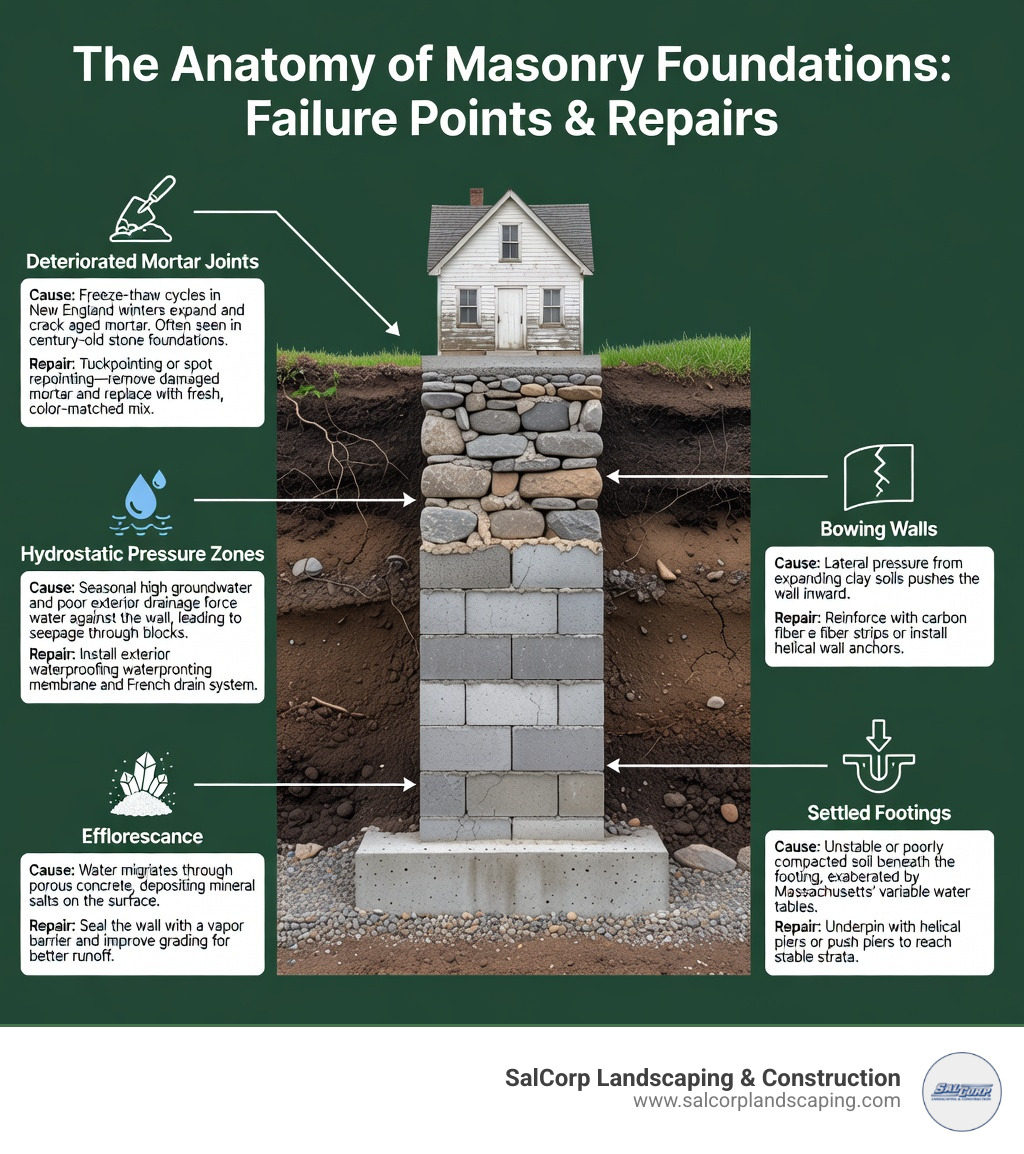
Your foundation is the most important structural element of your home. And in Massachusetts, it faces a unique set of challenges — freeze-thaw cycles, clay-heavy soils, hydrostatic pressure from seasonal groundwater, and the simple reality that many local homes sit on stone or brick foundations that are over a century old.
Most homeowners don’t think about their foundation until something goes visibly wrong. By then, small problems — like crumbling mortar joints or a hairline crack in a block wall — have often grown into costly structural issues.
The good news: caught early, most masonry foundation problems are very fixable. The key is knowing what you’re looking at, which repair method fits your situation, and who to trust with the work.
I’m Sal Musto, owner of SalCorp Landscaping & Construction, and over more than two decades of hands-on masonry and construction work across Massachusetts, I’ve seen how the right masonry foundation repair approach can protect a property for decades to come. In the sections below, I’ll walk you through exactly how to identify damage, understand your repair options, and make a smart, informed decision.
Related content about masonry foundation repair:
Identifying Damage and Modern masonry foundation repair Methods
When we walk into a basement in towns like Braintree or Newton, the first thing we look for isn’t just the crack—it’s the story behind the crack. Masonry foundations, unlike poured concrete, are made of individual units (stones, bricks, or blocks) held together by mortar. This means they “breathe” and move differently.
Common signs of trouble include:
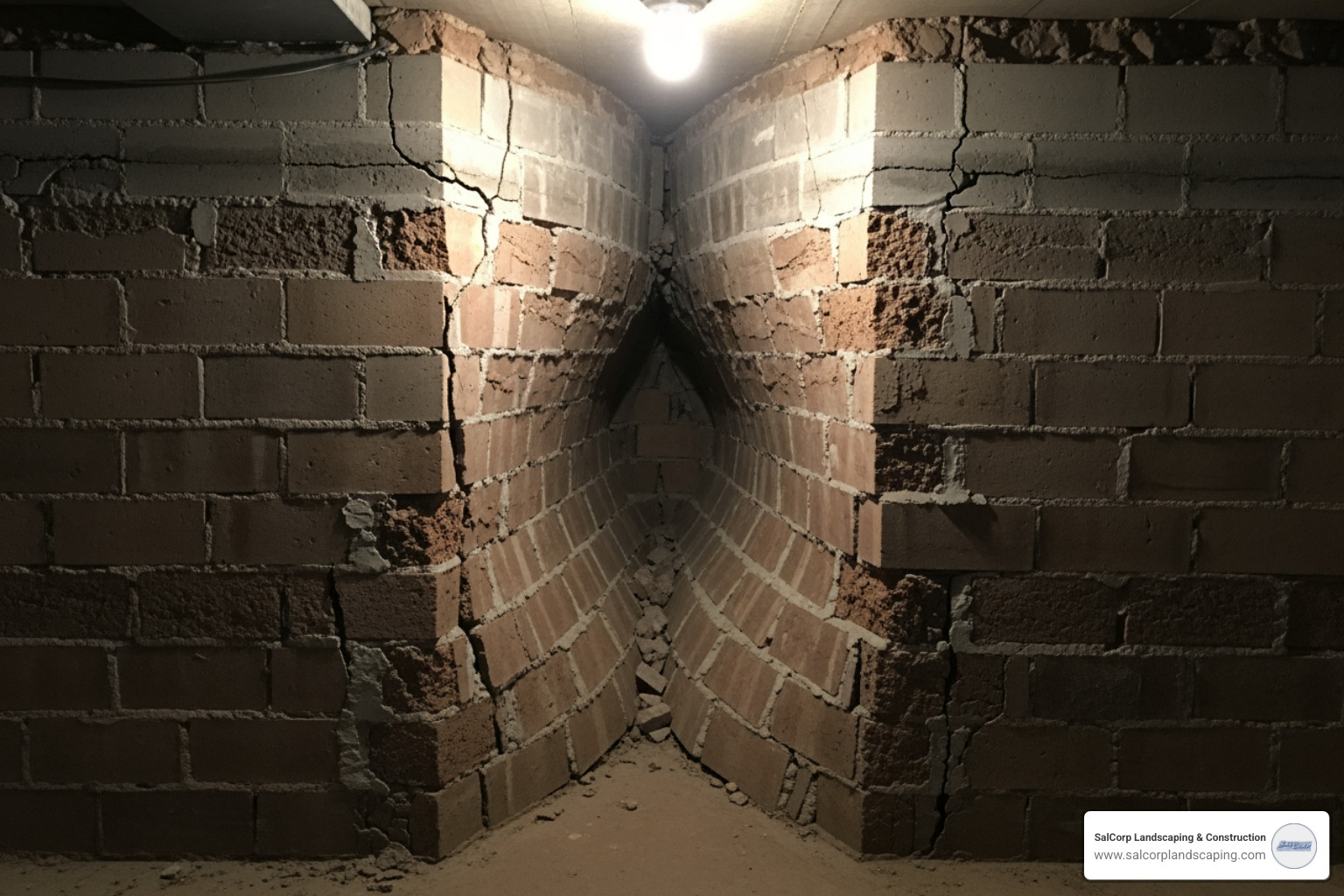
- Stairstep Cracks: Usually found in block or brick walls, these follow the mortar lines and often indicate that one corner of your home is settling faster than the rest.
- Bowing or Bulging: If a wall looks like it’s “pregnant” or leaning inward, it’s likely a victim of external pressure.
- Efflorescence: That white, powdery substance on the walls. It’s not just “basement dust”; it’s salt left behind by evaporating water, a surefire sign of moisture intrusion.
- Mortar Deterioration: In older stone foundations, the mortar can turn to sand, leaving the heavy stones to shift under the weight of the house.
The Physics of Failure: Hydrostatic Pressure and Soil
Why do these things happen? It usually comes down to hydrostatic pressure. When the soil around your home in Walpole or Foxborough becomes saturated with water, it expands and exerts massive force against your foundation walls.
Furthermore, technical guides on masonry support highlight that construction tolerances can play a role. If a foundation wasn’t built perfectly level or if the soil wasn’t compacted correctly, the weight of the masonry can create stress concentrations that lead to failure.
The Role of Tuckpointing in masonry foundation repair
If you live in a historic home—say, a pre-1910 farmhouse in Concord or a 1920s colonial in Brookline—your foundation is likely made of fieldstone or large granite blocks. These foundations don’t “crack” in the traditional sense; instead, the mortar between the stones fails.
Tuckpointing is the art of removing that old, sandy mortar and replacing it with fresh, structurally sound material.
- Pre-1910 Stone Basements: These often feature smaller, irregular stones. They take longer to repair because there are more joints to fill.
- 1910–1930 Foundations: These typically use larger, more uniform stones, which can sometimes make the process faster, though the scale of the basement is often larger.
One thing we always tell homeowners: avoid “quick fixes” like spray foam or shotcrete on these beautiful old stone walls. Spraying foam over a stone foundation is like putting a blindfold on a doctor; it hides structural issues and prevents future inspections, which can be a nightmare when you try to sell your home or get a loan.
For more information on how we handle these delicate projects, check out our masonry services page.
Structural Solutions: Carbon Fiber, Anchors, and Piering
When the issue is more than just “skin deep,” we move into structural stabilization. Modern masonry foundation repair has evolved far beyond simply rebuilding walls.
- Carbon Fiber Strips: These are a marvel of modern engineering. They are stronger than steel but incredibly thin. We use them for walls that have moved less than two inches. They are bonded to the wall with high-strength epoxy to stop further bowing.
- Wall Anchors: If a wall has bowed significantly (more than 2-3 inches), we often look at wall anchors. These involve an anchor plate buried in the yard and a steel plate on the interior wall, connected by a rod that can be tightened over time to pull the wall back toward its original position.
- Helical and Push Piers: If your house is sinking (settling), we need to reach deeper soil. Helical piers are “screwed” into the ground until they hit load-bearing strata, while push piers use the weight of the house to drive steel pipes down.
- Epoxy and Polyurethane Injections: For smaller cracks in concrete blocks, we use high-pressure injections to seal out water and bond the masonry back together.
- Polyjacking: If your basement floor or a concrete slab has sunk, we can inject high-density polyurethane foam through small holes. The foam expands, lifting the slab back to level in minutes.
Advanced Engineering for masonry foundation repair Challenges
Sometimes the problem isn’t the ground—it’s the way the house sits on the foundation. We often see “veneer overhangs,” where the brick or stone siding of a house extends past the edge of the foundation.
To fix this, we use techniques like:
- Corbeling: Building out layers of masonry to create a supportive “shelf.”
- Shelf Angles: Installing steel supports to carry the weight of the masonry veneer.
- Additional Anchors: Tying the masonry back to the structure to prevent it from peeling away.
Handling these complex structural shifts often requires excavation services to get to the root of the problem.
Understanding Costs and Choosing a Qualified Contractor
Talking about money is never the “fun” part of the job, but it is the most necessary. We want our neighbors in Stoughton and Canton to have a realistic idea of what they might invest in their home’s longevity.
Note: The following figures are average costs based on internet data and are not actual costs for SalCorp Landscaping & Construction. Every foundation is unique, and local conditions in Massachusetts can vary significantly.
Average Costs for Stone and Block Foundation Repairs
When listing average pricing based on sources, we see a wide range. Factors like the size of the basement, the type of stone, and the depth of the foundation all play a role.
| Repair Method | Low-End Average | High-End Average |
|---|---|---|
| Tuckpointing (Small Stone Basement) | $4,300 | $13,000+ |
| Tuckpointing (Large Stone Basement) | $5,800 | $19,500+ |
| Steel/Push Piering (Full Home) | $15,000 | $55,000+ |
| Helical Piering (Average Home) | $24,000 | $75,000+ |
| Polyjacking (Slab Repair) | $900 | $22,500+ |
| Carbon Fiber Strips (Per Strip) | $500 | $2,500+ |
Several factors will push you toward that high-end pricing:
- Accessibility: Can we get our machinery into the area, or is it a tight crawlspace?
- Stone Size: Smaller stones mean more mortar and more labor hours.
- Soil Depth: If we have to go 30 feet down to hit bedrock for piers, the cost increases.
- Permits and Engineering: In many Massachusetts towns, structural repairs require stamped engineering plans and specific municipal inspections.
When to Call a Specialist in Massachusetts
You might be tempted to call a general handyman for a crack in the wall, but masonry foundation repair is a specialized field. A general contractor might see a crack and suggest a “patch,” but a specialist will ask why the crack is there.
At SalCorp Landscaping & Construction, we are an owner-operated business based right here in Walpole, MA. We don’t just “sub out” the work; we use our own specialized machinery and our 20+ years of experience to ensure the job is done to Massachusetts code. Whether you’re in Braintree, Brockton, or Bourne, you want someone who understands the local soil—from the sandy reaches of the Cape to the heavy clay of the Norfolk County suburbs.
For peace of mind, always look for contractors who understand homeowner services and certifications.
Long-Term Maintenance and Building Code Compliance
Once the repair is done, the goal is to make sure you never have to call us for the same problem again. This usually involves “water management.”
- Grading: Massachusetts building code (780 CMR) generally requires a minimum 6-inch fall in the grade within the first 10 feet away from the foundation. If water is pooling against your house, no repair will last forever.
- Drainage: Installing proper downspout extensions and French drains can keep hydrostatic pressure from building up.
- Frost Protection: In our region, foundations must extend at least 4 feet below finished grade to stay below the frost line. If your foundation is “heaving,” it might be because it wasn’t deep enough to begin with.
We often integrate these repairs with hardscaping solutions, such as retaining walls or properly sloped patios, to ensure water stays far away from your basement walls.
Conclusion: Take Action Before the “Small” Becomes “Big”
A foundation issue is one of the few home problems that truly never gets better with time. It only gets more expensive. If you’ve noticed sticking doors, new cracks in your drywall, or a basement wall that looks a little “off,” now is the time to act.
We serve a wide range of communities, including:
- Norfolk County: Walpole, Norwood, Dedham, Milton, and Sharon.
- Plymouth County: Brockton, Bridgewater, and Wareham.
- The Cape: Barnstable, Brewster, and Sandwich.
- Greater Boston: Newton, Brookline, and West Roxbury.
Don’t let your foundation crumble. Whether you need a simple tuckpointing job for a historic stone basement or a complex structural stabilization with helical piers, our team has the machinery and the expertise to handle it.
Ready to protect your home? Contact us today for an assessment. We’ll help you navigate the complexities of masonry foundation repair and ensure your home stays on solid ground for the next 100 years.