

Why New Build Backyard Landscaping Is Your Blank Canvas Opportunity
New build backyard landscaping transforms bare dirt and construction debris into functional, beautiful outdoor spaces that extend your living area and boost property value. Here’s what you need to know to get started:
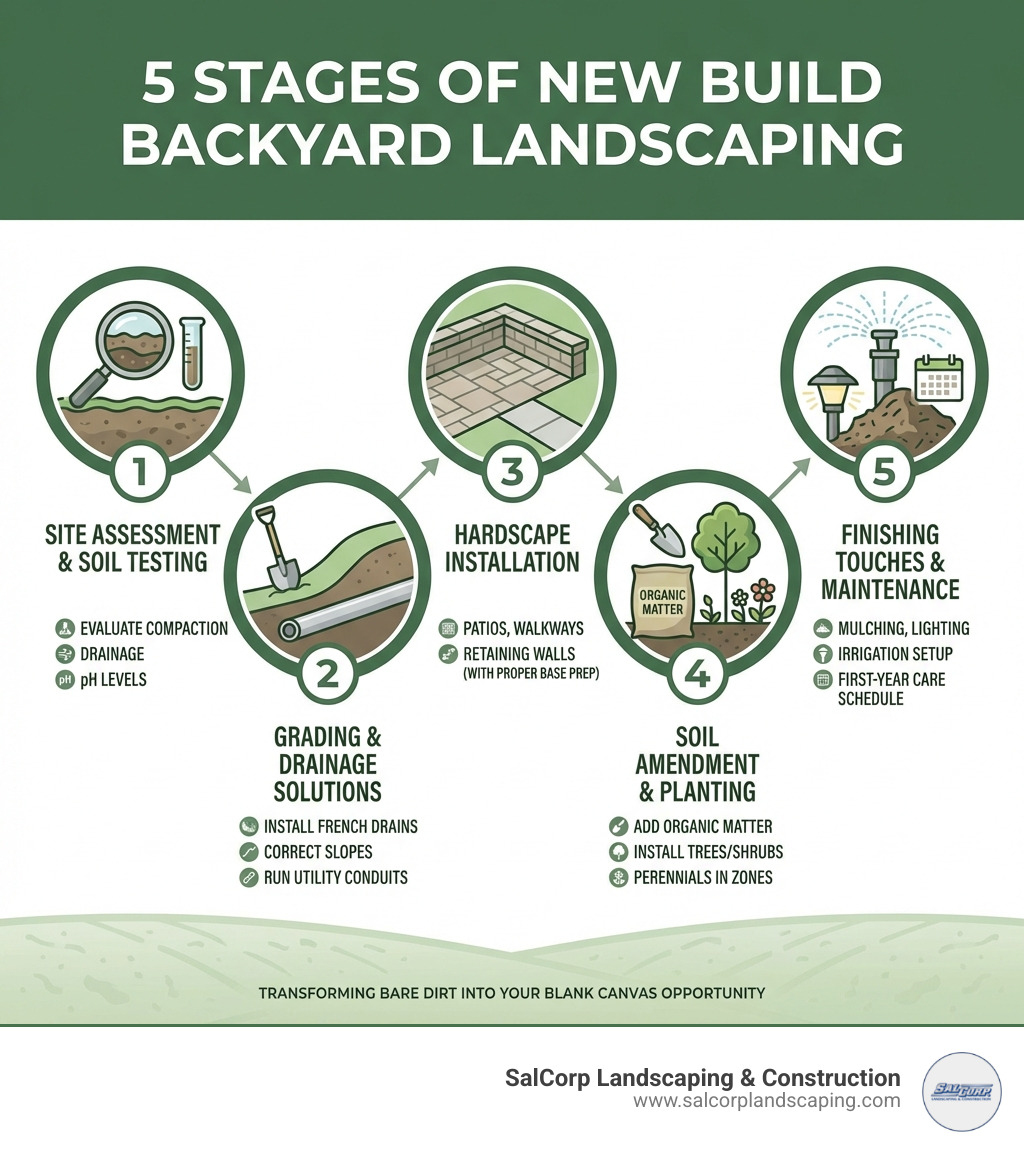
Essential First Steps for New Build Backyard Landscaping:
- Evaluate site conditions – Test soil quality, check drainage patterns, identify sun/shade areas
- Fix soil issues first – Remove construction debris, break up compaction, add organic matter
- Create a master plan – Design functional zones (dining, play, relaxation) before installation
- Install hardscape elements – Patios, walkways, and retaining walls before planting
- Choose low-maintenance plants – Native species with multi-seasonal interest
- Plan for privacy – Evergreen borders, fencing, or screening structures
- Work in phases – Spread costs over 1-5 years with a cohesive long-term vision
Key Challenges Unique to New Builds:
- Compacted soil from heavy machinery restricts root growth
- Poor drainage from disturbed grading causes pooling and foundation damage
- No privacy in new subdivisions lacking mature trees
- Stripped topsoil lacking nutrients for healthy plant growth
Budget Reality:
Most homeowners complete the main structure within 1-2 years, though a fully mature landscape takes 3-5 growing seasons. Phased installation with proper planning prevents costly rework and matches your budget timeline.
I’m Sal Musto, owner of SalCorp Landscaping & Construction, and over two decades I’ve helped Massachusetts homeowners transform bare new build lots into outdoor spaces they actually use year-round, with particular expertise in solving the drainage and soil quality issues common in new construction. My team stays on-site throughout new build backyard landscaping projects to ensure proper grading, utility placement, and phased installation that protects your investment.
Basic new build backyard landscaping glossary:
- custom landscape construction
- landscape construction management software
- what is landscape construction
Planning Your New Build Backyard Landscaping
Stepping out of your brand-new sliding glass door only to find a sea of mud and orange construction stakes can be disheartening. However, at SalCorp Landscaping & Construction, we see this as the ultimate “blank canvas.” Unlike older homes where you might have to tear out decades of overgrown shrubs or crumbling concrete, a new build allows you to get the foundation right from day one.
The most critical part of new build backyard landscaping isn’t picking out flowers—it’s the master plan. We recommend creating a scaled sketch of your backyard on graph paper or working with a professional to map out your dream features. This plan should include everything from your primary patio to where the kids’ swing set will go.
One pro tip we always share with our clients in towns like Walpole or Medfield: run your utility conduits early. If you think you might want an outdoor kitchen or a heated pool in three years, lay the gas and electric lines now while the ground is already open. It saves a fortune in excavation costs later.

For more information on how we help you map out these details, explore our landscape design services.
Evaluating Site Conditions for New Build Backyard Landscaping
Before the first shovel hits the ground, you must understand what you’re working with. New construction sites are notorious for having “disturbed soil.” During the building process, heavy machinery often strips away the nutrient-rich topsoil and leaves behind a compacted subsoil that is as hard as a brick.
Soil Testing and Grading We highly recommend a soil pH and nutrient test. Most new builds have soil that is stripped of organic matter, meaning your new plants will struggle to survive without amendments. Furthermore, you need to walk your yard after a heavy Massachusetts rainstorm. Are there puddles near the foundation? Does the water sit for more than 24 hours? Identifying these low spots early allows us to install drainage solutions like French drains or vegetated swales before they become a problem for your basement.
Sod vs. Hydroseeding For many homeowners, getting a green lawn is the first priority. In Massachusetts, you typically have two main choices:
| Feature | Sod Installation | Hydroseeding |
|---|---|---|
| Instant Result | Green lawn in one day | 3-5 weeks for initial growth |
| Cost | Higher upfront investment | More budget-friendly |
| Maintenance | Requires heavy watering for 2 weeks | Requires frequent light misting |
| Best For | Sloped areas (prevents erosion) | Large, flat expansive areas |
| Success Rate | Very high with proper prep | High, but susceptible to washouts |
If you’re looking for more inspiration on what to plant once your soil is ready, check out these backyard garden ideas. You can also learn more about the RHS perspective on new-build gardens for additional site assessment tips.
Defining Functional Zones and Garden Rooms
One of the biggest mistakes in new build backyard landscaping is treating the yard as one giant rectangle of grass. To make a space feel “luxe” and lived-in, you need to divide it into “garden rooms.”
Think about how you want to move through the space:
- The Dining Zone: Usually located closest to the house for easy access to the kitchen.
- The Relaxation Zone: A spot further away, perhaps centered around a fire pit or a water feature.
- The Play Zone: A dedicated area for kids or pets, often using durable turf or soft mulch.
- The Utility Zone: A hidden spot for trash cans, AC units, or a backyard shed.
Using different materials, such as transitioning from a paver patio to a lush lawn or a gravel path, helps define these zones visually. For more ideas on creating these areas, see our guide on outdoor living spaces or learn about our full backyard landscape services.
Essential Hardscape Elements for New Construction
Hardscaping is the “bones” of your backyard. In a new build, where the house often looks very “clean” and modern, your hardscape should match that scale and style.
Patios and Walkways A 10’x12’ patio might work for a small bistro set, but for entertaining, we suggest at least 12’x16’. We often use paver patio designs or backyard brick patio ideas to create durable, beautiful surfaces that won’t crack like poured concrete.
Retaining Walls If your new build was carved out of a hillside—common in many MetroWest developments—you likely have a sloped backyard. Retaining walls are essential here to create level “shelves” of usable land. Without them, your backyard is just a hill you have to mow.
Check out this Patio Planning Guide for tips on layout, and see how our backyard patio builders can help. If you’re dealing with a slope, we have plenty of retaining wall ideas for sloped backyards to get you started.
Execution, Budgeting, and Long-Term Success
Once the plan is set and the heavy machinery has finished the grading, it’s time for the “soft” side of new build backyard landscaping. This is where the dirt starts looking like a home.
Plant Selection for the Long Haul In Massachusetts, we experience everything from humid summers to sub-zero winters. Choosing the “right plant for the right place” is non-negotiable. For new builds, we prioritize:
- Evergreens for Privacy: Since new subdivisions often lack mature trees, planting a border of Arborvitae or Spruce provides year-round screening from neighbors.
- Native Species: Plants like Coneflowers, Blueberries, or Winterberry are adapted to our climate and require less water and fertilizer once established.
- Layering: Plant in “drifts” with taller trees in the back, shrubs in the middle, and perennials in the front to create depth.
To ensure your plants thrive, you must amend the soil. We typically add a bucketful of organic matter or farmyard manure per square meter to break up that construction compaction. For more on choosing the right materials, visit our page on hardscape materials.
Budget Considerations for New Build Backyard Landscaping
Budgeting for a new backyard can feel overwhelming, but it’s all about ROI and phasing. A well-landscaped home can see a significant boost in property value, often recouping much of the investment upon resale.
Average Project Costs Please note: The following are average costs based on internet data and are not actual quotes for SalCorp Landscaping. Every project varies based on materials, site access, and specific design needs.
| Project Scope | Average Price Range |
|---|---|
| Basic (Lawn, small patio, basic foundation plants) | $5,000 – $15,000+ |
| Mid-Range (Large paver patio, walkway, privacy screening, irrigation) | $20,000 – $60,000+ |
| Luxury (Outdoor kitchen, fire features, retaining walls, high-end lighting) | $75,000 – $225,000+ |
Cost-Saving Tips for New Homeowners:
- Phase the Work: Do the “bones” (grading, drainage, main patio) in Year 1. Add the outdoor kitchen in Year 3 and the luxury lighting in Year 5.
- Buy Smaller Plants: Young trees and shrubs establish faster and are much cheaper than “instant” mature specimens.
- Focus on the Foundation: Spend your money on high-quality soil prep and drainage first. You can always replace a dead shrub, but fixing a cracked patio base is expensive.
Trending Luxury Features and Privacy Solutions
If you’re looking to take your new build backyard landscaping to the next level, several high-impact features are currently trending in the Massachusetts area.
Fiberglass Pools Unlike concrete pools that can take months to install, fiberglass pools offer a faster installation and a smooth, algae-resistant surface. They integrate beautifully with stone coping and patio designs with pavers.
Outdoor Kitchens and Fire Pits Outdoor kitchens have moved from “nice-to-have” to essential for many luxury builds. We design these to be seamless extensions of the home’s architecture. Pair them with a custom fire pit to extend your outdoor season into the chilly New England autumn.
Privacy Screens and Pergolas In tight suburban developments, a pergola with integrated privacy slats or climbing vines can create a secluded sanctuary without the need for a 10-foot fence (which often requires special permits anyway).
Learn more about our outdoor kitchen designs to see how we can elevate your space.
Avoiding Common Mistakes and Ensuring Durability
The biggest mistake we see in new build backyard landscaping is rushing the process. Homeowners often want “green” immediately and skip the crucial underground work.
- Ignoring Drainage: Never landscape over a drainage problem. It will only come back to haunt your foundation.
- Poor Base Preparation: A patio is only as good as the hole it sits in. At SalCorp, we use deep excavation and heavy compaction to ensure your pavers don’t shift during the freeze-thaw cycles of a Massachusetts winter.
- Skimping on Quality: Cheap materials look great for one season but fail after three.
The SalCorp Difference As an owner-operated business based in Walpole, MA, we don’t just drop off a crew and leave. We use our own machinery and stay on-site to ensure every detail—from the pitch of the lawn to the tightness of the paver seams—is perfect. We believe in our work so much that we offer a 3-year labor warranty on our landscaping projects.
Whether you are in Canton, Sharon, or Needham, your new build deserves a backyard that matches the quality of your home.
Start your transformation with SalCorp landscape design services and turn that bare dirt into your own private bliss.
