Retaining Wall Concrete Blocks: The Ultimate 2025 Guide
Why Retaining Wall Concrete Blocks Are the Foundation of Smart Landscaping
Retaining wall concrete blocks are modular units designed to hold back soil and create level surfaces on sloped terrain. These engineered blocks offer structural support and aesthetic appeal in various styles for any property.
Key benefits of retaining wall concrete blocks:
- Soil retention – Hold back earth on slopes and prevent erosion
- Space creation – Transform unusable sloped areas into functional terraces
- Durability – Last decades with minimal maintenance when properly installed
- Versatility – Available in multiple textures, colors, and interlocking systems
- Cost-effectiveness – More affordable than poured concrete or natural stone walls
Retaining walls serve a critical function beyond aesthetics. They provide lateral support to vertical slopes of soil, preventing natural collapse. This makes them essential for creating usable outdoor space, protecting foundations, and managing water drainage.
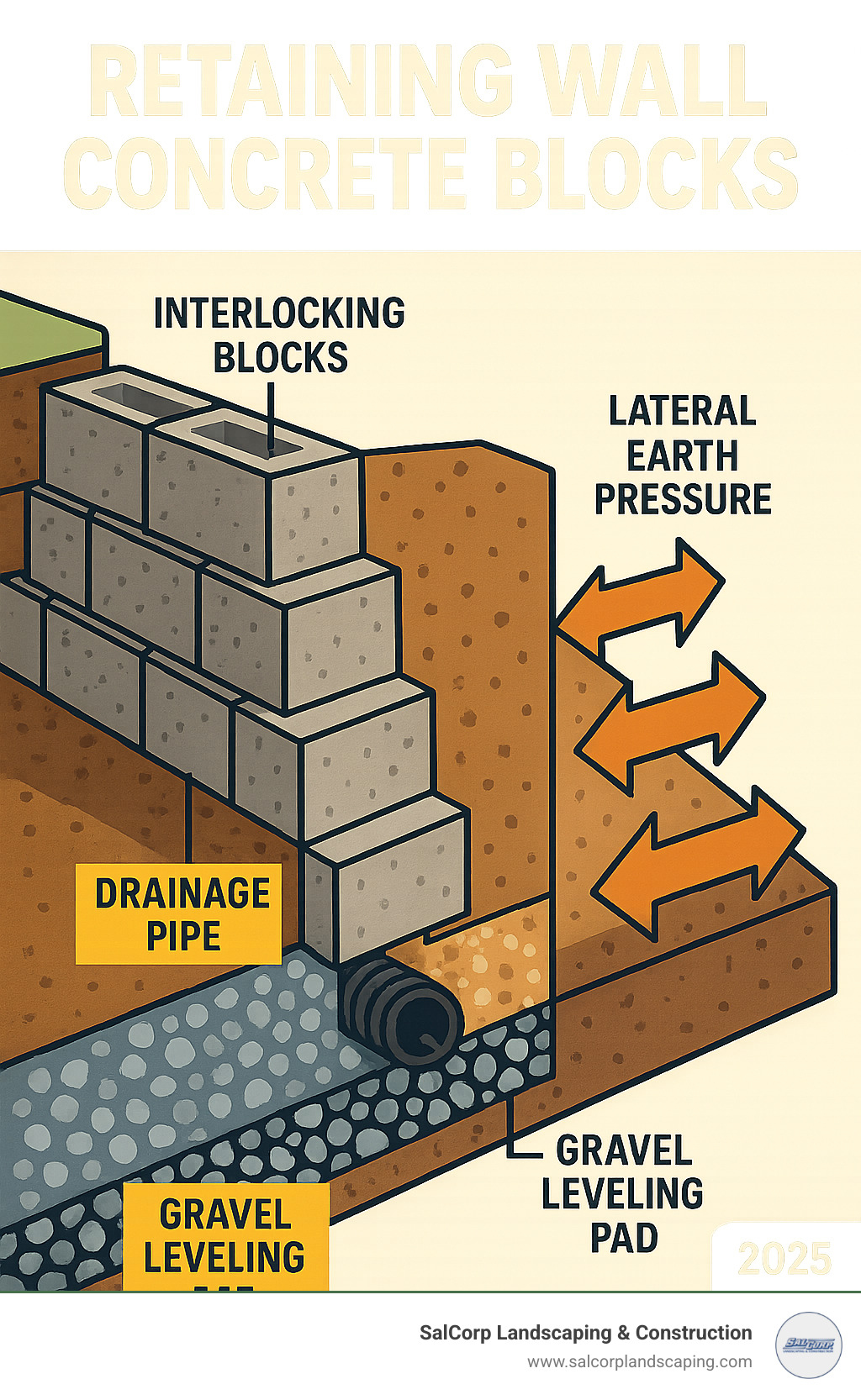
The engineering behind these walls is sophisticated. They must resist lateral earth pressure—the force of soil moving downhill. Modern blocks achieve this through interlocking designs, drainage, and backfill, creating a stable, long-lasting structure.
As Sal Musto, owner of SalCorp Landscaping & Construction, I’ve installed countless retaining wall concrete blocks throughout Massachusetts over the past two decades, helping clients transform challenging slopes into beautiful, functional outdoor spaces. My experience shows that choosing the right blocks and installation methods makes all the difference in creating walls that stand the test of time.
Retaining wall concrete blocks helpful reading:
Why Choose Concrete Blocks for Your Retaining Wall?
When looking at options for your retaining wall, retaining wall concrete blocks are the smart choice for Massachusetts homeowners. After two decades of building walls in our region, I can tell you these blocks deliver on every front.
Functionality: These blocks are engineered to handle lateral soil pressure. With compressive strengths over 5000 PSI, they withstand harsh New England winters and freeze-thaw cycles that destroy lesser materials.
Durability: Properly installed concrete block walls last for decades with minimal maintenance, unlike other materials that age quickly. I’ve seen my 15-year-old walls still looking as solid as day one.
Versatility: These blocks offer incredible versatility. With styles ranging from natural stone to sleek contemporary, there’s a block to fit any vision, working beautifully in both formal and casual landscapes.
Cost-effectiveness: Concrete blocks offer exceptional value, providing the integrity and longevity of expensive materials without the premium price. They are accessible for most budgets and deliver professional results.
Increased Property Value: By turning unusable slopes into functional outdoor living areas, you add usable square footage to your yard. This is an investment that pays dividends in both enjoyment and resale value.
Environmental Benefits: Many manufacturers now incorporate recycled materials into their blocks, and the long lifespan means fewer resources are consumed over time compared to materials needing frequent replacement.
The Functional and Economic Benefits
The practical advantages of retaining wall concrete blocks go beyond just holding back dirt. These walls are problem-solvers that can transform your outdoor experience.
Erosion control is a primary driver for many projects. Concrete blocks create a permanent barrier against topsoil loss from heavy rains, protecting your landscape and preventing damage to foundations or driveways.
Creating level ground turns a steep, difficult backyard into prime real estate for gardens, play areas, or patios. Terracing works with your property’s natural contours to maximize every square foot.
The structural support these blocks provide extends beyond holding back soil. They can support raised patios, create foundations for outdoor kitchens, or provide the backbone for elaborate landscape features. For comprehensive outdoor changes, explore our hardscaping services.
When it comes to longevity versus other materials, concrete blocks are in a league of their own. Timber walls rot and natural stone can shift, but properly installed concrete block walls maintain their integrity year after year. This reliability translates directly into increased usable space you can count on for decades.
Aesthetic Appeal and Landscape Improvement
Modern retaining wall concrete blocks bring serious structural beauty to landscape design. They excel at delineating outdoor spaces and creating natural transitions between different areas of your yard. A curved wall can guide visitors along a path, while terraced walls can separate a garden from an entertainment area.
Creating focal points is where these blocks show their artistic potential. A well-designed retaining wall becomes a landscape feature in its own right, especially when combined with strategic lighting or plantings. The wall becomes part of the garden’s personality.
The key is complementing existing hardscapes. With dozens of colors, textures, and styles available, you can match your retaining wall to your patio pavers or coordinate with your home’s exterior. Our landscape design services can help you envision how these elements work together.
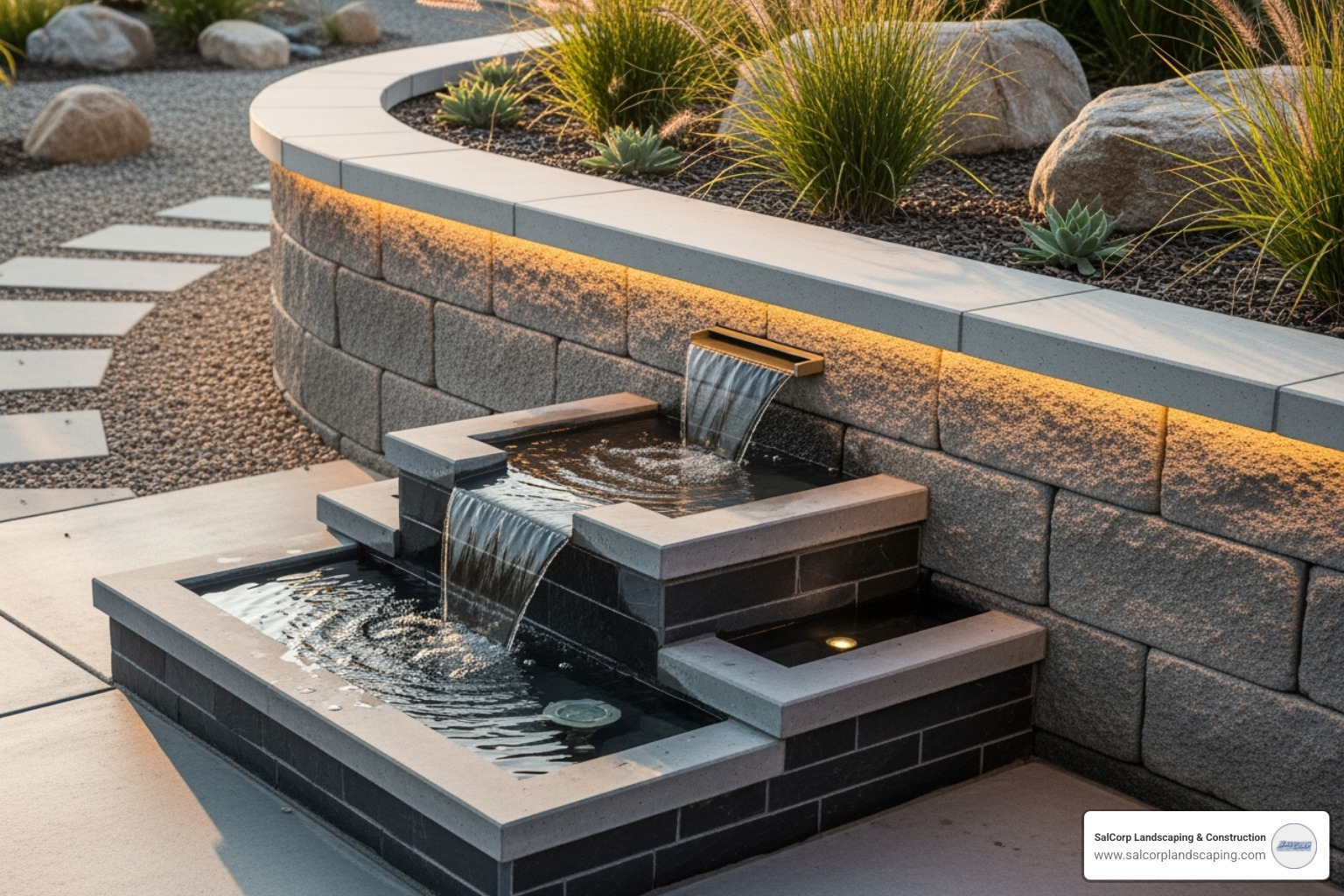
The wall and water feature shown above demonstrates how retaining walls can support and improve other landscape features, creating cohesive outdoor environments that feel both natural and intentionally designed.
Decoding the Types of Concrete Retaining Wall Blocks
Exploring retaining wall concrete blocks can feel overwhelming due to the many options. Understanding the basics makes choosing the right block for your project much clearer.
The foundation of all retaining wall blocks is the basic Concrete Masonry Unit (CMU). These are traditional rectangular blocks (typically 8″ x 8″ x 16″) with hollow cores. For retaining walls, these cores are filled with concrete and reinforced with rebar for taller structures.
The industry has moved far beyond basic CMUs. Today’s retaining wall concrete blocks are sophisticated systems designed for landscape applications. Modular blocks are specially shaped units that stack together easily, often without mortar, bringing both strength and visual appeal.
Interlocking systems are a real game-changer. These blocks feature clever engineering like built-in lips, pins, or knob-and-channel designs that lock each block securely to the one below it. This mechanical connection creates incredibly strong walls while making installation faster.
Hollow-core blocks are lighter, easier to handle, and can be planted to create beautiful “living walls” that blend hardscaping with greenery, giving you a retaining wall and vertical garden in one.
Interlocking vs. Traditional Mortared Blocks
After two decades in this business, the shift toward interlocking blocks has been one of the best developments in retaining wall construction. The difference is night and day.
Interlocking mechanisms are ingenious. Some use integral lips that hook over the block below, while others use pin systems or knob and channel systems that work like puzzle pieces. This mortarless construction dramatically speeds up installation and reduces labor costs. The slight flexibility of dry-stacked walls also helps them handle minor ground movement better than rigid mortared walls.
The installation speed alone makes interlocking blocks a clear winner for many projects. Our crews can build these walls with impressive efficiency, meaning your project gets completed faster and often at a lower cost. The precise fit of interlocking blocks creates a “monolithic structure,” where each block works with its neighbors to resist soil pressure, resulting in increased overall strength. When you need expert installation, our block wall builder services ensure your wall is built to last.
Finishes, Textures, and Styles
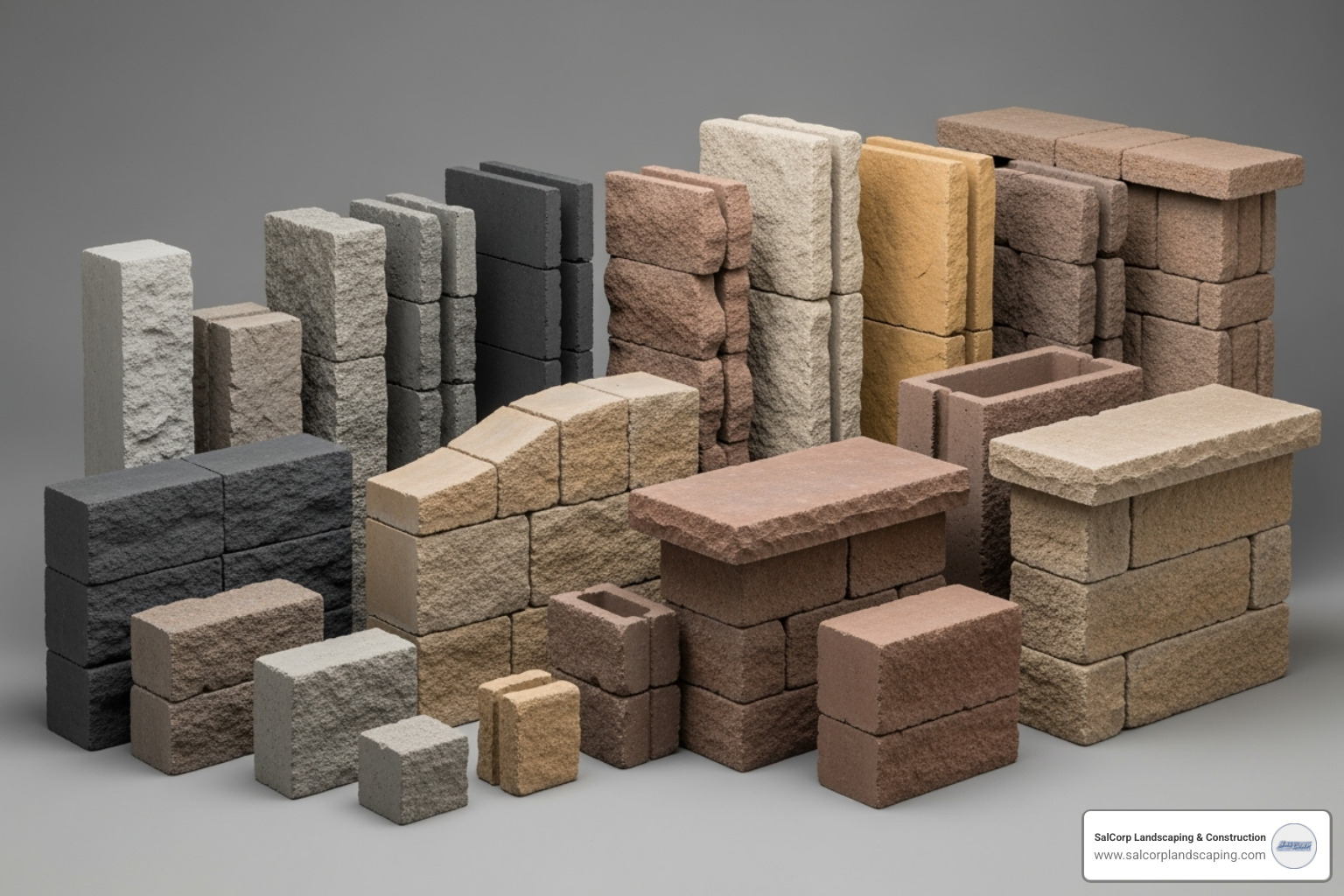
Today’s retaining wall concrete blocks offer an amazing variety of finishes that can make your wall a true design feature.
- Split-face blocks create a rugged, natural stone appearance.
- Smooth finish blocks offer a clean, contemporary look.
- Tumbled stone look blocks have a weathered, aged appearance for instant character.
- Rock face textures mimic quarried stone with deep, irregular patterns.
Many manufacturers have perfected natural stone mimicry to the point where it’s hard to tell the difference. You get the beauty of natural materials with the benefits of engineered concrete.
When it comes to style, you have three main directions:
- Classic styles feature traditional, symmetrical designs.
- Contemporary styles emphasize clean lines and smooth finishes.
- Rustic styles accept rougher textures and earth tones.
We often combine different textures and colors to create unique, personalized designs that perfectly complement your home and landscape vision.
Key Considerations for Your Retaining Wall Concrete Blocks Project
A successful retaining wall concrete blocks project requires careful planning. My two decades of experience in Massachusetts have shown that proper planning and execution are the difference between a wall that lasts and one that fails prematurely.
The foundation of any good project starts with understanding your soil type and drainage conditions. The height of your wall also determines the type of blocks needed and whether professional engineering is required. Don’t forget about local building codes; here in Massachusetts, most municipalities have specific requirements for retaining walls, especially taller ones. Getting the proper permits upfront saves headaches later.
For comprehensive technical guidance on segmental retaining walls, I recommend checking out The Concrete Network’s detailed guide.
The Critical Role of Engineering and Drainage
Underestimating engineering and drainage is a common mistake. Water is the enemy of any retaining wall, and hydrostatic pressure from trapped water can destroy even the strongest structure. That’s why we always install comprehensive drainage systems, including perforated pipes and free-draining gravel backfill. Weep holes in the wall face provide additional water escape routes.
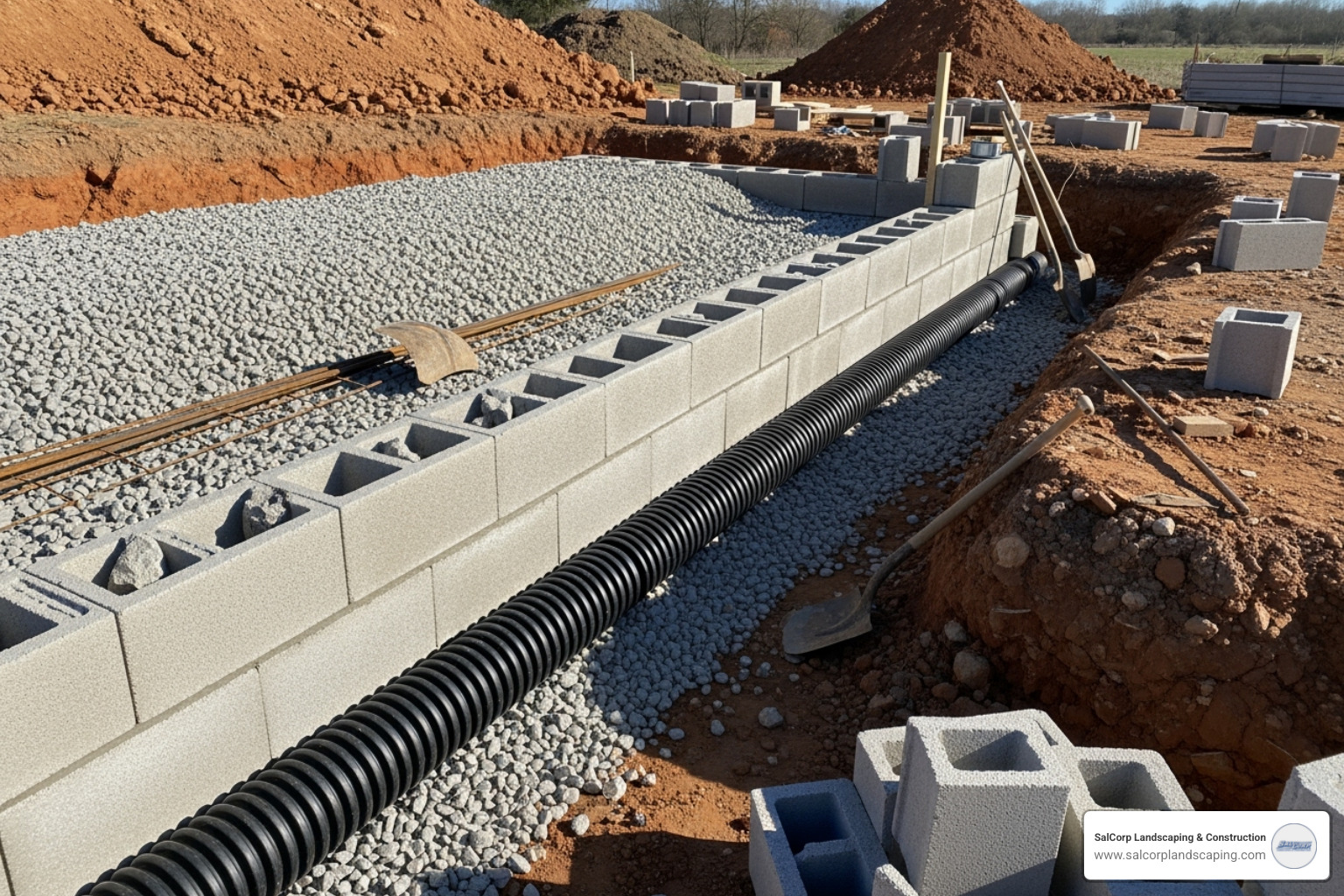
For taller walls, geogrid reinforcement is essential. These polymer sheets buried in the backfill turn the wall into part of a larger, stable soil mass. The leveling pad, a compacted gravel base, is another non-negotiable element, ensuring the first course is level and providing proper drainage.
A hard rule we never break: professional design for walls over 4 feet is mandatory. This is often required by building codes and is absolutely necessary for safety. For complex projects, visit our retaining wall design services.
Choosing the Right Retaining Wall Concrete Blocks
Selecting the right blocks involves balancing several factors. Size and weight affect handling and equipment needs. Color selection and style matching are crucial for creating harmony with your home and existing hardscaping. From a technical standpoint, look for a compressive strength of at least 5000 PSI and good freeze-thaw resistance for our Massachusetts climate.
If you’re wondering where to source quality materials in our area, check out our guide to retaining wall blocks near you.
Cost of Retaining Wall Concrete Blocks
Understanding project costs helps you make informed decisions about your retaining wall concrete blocks investment. Prices vary significantly based on block type and project complexity, though they are generally cost-effective.
Important note: The pricing information below represents average estimates based on public data research and does not reflect actual SalCorp Landscaping & Construction project costs. Actual costs depend on your specific site conditions, design, and local Massachusetts factors.
| Block Type | Typical Cost Range (per unit) | Pros | Cons |
|---|---|---|---|
| Standard CMU | $5 – $15 | Very affordable, widely available | Requires mortar, limited aesthetic appeal, may need reinforcement |
| Interlocking | $8 – $25 | Mortarless installation, wide style variety | Higher per-unit cost, requires specific cap blocks |
| Large-Format | $80 – $250+ | High strength, efficient for large walls | Needs heavy equipment, limited residential appeal, very heavy |
Beyond the blocks, your total budget includes site preparation, drainage materials, geogrid reinforcement for taller walls, cap blocks, and labor, which is often the largest expense. While the material cost is attractive, professional installation is crucial for a wall that lasts decades and avoids expensive future repairs.
More Than Just a Wall: Versatile Applications
Retaining wall concrete blocks are the Swiss Army knife of landscaping materials. Beyond holding back soil, they are incredibly useful for creating outdoor features that make your yard more functional and beautiful.

Raised garden beds are a great example. We use these blocks to create liftd planting areas that are easier on your back, protect plants, and give your garden a clean, organized look.
Outdoor kitchens are another fantastic application. The durability that makes these blocks perfect for retaining walls also makes them ideal for supporting heavy grills, countertops, and storage areas.
We’ve built amazing fire pits using retaining wall concrete blocks. Their heat-resistant properties make them naturally suited for this, and you can create custom shapes and sizes. We can also incorporate built-in seating using matching blocks.
Columns and patios are other creative uses. Decorative columns can frame an entrance or support a pergola, while raised patios created with these blocks provide level entertaining space on sloped lots.
The modular nature of retaining wall concrete blocks allows them to adapt to any vision, whether we’re building curved garden features, integrating them into water features, or creating custom outdoor spaces.
This versatility makes them a smart investment. You’re not just getting a retaining wall; you’re getting the building blocks to transform your entire outdoor living space. To see how we can put these versatile blocks to work in your yard, check out our comprehensive hardscaping services.
Frequently Asked Questions about Concrete Block Walls
Over our 20+ years in business, we’ve answered countless questions about retaining wall concrete blocks. These are the most common questions from homeowners:
How high can you build a retaining wall with concrete blocks?
The height limit for a retaining wall concrete blocks wall depends on the block system, soil conditions, and reinforcement. Unreinforced walls using standard interlocking blocks are typically kept under 3 to 4 feet. Taller walls require professional engineering, which is mandated by Massachusetts building codes for safety.
With proper engineering and geogrid reinforcement, which anchors the wall to the soil behind it, these walls can safely exceed 50 feet. The geogrid creates a large, stable soil mass. Local Massachusetts building codes may have specific height restrictions or permit requirements, all of which we ensure our projects meet.
Do concrete block retaining walls need a foundation?
Yes, retaining wall concrete blocks need a proper foundation, but not a deep concrete footing like a house. Instead, they require a compacted gravel leveling pad. This pad provides a stable, level base for the first course of blocks and is critical for drainage, allowing water to move away from the wall’s base.
Skipping the leveling pad is a mistake that will cause problems down the road. We never cut corners on this crucial step, as the wall’s long-term success.
Can you paint or stain concrete retaining wall blocks?
Absolutely. Retaining wall concrete blocks can be painted or stained to customize their look or refresh an older wall.
Painting requires a high-quality masonry paint designed for outdoor concrete surfaces. Proper surface preparation is key, but paint sits on the surface and can chip or peel over time, especially in our Massachusetts climate.
Staining is often our preferred recommendation because it penetrates the concrete rather than just coating it. This creates a more natural, durable finish that won’t chip or peel like paint. Concrete stains come in a wide range of colors and improve the block’s existing texture.
Both options allow you to match your wall to your home’s exterior or other hardscaping elements.
Conclusion
Retaining wall concrete blocks are more than just utilitarian structures; they are game-changers that can transform how you use and enjoy your outdoor space.
The durability of properly installed concrete block walls is remarkable, especially in harsh New England winters. Their versatility opens up possibilities for raised gardens, outdoor kitchens, fire pits, and more. The aesthetic potential is also exciting, with today’s blocks able to mimic natural stone, offer clean contemporary lines, or provide rustic charm to match any landscape vision.
Proper installation makes all the difference. A beautiful wall that fails is just an expensive problem. For homeowners and property managers in Massachusetts, working with experienced professionals for Retaining Wall Installation ensures your investment stands strong for decades.
At SalCorp Landscaping & Construction, our 20+ years of experience with retaining wall concrete blocks means we understand Massachusetts soil, codes, and how to build walls that last. As an owner-operated business, we take pride in every project.
Ready to turn that challenging slope into your favorite outdoor space? Contact a professional retaining wall contractor and let’s make it happen together.