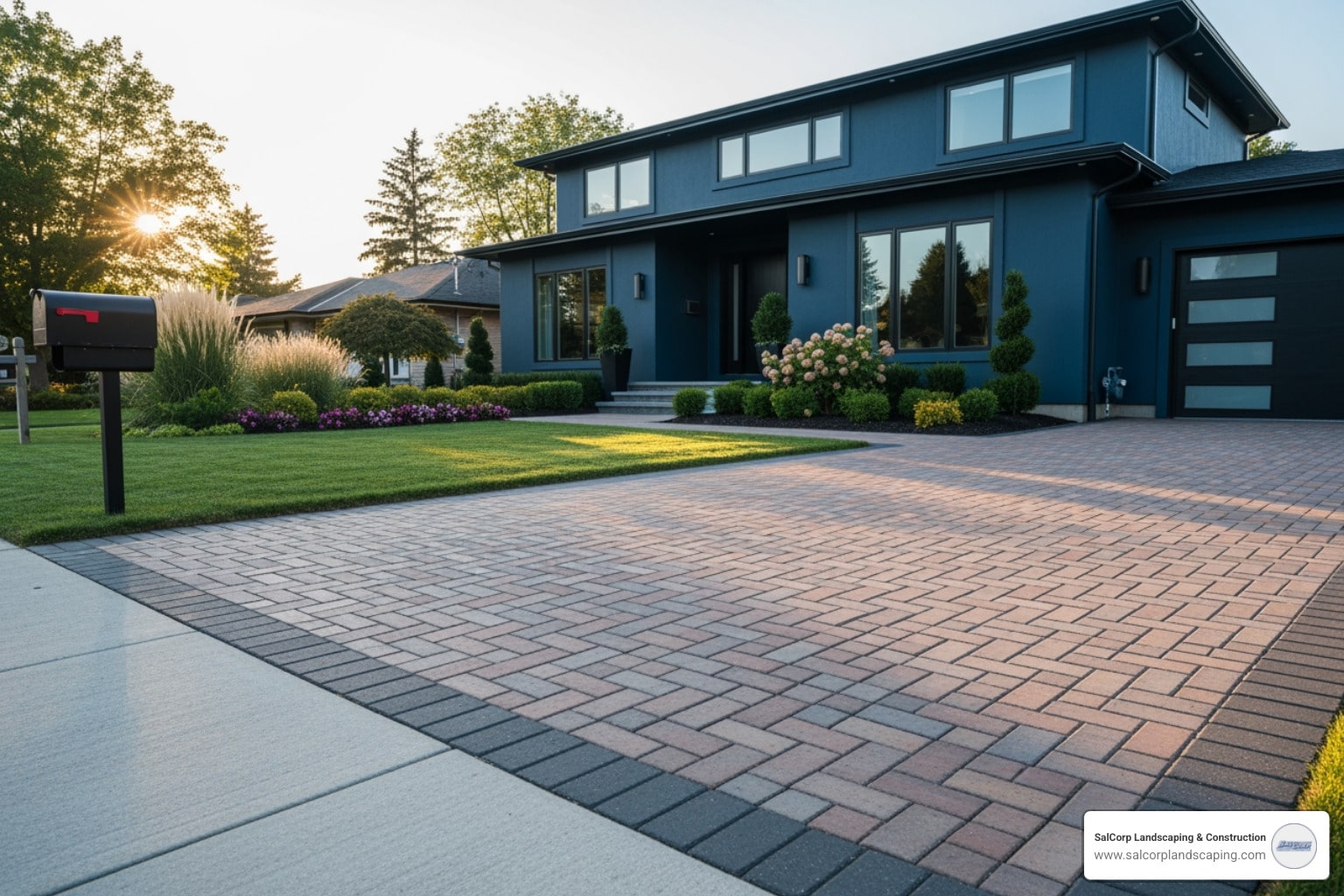
Why Accurate Block Paving Calculations Matter for Your Massachusetts Property
Block paving per square metre is the key calculation for estimating materials for your driveway, patio, or walkway. Getting it right prevents costly over-ordering or frustrating mid-project shortages.
Quick Answer: Standard Block Paving Quantities Per Square Metre
| Paver Size | Blocks Per m² |
|---|---|
| 200mm x 100mm (Standard UK) | 50 blocks |
| Interlocking pavers | 48 blocks |
| Cottage pavers (200mm x 150mm) | 33.3 blocks |
Always add 10% extra for cuts, wastage, and breakage.
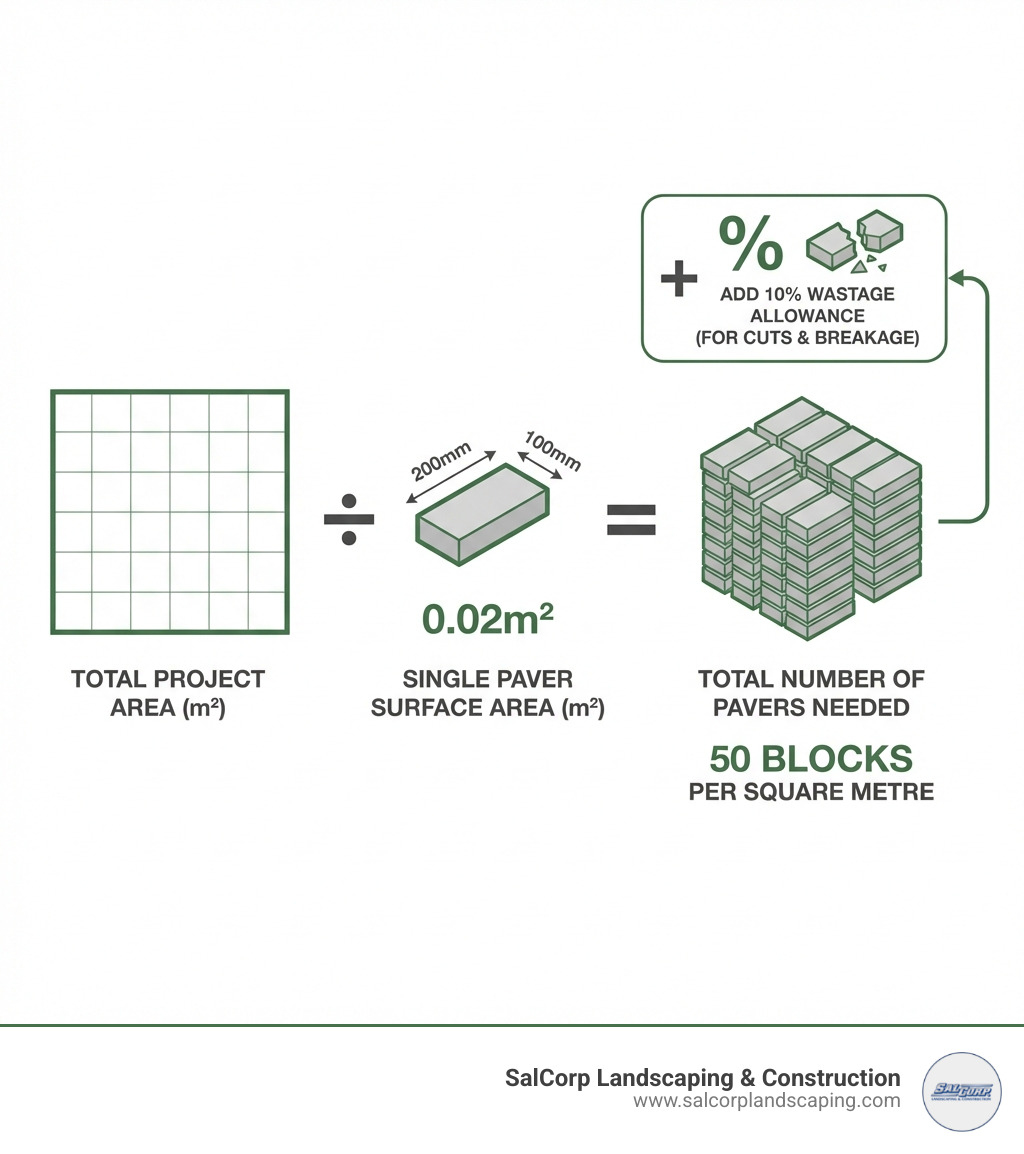
The basic formula is simple: divide your total project area by the surface area of one paver. For example, a standard 200mm x 100mm block covers 0.02m², meaning you need 50 blocks per square metre. However, paver size, laying patterns, and edge cuts will affect your final count.
For Massachusetts property owners, accurate calculations keep hardscaping projects on budget and schedule. Running short on pavers can delay your entire installation.
I’m Sal Musto, owner of SalCorp Landscaping & Construction. With over two decades of experience in Massachusetts, I’ll guide you through the formulas and adjustments needed to order the right amount of material for your project.
The Core Calculation: How Many Pavers Do You Need?
The first step in any block paving project is determining how many pavers you need. This calculation is the backbone of your project, affecting your budget and timeline. Accurate numbers prevent shortages or expensive leftovers.
Here’s the basic formula we use at SalCorp Landscaping & Construction:
Total Number of Pavers Needed = Total Project Area (in square metres) / Surface Area of a Single Paver (in square metres)
First, measure your project’s total area in square metres. Next, find the surface area of your chosen paver. For a 200mm x 100mm paver, convert to metres (0.2m x 0.1m) to get a surface area of 0.02m². For a 20-square-metre project, the calculation is: 20 m² / 0.02 m² per paver = 1000 pavers. However, this is just the starting point; real-world adjustments are necessary.
Accurate planning is vital. For more detailed insights into planning your driveway, check out our guide on Hardscaping/Driveways.
How Paver Size Determines the Number of Blocks Per Square Metre
Paver size is the main factor determining how many blocks you need per square metre. Larger pavers mean fewer blocks are needed, while smaller pavers require more.
Let’s look at some common paver sizes we encounter in projects across Massachusetts:
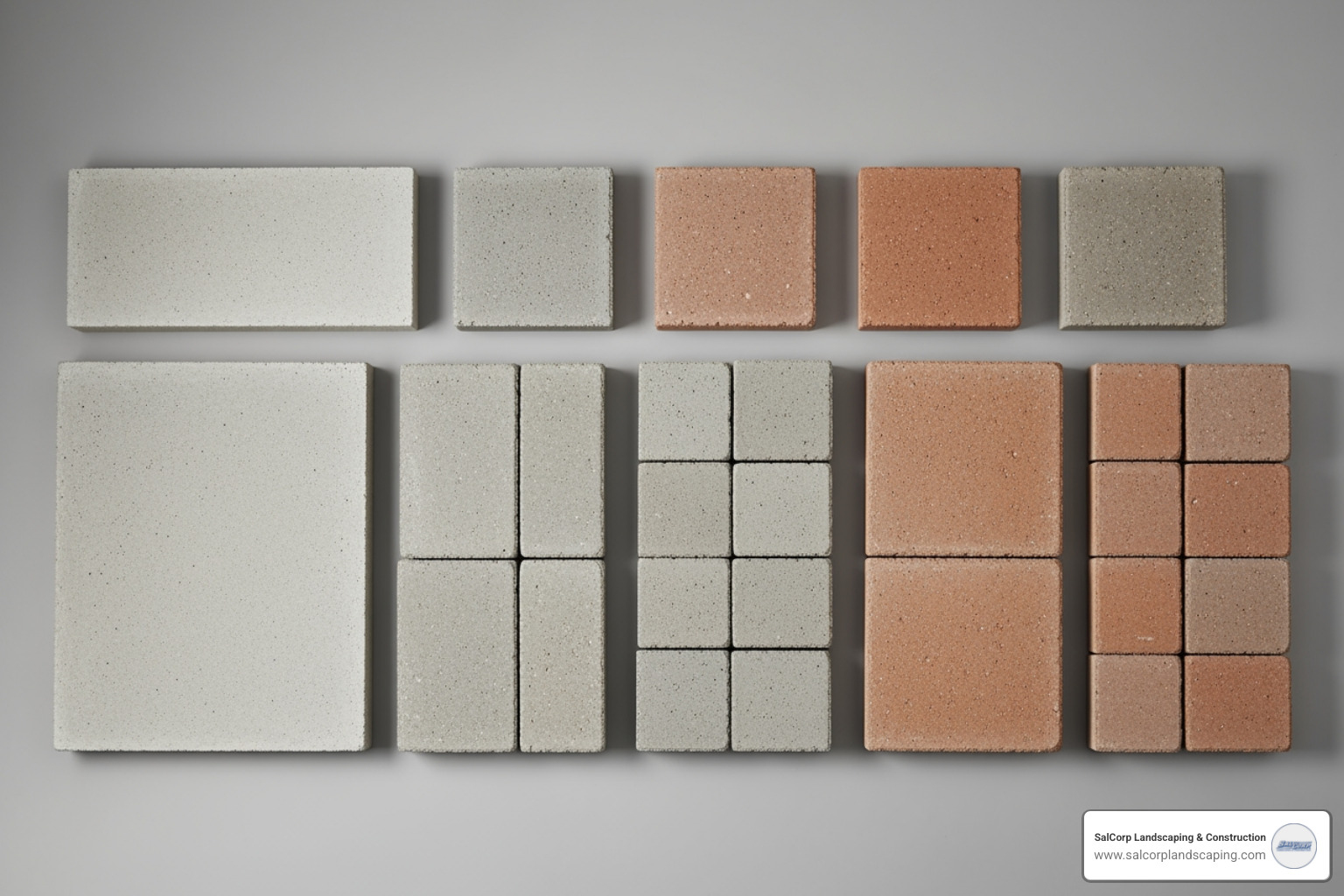
- Standard Rectangular Pavers (200mm x 100mm): A popular and versatile choice. With a surface area of 0.02m², you need 50 blocks per square metre.
- Interlocking Pavers: Designed for stability, especially on driveways. Sizes vary, but a common type requires about 48 blocks per square metre.
- Cottage Paving Bricks (200mm x 150mm): These larger bricks have a surface area of 0.03m², requiring approximately 33.3 bricks per square metre. You’ll need to round up when ordering.
Does paver thickness affect the quantity? No. The number of pavers needed per square metre depends only on length and width. Thickness (e.g., 50mm, 60mm, 80mm) is critical for durability and load-bearing capacity (patio vs. driveway) but doesn’t change your block paving per square metre count.
Choosing the right paver involves aesthetics, durability, and function. Explore our insights on How to Choose the Right Paver for Your Patio or Walkway.
A Step-by-Step Guide to Calculating Pavers for Your Area
Here are the practical steps to calculate the total pavers needed for your project.
- Sketch Your Project Area: Draw a rough sketch of the area to help visualize and break down the space.
- Measure Accurately: For rectangles/squares, measure length and width in metres. For irregular shapes, divide the area into smaller rectangles and measure each one.
- Calculate the Area in Square Metres: For regular shapes, multiply length by width (e.g., 5m x 3m = 15 m²). For irregular shapes, calculate the area of each smaller rectangle and add them together for the total.
- Determine Your Chosen Paver’s Surface Area: Convert the paver’s dimensions from millimetres to metres (divide by 1000). Multiply length by width to get the surface area in m² (e.g., 0.2m x 0.1m = 0.02m²).
- Perform the Core Calculation: Divide your total project area by the single paver’s surface area (e.g., 15 m² / 0.02 m² per paver = 750 pavers).
- Round Up (Always!): Always round up to the nearest whole number. If your calculation is 750.1, you need 751 pavers.
This systematic approach provides a solid baseline for your material order. For more on creating the perfect outdoor living space, see our guide on Building a Patio.
Calculating Block Paving Per Square Metre: Adjusting for Real-World Projects
Your initial calculation is a theoretical number. Real-world projects require adjustments for cuts, waste, and laying patterns to avoid delays and extra costs. At SalCorp Landscaping & Construction, we factor these variables into every Massachusetts project for accurate estimates. While not part of the paver count, other materials are also vital for a successful installation.
Understanding these adjustments is key to effective budgeting. Learn more about our process on our Hardscape Installation page.
The Impact of Laying Patterns and Wastage on Your Final Count
The laying pattern you choose affects the number of pavers you need due to cuts and waste. This is why the basic block paving per square metre calculation is only a starting point.
- Laying Patterns:
- Running Bond / Stretcher Bond: A common, efficient pattern with parallel rows. It generates less waste as cuts are predictable and often reusable.
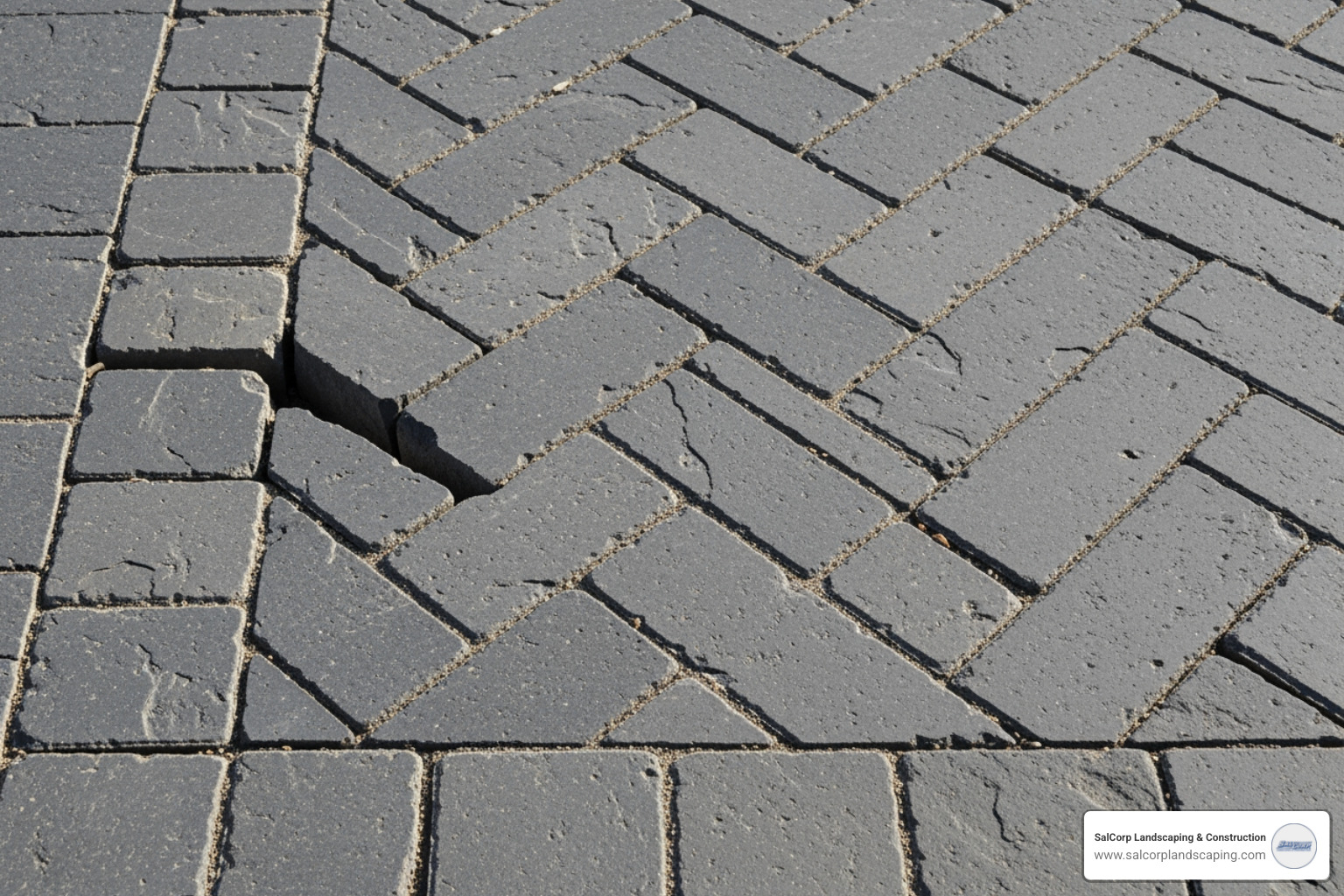
- Herringbone Pattern: A strong, classic pattern popular for driveways. Pavers are laid at 45 or 90-degree angles, creating a “V” shape. This pattern, especially at 45 degrees, requires more cuts along the edges, resulting in more waste.
- Basketweave, Stacked Bond, Diagonal: These and other angled patterns also generate more cuts and waste, especially along borders.
- Wastage Allowance:
- The 10% Rule: We always recommend adding at least a 10% allowance for cuts and wastage. For complex patterns or irregular shapes, a higher percentage may be safer. Always add this to your calculation, even if using an online tool.
- Why 10%? This allowance covers cuts along edges and around obstacles, plus any accidental breakage. Having a few extra pavers for future repairs is better than halting the project to order more.
By factoring in your chosen laying pattern and adding this crucial wastage allowance, your calculation becomes far more realistic. For inspiration, explore our Patio Designs With Pavers guide.
Estimating the Total Cost of block paving per square metre
Beyond quantity, understanding costs is vital for budgeting your Massachusetts hardscaping project. The figures below are general market averages based on internet data, not a quote from SalCorp Landscaping & Construction. We provide custom quotes based on your specific project.
| Paver Type | Average Material Cost (USD per m²) |
|---|---|
| Concrete Blocks (50-60mm thick) | $100 – $300 |
| Permeable Concrete Blocks or Clay Pavers | $130 – $550 |
| Natural Stone Setts | $180 – $800 |
Other factors contribute to the overall cost:
- Edging Costs: Edge restraints prevent pavers from shifting and are crucial for durability. This can add $10 to $40 per square metre to the cost, depending on the material.
- Drainage Costs: Proper drainage is essential in Massachusetts. Solutions like linear drains can add $8 to $30 per square metre. Permeable pavers can sometimes reduce the need for extensive drainage systems.
- Installation Costs: Labor for site prep, sub-base, and paver installation is a significant cost. It varies with project complexity, site conditions, and installer experience.
- Regional Variations: Costs can fluctuate based on your location within Massachusetts, with urban areas sometimes having higher prices.
For ideas on how to achieve stunning outdoor spaces within various budgets, check out our guide on Budget-Friendly Patio Designs for a Stunning Outdoor Space. You can also explore external resources like this Paving Calculator | Howarth Timber for general estimation tools.
Don’t Forget These Additional Materials
A successful block paving installation relies on a carefully constructed foundation. When we calculate your block paving per square metre, we consider the entire system.
- Sub-Base Material (e.g., MOT Type 1 Gravel): The foundation of your paved area. This compacted layer of crushed stone provides stability and prevents settlement. We recommend a depth of at least 150mm for driveways and 100mm for patios.
- Geotextile Fabric: Placed between the soil and sub-base, this fabric prevents mixing, maintains foundation integrity, and improves drainage.
- Bedding Sand (Sharp Sand): A 40-50mm layer of sharp sand is laid over the sub-base. Its angular grains interlock to create a stable, level bed for the pavers.
- Jointing Sand (Kiln-Dried Sand): After laying the pavers, fine, dry sand is swept into the joints to lock the blocks together and prevent movement.
- Edge Restraints: These are vital for holding the paved area together and preventing blocks from spreading. Options include concrete, plastic or metal edging, or border pavers.
- Sealer (Optional but Recommended): A quality sealer protects against stains, inhibits weeds, and can improve the color and longevity of your pavers.
Calculating these additional materials is just as important as calculating your pavers. To learn more about foundational elements, dive into our guide on What is Hardscape Construction.
From Calculation to Construction: Finalizing Your Project
You’ve calculated your block paving per square metre, factored in wastage, and considered additional materials. Now it’s time to bring your vision to life by deciding on execution and knowing when to seek professional help.
Online Calculators and Professional Guidance
Online calculators are a good starting point for estimating paver quantities and often include a 10% wastage factor. However, they are general tools and may not account for complex patterns, specific ground conditions, or drainage nuances on your Massachusetts property.
This is where professional guidance is invaluable. At SalCorp Landscaping & Construction, our experience allows us to provide precise material estimates based on a thorough site evaluation. We also help you select the best pavers to withstand harsh New England winters, considering factors like salt resistance.
DIY vs. Professional Installation
Deciding between DIY and professional installation depends on project complexity, your skill, and time.
- DIY: A small, simple path may be a manageable DIY project. However, it requires significant physical labor, specialized tools (like a plate compactor), and precision to ensure a level, stable surface.
- Professional Installation: For large areas like driveways, complex designs, or when durability is paramount, hiring a professional like SalCorp Landscaping & Construction is the best choice. We offer:
- Expertise: Deep knowledge of materials, patterns, and local Massachusetts ground conditions.
- Efficiency: The right machinery and skilled crews to complete the job quickly.
- Durability: Professional installation from the sub-base up ensures a long-lasting result.
- Guaranteed Results: As an owner-operated business, we stand by our work, protecting your investment.
We are passionate about helping homeowners and businesses in Walpole and surrounding Massachusetts communities create beautiful, functional outdoor spaces. Learn more about The Importance of Hiring a Professional Hardscaping and Landscaping Company.
Accurately calculating your block paving per square metre is the first step to a successful project. With this guide, you can make informed decisions. When you’re ready to move from calculation to construction, we’re here to help. Explore our services on our Hardscaping/Driveways page.