

Walkway Installation in Massachusetts
Paver, bluestone, brick, and natural stone walkways built on proper bases for New England freeze-thaw conditions. From front entries to garden paths, designed to last decades — not seasons.
Get Your Free Estimate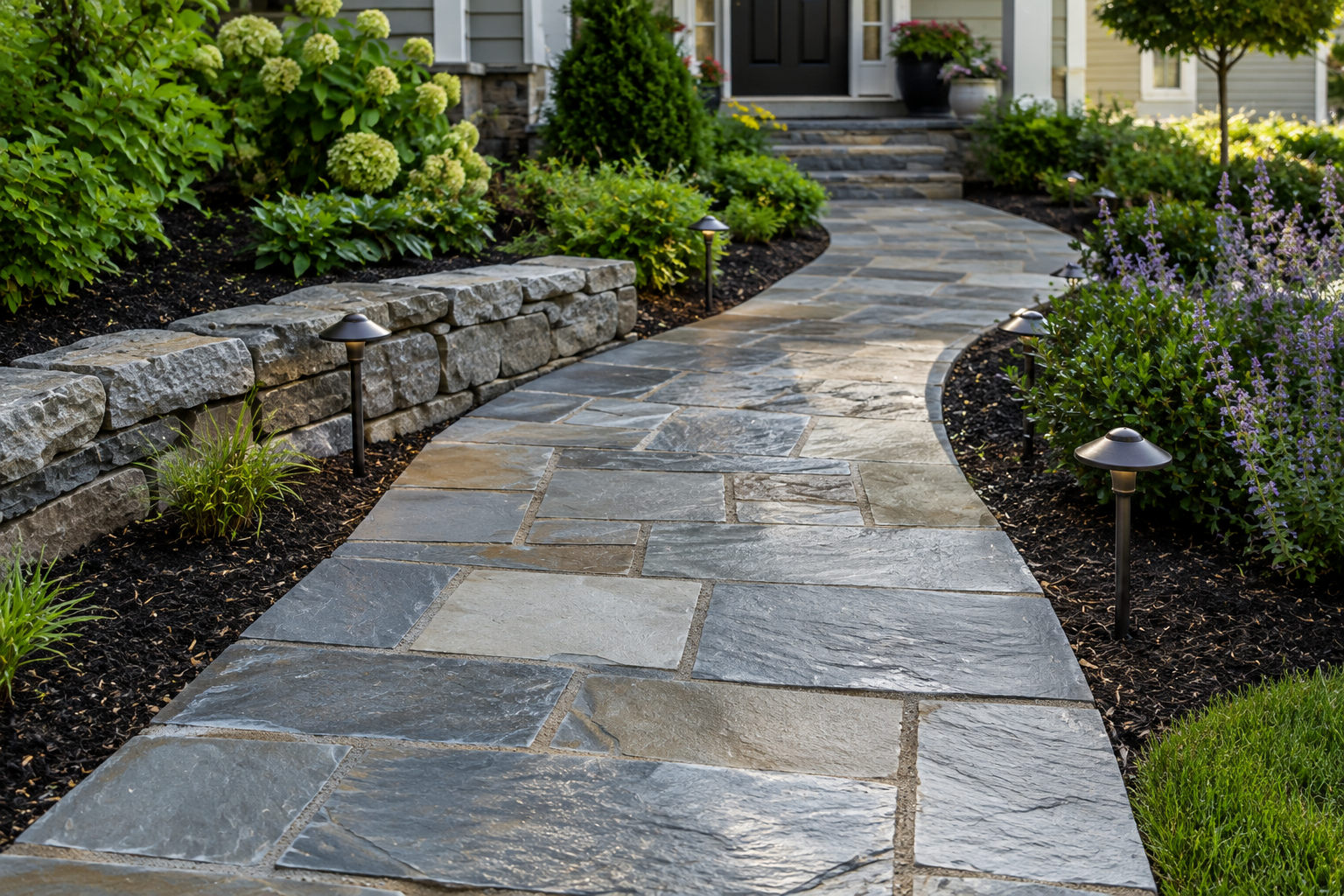
What's Underneath Is What Lasts
A walkway in Massachusetts faces the same freeze-thaw challenge as any hardscape: water gets into the base, freezes, expands, and heaves the surface. The difference between a walkway that looks the same in fifteen years and one that's buckled after two winters comes down to base depth, compaction quality, and whether geotextile fabric was installed.
We build every walkway on 4-6 inches of compacted crushed gravel over geotextile fabric, with proper cross-slope for drainage and edge restraints to hold the perimeter in place. The surface material is the part you see — the base is the part that works.
Walkway Material Options
The right material depends on your home's architecture, how the walkway will be used, and the look you're after. Each option handles Massachusetts conditions well when installed on a proper base.
Concrete Pavers
Manufactured to exact tolerances in a wide range of colors, sizes, and patterns. Most popular for residential walkways — excellent freeze-thaw performance, consistent installation, and individual units can be replaced if damaged.
Most popularBluestone
The premium New England walkway material. Natural cleft or thermal-finished surface provides excellent traction. Ages beautifully with a silver-blue patina. Fits traditional, colonial, and contemporary homes equally well.
Premium choiceBrick
Clay-fired with natural color variation and classic character. Particularly well-suited to colonial, federal, and traditional Massachusetts homes. Color is integral to the material — it won't fade. Boston's brick sidewalks prove the durability.
Classic New EnglandNatural Flagstone
Irregular, organic shapes for a naturalistic look that blends with informal landscapes and garden settings. Each piece is unique. Requires skilled hand-fitting but delivers character that manufactured products can't replicate.
Organic characterGranite
The hardest natural stone option — virtually indestructible in freeze-thaw conditions. Available as sawn pavers, cobbles, or steps. Premium pricing reflects extreme durability and a look that says permanence.
Maximum durabilityStepping Stones
Individual stones set in gravel, mulch, or ground cover for informal garden paths. Lower cost, lighter installation, and a relaxed feel. Best for secondary paths where a formal walkway isn't needed.
Informal paths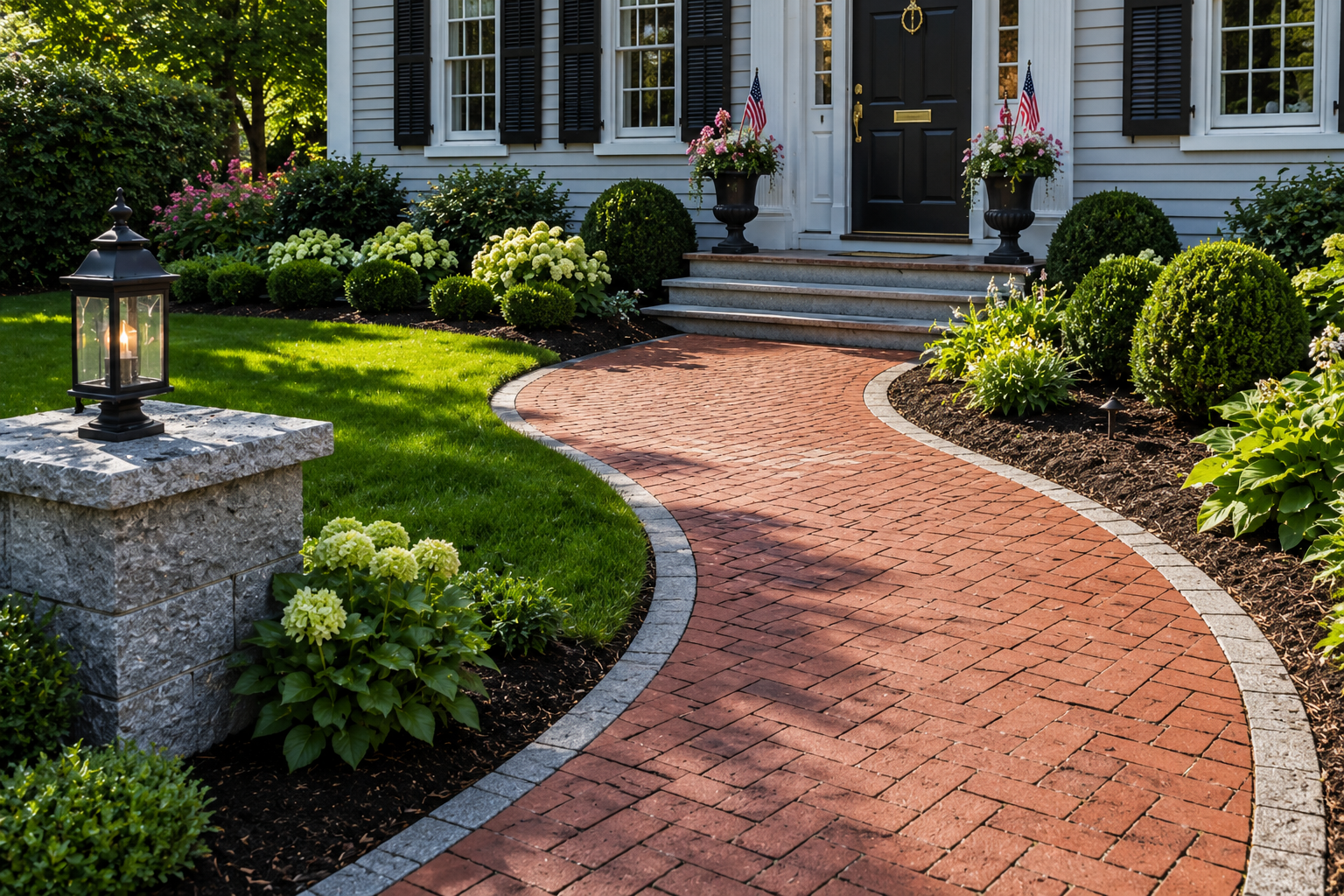
Brick Walkways That Age Like Boston
Brick has been the walkway material of choice in New England for centuries — and for good reason. The color is fired into the clay, so it doesn't fade. The slight irregularity of hand-made brick gives each walkway a character that manufactured pavers approximate but never quite match.
We install brick walkways using the same base preparation as any paver project: excavation, compacted gravel, geotextile, screeded sand, edge restraints, and polymeric sand in the joints. The classic material gets a modern installation method — the combination of the two is what makes it last.

How We Build a Walkway
Every walkway follows the same structural sequence: layout and grading, excavation to proper depth, geotextile fabric, 4-6 inches of compacted gravel in 2-inch lifts, 1 inch of screeded concrete sand, the walkway material itself, edge restraints secured with steel spikes, and polymeric sand swept into the joints.
For walkways with steps or grade changes, footings are poured below frost line and risers are built to consistent heights for safety. Cross-slope ensures water sheds off the surface rather than pooling — critical for both the walkway's longevity and winter ice prevention.
Planning Your Walkway
A few decisions to make before construction starts:
- Width — 3 feet minimum for a single-file path. 4-5 feet for a front entry walkway where two people walk side by side. Wider feels more welcoming and proportional to most homes.
- Route — straight lines feel formal and direct. Gentle curves feel natural and inviting. The right choice depends on your home's architecture and the landscape around the walkway.
- Steps and landings — if your property has grade changes, steps or a gradual slope may be needed. Landings every 4-5 steps make longer stairways safer and more comfortable.
- Lighting — low-voltage path lighting along the walkway adds safety, ambiance, and curb appeal. Far easier and less expensive to install during construction than after.
- Drainage — the walkway needs to shed water, not collect it. Cross-slope and proper grading at the edges prevent puddles that freeze into ice in winter.
Front entry walkways set the tone for the entire property.
The walkway from the driveway or sidewalk to your front door is the first thing every visitor, delivery person, and potential buyer experiences. A well-designed entry walkway with proper proportions, good materials, and integrated lighting communicates quality before anyone reaches the door. It's one of the highest-return hardscape investments on a residential property.
Massachusetts Communities We Serve
SalCorp installs walkways throughout Norfolk County, Plymouth County, and Greater Boston — including Walpole, Westwood, Norwood, Needham, Wellesley, Dover, Sherborn, Medfield, Sharon, Foxborough, Hingham, Norwell, Cohasset, Scituate, Weymouth, Braintree, Milton, Canton, Avon, Hopkinton, and surrounding communities.
Ready to plan your walkway? Contact SalCorp for a free on-site consultation. We'll evaluate your property, discuss material options, and provide a detailed estimate.
Twenty Years of Hardscape in Massachusetts
20+
Years serving
Massachusetts
In-house
Owner-supervised,
no subcontractors
Licensed
Fully insured &
guaranteed
Walpole
Norfolk County
since 2004
Walkway Installation FAQs
How much does walkway installation cost?
Walkway installation in Massachusetts typically ranges from $9 to $30 per square foot depending on material. Concrete pavers $9-$20, brick $10-$25, flagstone $15-$30, gravel or stepping stones $5-$12. A standard 4-foot by 30-foot walkway runs $1,100 to $3,600. We provide detailed estimates after an on-site visit.
What is the best walkway material for Massachusetts?
Concrete pavers are most popular for freeze-thaw performance and design flexibility. Bluestone is the premium choice for traditional homes. Brick delivers classic New England character. The right material depends on your home's style and budget — we help you choose during the consultation.
How long does installation take?
Most residential walkways take 2-4 working days. A straightforward 30-40 foot paver walkway on flat ground can be completed in 2 days. Longer walkways, steps, grade changes, and natural stone add time.
Do I need a base under a walkway?
Yes — a compacted gravel base is essential in Massachusetts. Without it, freeze-thaw will heave and shift the walkway within one or two winters. A proper base includes 4-6 inches of compacted gravel, geotextile fabric, and 1 inch of screeded concrete sand.
Can you install a walkway on a slope?
Yes — using gradual grade changes for mild slopes or integrated steps and landings for steeper terrain. Sloped walkways require careful drainage so water flows alongside rather than down the middle. Steps need their own footings and consistent riser heights for safety.
What's the difference between paver and brick walkways?
Pavers are manufactured with consistent sizing and come in more color and pattern options. Brick is clay-fired with natural color variation and traditional character suited to colonial homes. Both perform well in Massachusetts when installed on a proper base. Cost is comparable.
Do I need a permit?
Most residential walkways don't require a permit. Exceptions include significant grading, retaining walls, work in wetland buffers, or modifications to public sidewalks. We check local requirements for your town as part of planning.
How do you prevent heaving in winter?
A proper gravel base that drains water below the frost action zone, geotextile fabric to prevent soil migration, edge restraints to hold position, and cross-slope so water sheds off the surface instead of pooling and freezing.
Ready to Plan Your Walkway?
Schedule a free consultation with SalCorp. We'll evaluate your property, discuss material options, and provide a detailed estimate for your walkway project.
Get Your Free Estimate