

Fire Pit & Outdoor Fireplace Installation in Massachusetts
Custom fire pits and masonry outdoor fireplaces built for New England backyards: wood or gas, seating walls, frost-depth footings, and clearances that meet your town's rules. One owner-supervised crew from layout to the first fire.
Plan Your Fire FeatureFire Features Built for Massachusetts Backyards
A fire feature is the reason a patio gets used after dark and after the warm months end. We build fire pits and outdoor fireplaces as part of the hardscape, not as an afterthought dropped on top of it.
Built-In Fire Pits
Round or square masonry fire pits in natural stone, wall block, or brick, with a steel ring or fire-rated liner and a compacted base that drains.
Gas Fire Pits & Fire Tables
Natural gas or propane burners with electronic ignition, concealed supply, and a bluestone or granite cap, for smoke-free evenings at the turn of a knob.
Masonry Outdoor Fireplaces
Full-height stone or brick fireplaces with a firebrick firebox, hearth, chimney, and optional wood storage, built on their own frost-depth footing.
Seating Walls
Curved or straight seat walls in matching stone or block, sized so chairs and people sit at a comfortable distance from the flame.
Patio Integration
New paver patios designed around the fire feature, or fire features added to the patio you already have, with base and drainage handled together.
Wood Storage & Accessories
Built-in wood boxes, cooking grates, spark screens, and lighting on the surrounding walls so the space works, not just looks finished.
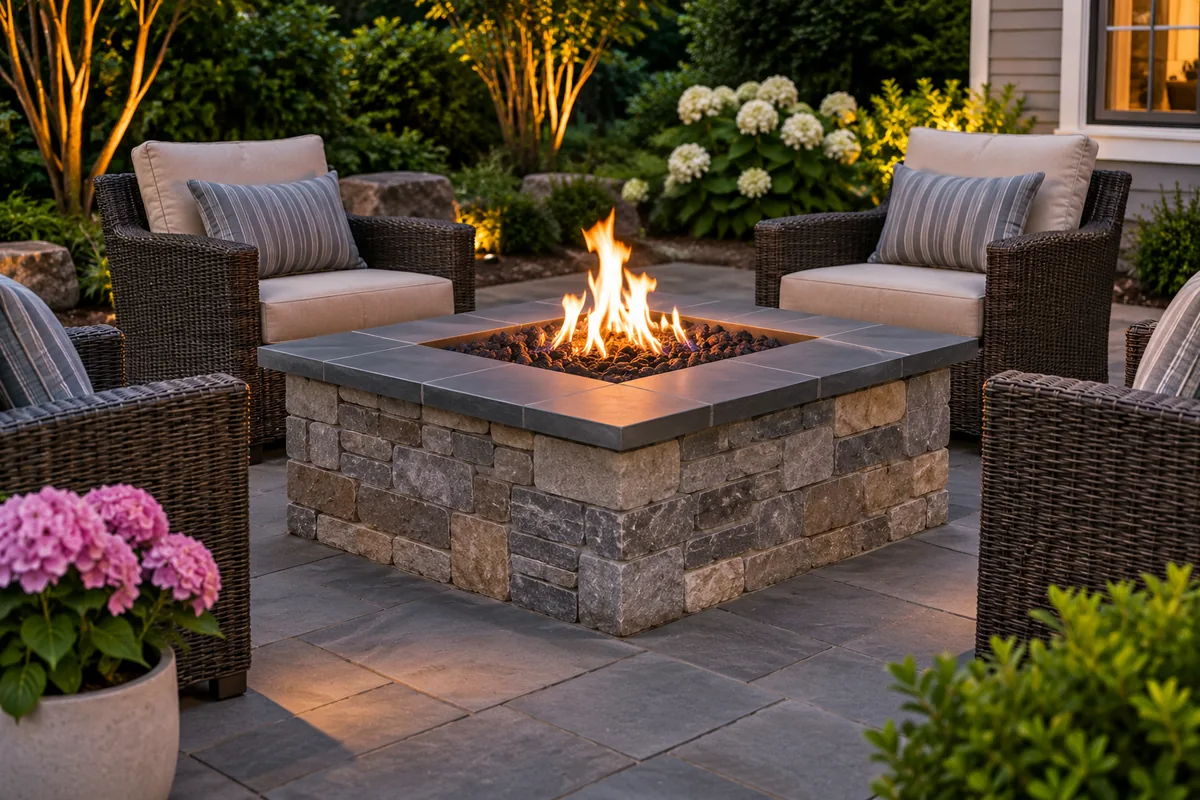
Wood-Burning vs. Gas Fire Pits
A wood-burning fire pit is the classic campfire: more radiant heat, the crackle and smell of real wood, and the option to cook over it. It also means hauling and storing firewood, cleaning out ash, managing smoke, and respecting larger clearances. Wood pits are built with a steel ring or fire-rated liner inside the masonry so the heat does not break down the stone.
A gas fire pit lights instantly, burns clean with no smoke or embers, and the flame height is adjustable. It is the better fit for frequent weeknight use, smaller yards, and spaces close to seating. Natural gas runs on a trenched line from the house; propane runs on a concealed tank. In Massachusetts the gas connection is made by a licensed gas fitter, and we coordinate that work as part of the project.
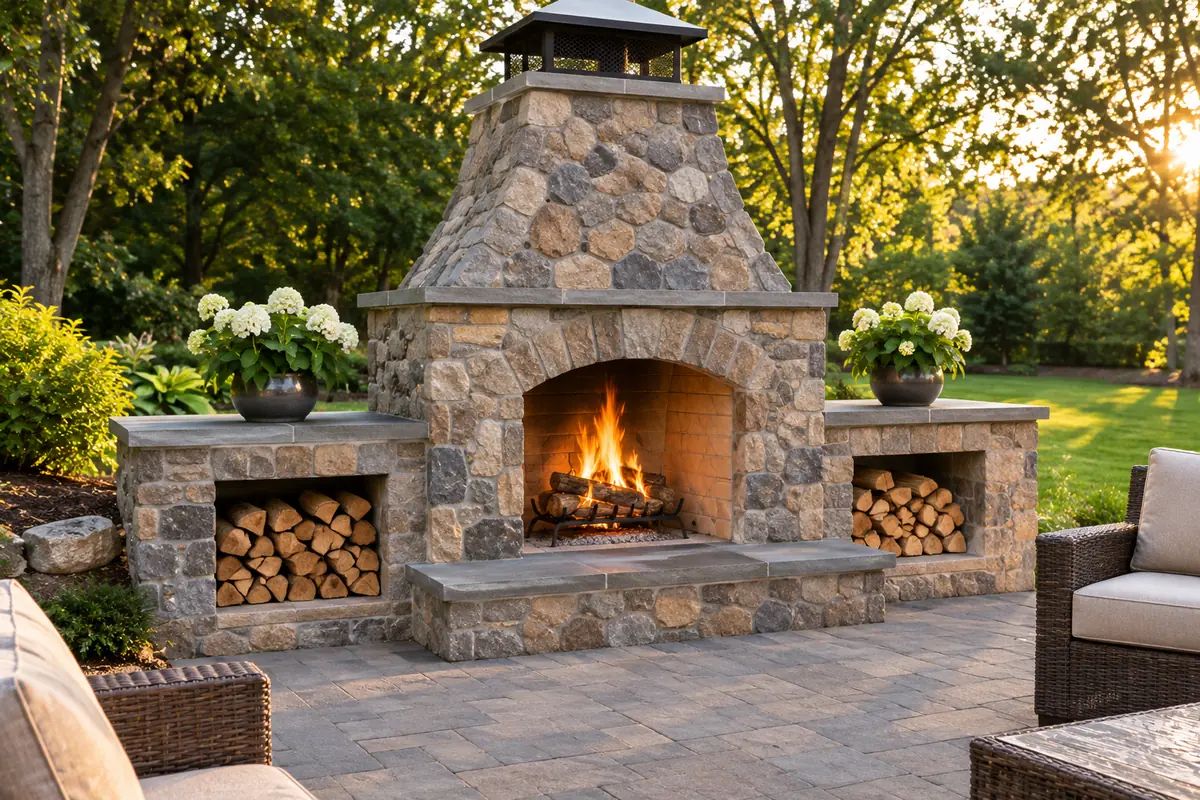
Masonry Outdoor Fireplaces: When a Fire Pit Isn't Enough
A fire pit radiates heat in every direction and gathers people in a circle. An outdoor fireplace is a structure: a back wall, side walls, a firebox, and a chimney that pushes heat forward toward the seating and carries smoke up and away. It anchors a patio the way a fireplace anchors a living room, and it holds and re-radiates heat after the fire burns down.
Because it weighs thousands of pounds, a masonry fireplace is built like one. It gets a reinforced concrete footing below the frost line, isolated from the patio so seasonal movement does not crack the structure, a firebrick-lined firebox, and a properly sized flue and cap. Stone or brick veneer, a bluestone hearth, and wood storage niches finish it.
What's Inside a Fire Feature That Lasts
The difference between a fire pit that looks the same after ten winters and one that is leaning and cracked by the third is everything you cannot see once it is finished.
Excavated, Compacted Base
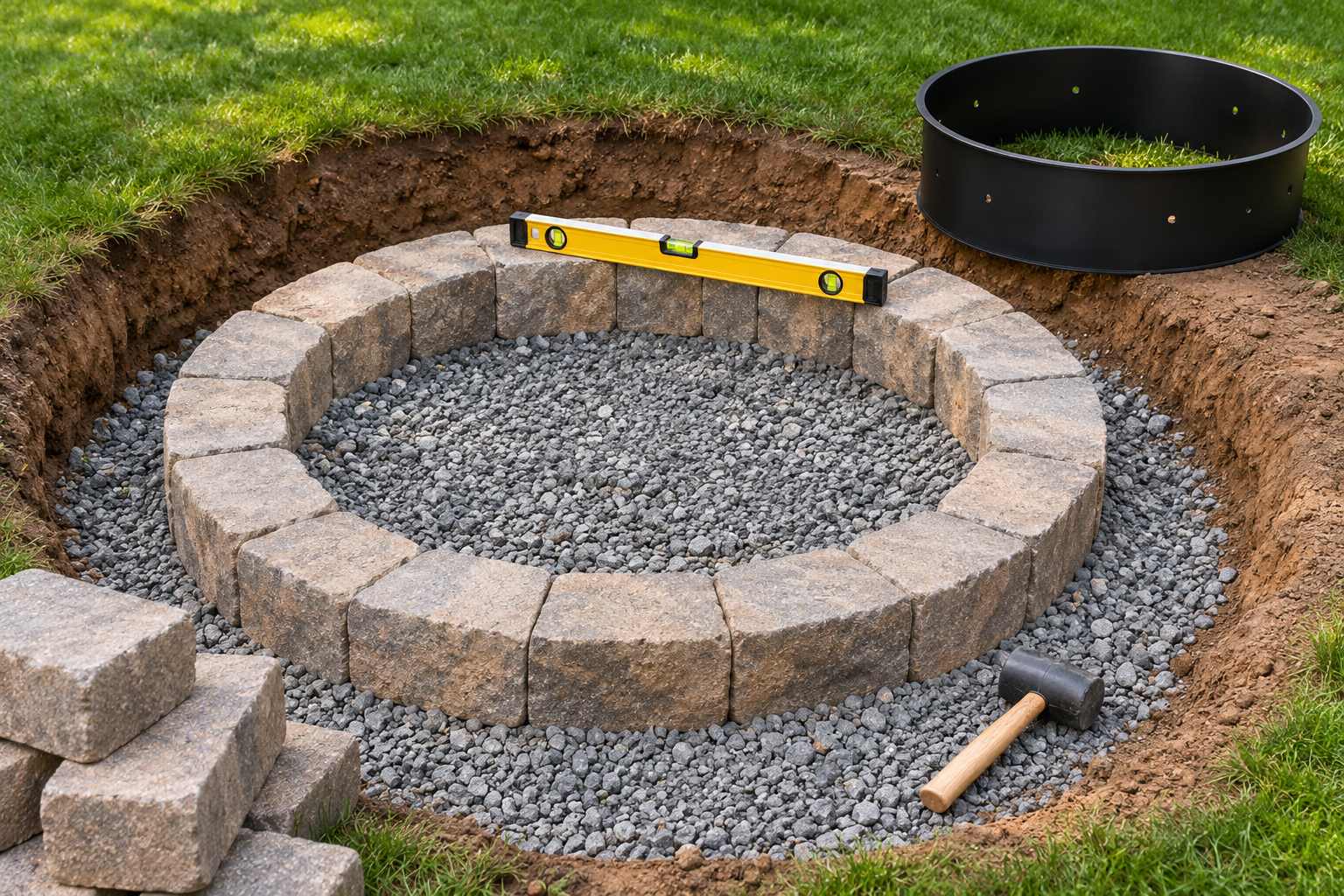
The pit footprint is excavated, organic soil removed, and crushed stone placed and compacted in lifts so the structure sits on something that does not move.
Drainage
Weep openings and a gravel core let rain and meltwater drain out of the pit instead of sitting in it, freezing, and pushing the masonry apart.
Fire-Rated Interior
A steel ring insert or firebrick liner takes the direct heat, so the decorative stone or block on the outside is never the part being cooked.
Frost-Depth Footing (Fireplaces)
Outdoor fireplaces get a reinforced concrete footing extended below the Massachusetts frost line, poured independent of the patio.
Caps That Shed Water
Bluestone or granite caps overhang the walls so water runs off the face instead of into the joints.
Clearances Laid Out First
Distance from the house, fences, trees, and overhead structures is measured against your town's bylaw before the first block is set.
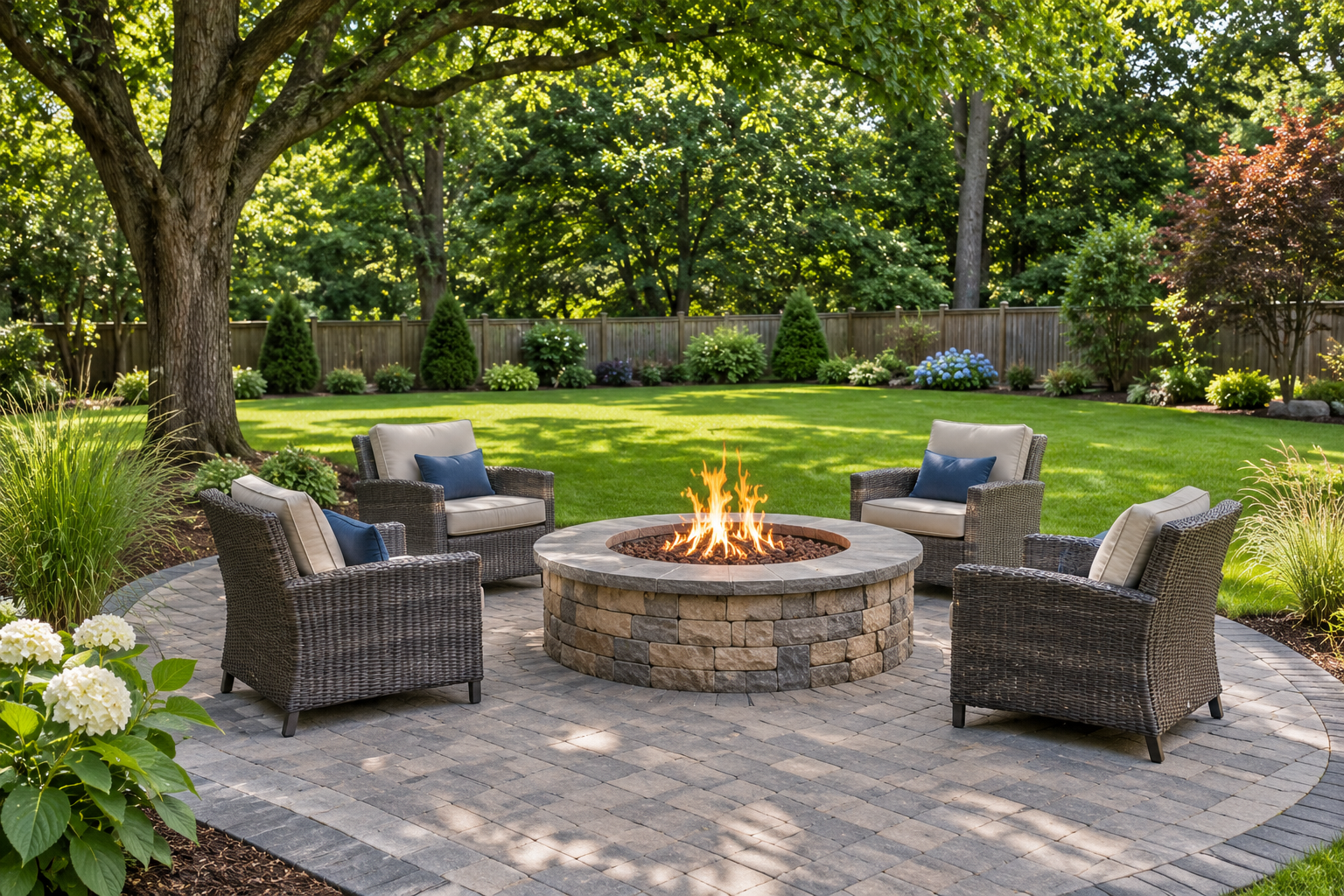
Massachusetts Fire Pit Rules: Size, Clearances, and Permits
Massachusetts treats small recreational and cooking fires at single-family homes differently from open burning of brush. A contained fire pit, generally no more than a few feet across and a couple of feet high, burning only clean dry firewood, attended by an adult with water or an extinguisher nearby, is allowed in most towns without a state permit. Burn bans during dry or windy conditions still apply.
Clearances are set by the town and commonly range from 10 to 25 feet from the house, garage, shed, fence, deck, and overhanging branches, on a non-combustible surface at ground level, never on a wooden deck. Some cities restrict or ban solid-fuel fire pits and allow only professionally installed gas units. A permanent masonry build, a gas line, or a fireplace with a chimney can require a building or gas permit. We check your town's rules before we design, so the feature is built where it is allowed to be.
Seating Walls and Patio Integration
A fire feature works when the space around it does. We size the patio so chairs sit a comfortable distance from the flame, build seat walls that double as the edge of the room, and keep the fire pit on its own base so it never depends on the patio to hold it up.
Fire Feature With a New Patio
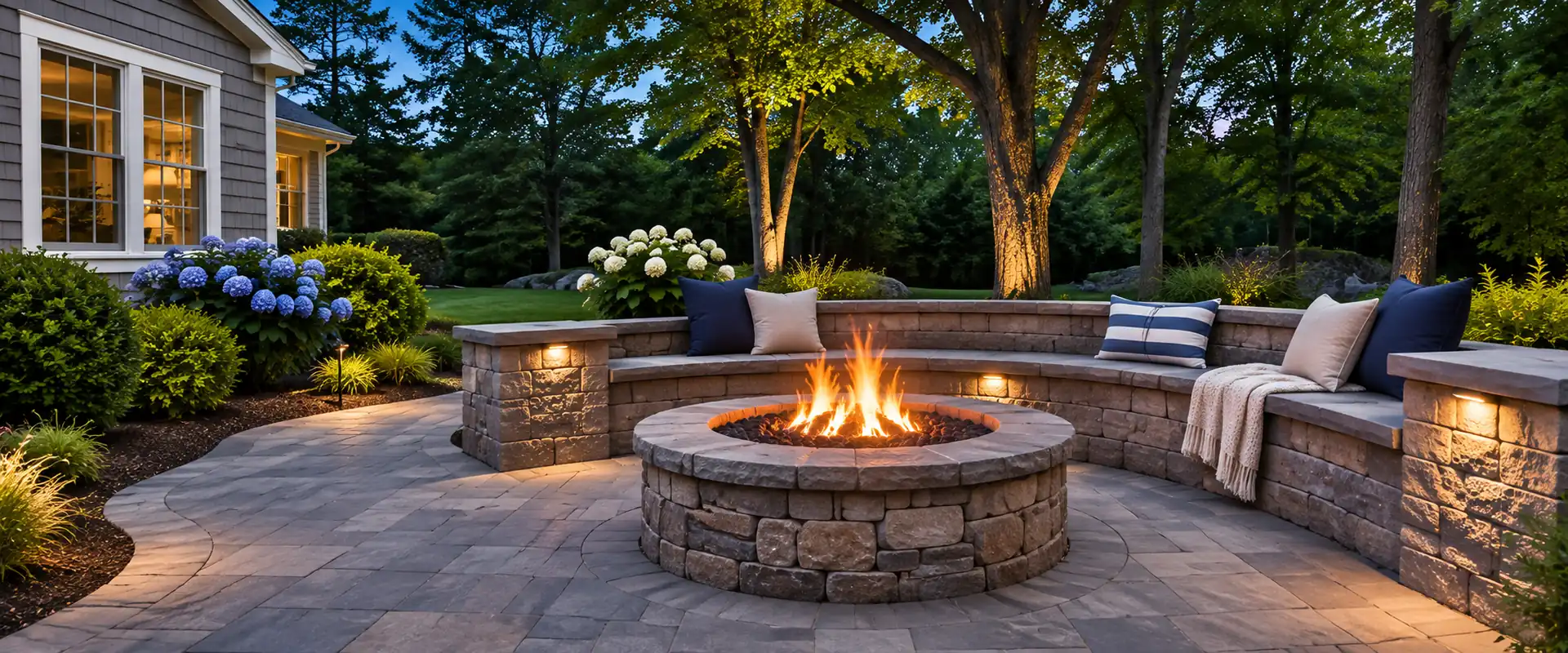
When the patio and fire feature are designed together, the base, drainage, grades, gas sleeve, and seating all get built in one sequence by one crew.
- Patio pitched away from the fire pit and the house
- Gas sleeve trenched under the patio before pavers go down
- Seating wall and fire pit in matching stone or block
- Lighting conduit run while the base is open
Adding to the Patio You Have
Most existing paver patios can take a fire pit on its own compacted base. A fireplace needs a footing, so we lift a section, pour it, and reset the pavers around it.
- Existing base and drainage evaluated first
- Fire pit set into or beside the patio on its own base
- Pavers lifted and reset cleanly around a fireplace footing
- Clearances re-checked against the house and trees
Our Fire Feature Installation Process
- On-site consultation: Sal walks the yard with you, checks clearances, sun and wind direction, gas access, and how the feature fits the patio
- Design and material selection: shape, size, fuel type, stone or block, cap, seating, and any wood storage or lighting, sized to the space
- Permits and Dig Safe: town rules confirmed, underground utilities marked, and gas fitter scheduled if a gas line is part of the project
- Base and utility prep: excavation, compacted stone base or frost-depth footing, drainage, and gas sleeve set before any masonry
- Masonry build and cap: liner or firebox set, walls built, veneer applied, caps set, joints finished
- First fire: we walk you through operation, clearances, and care before you light it
Why Homeowners Choose SalCorp for Fire Features
We build fire pits and fireplaces the same way we build retaining walls and steps: on a base that will not move, with drainage, with the owner on site. Fire features are hardscape, and hardscape in Massachusetts has to survive freeze-thaw or it is not worth building.
- Design and build by one crew: the people who lay out the clearances are the people who set the stone
- Twenty years of hardscape: across Norfolk and Plymouth County, through enough winters to know what holds up
- Owner on site: Sal prepares every estimate and supervises every project
- Fully insured: and Dig Safe called before any trench is opened
Planning the whole backyard?
Fire features are one piece of a larger outdoor room. See how kitchens, patios, and fire features come together on our outdoor living design page, or pair the fire pit with a new paver patio.
Communities We Serve
SalCorp installs fire pits and outdoor fireplaces throughout Norfolk County, Plymouth County, Greater Boston, and the South Shore, including Walpole, Westwood, Norwood, Needham, Wellesley, Dover, Sherborn, Medfield, Sharon, Foxborough, Canton, Dedham, Milton, Braintree, Weymouth, Hingham, Norwell, Cohasset, Newton, Brookline, and surrounding communities.
Ready for your first fire of the season? Contact SalCorp for an on-site consultation.
Twenty Years of Hardscape in Massachusetts
20+
Years serving
Massachusetts
In-house
Owner-supervised,
no subcontractors
Licensed
Fully insured &
guaranteed
Walpole
Norfolk County
based
Fire Pit & Outdoor Fireplace FAQs
Do you need a permit for a fire pit in Massachusetts?
For a small recreational or cooking fire pit at a single-family home, Massachusetts generally does not require a state permit as long as it follows the safety rules: a contained fire, clean dry firewood only, an adult present, and water or an extinguisher nearby. Local rules vary by town and some cities restrict or ban solid-fuel fire pits entirely. A permanent masonry build, a natural gas or propane line, or an outdoor fireplace with a chimney may need a building or gas permit. We confirm your town's requirements before we build.
How far does a fire pit need to be from a house in Massachusetts?
Most Massachusetts towns require a recreational fire pit to sit well away from the house, garage, shed, fence, deck, and overhanging branches, with clearances that commonly range from 10 to 25 feet depending on the town. It must sit on a flat, non-combustible surface at ground level, never on a wooden deck. We lay out the location against your town's bylaw before the first block goes down.
Is a fire in a fire pit considered open burning?
Technically, a fire pit without a chimney is open burning under most definitions, but Massachusetts and most towns treat small recreational and cooking fires differently from brush burning. Recreational fires are usually allowed year-round within size and clearance limits, while burning brush, leaves, or debris requires a seasonal open burning permit and is banned in many communities. Fire pits are still subject to burn bans during dry or windy conditions.
Gas vs wood fire pit: which is better?
Neither is better for everyone. Gas gives instant ignition, no smoke, no ash, and flame control, which suits frequent use and tight spaces, but it costs more to install and does not throw the same radiant heat. Wood gives the classic campfire, more heat, and the option to cook over it, but it needs firewood, cleanup, and more clearance. Many homeowners choose by how they will actually use it: nightly convenience leans gas, weekend gatherings lean wood.
Does an outdoor fireplace need a footing?
Yes. A masonry outdoor fireplace can weigh several thousand pounds, far more than a patio slab or compacted gravel is designed to carry. It needs its own reinforced concrete footing extended below the Massachusetts frost line, isolated from the surrounding patio so the patio can move seasonally without pulling on the fireplace. A fire pit is lighter and is typically built on a compacted gravel base, but a fireplace is a structure.
Can a fire pit or outdoor fireplace be added to an existing patio?
Usually, yes. A fire pit can often be set into or beside an existing paver patio on its own compacted base. An outdoor fireplace needs a footing, so a section of patio is lifted, the footing is poured, and the pavers are reset around it. We evaluate the existing base, drainage, and clearances on site before recommending the approach.
How much does a custom fire pit or outdoor fireplace cost?
Cost depends on fuel type, whether it is a kit or custom mortared masonry, the stone or veneer chosen, whether a gas line needs to be run, and how much patio and seating wall goes with it. A standalone fire pit and a full masonry fireplace with a chimney are very different projects. Every job is quoted after an on-site evaluation, because soil, access, and scope change the work from property to property. Contact us for a quote.
Does an outdoor fireplace add value to a home?
A well-built outdoor fireplace or fire pit extends the usable season of a backyard and is one of the features buyers notice in listings. Like any hardscape, the value depends on the build: a fireplace on a proper footing that stays plumb through winters adds value, while one that settles or cracks does not. That is why we build fire features the same way we build walls and steps.
Ready for Your First Fire?
Schedule an on-site consultation with SalCorp. We will lay out the clearances, pick the fuel and stone, and build a fire feature that lasts.
Plan Your Fire Feature