

Why Hiring the Right Paver Patio Installation Contractors Matters
Paver patio installation contractors are specialists who design, excavate, and build durable outdoor patio surfaces using concrete pavers, natural stone, or clay brick. Here’s what to know right away:
Quick Answer: What to Look for in a Paver Patio Contractor
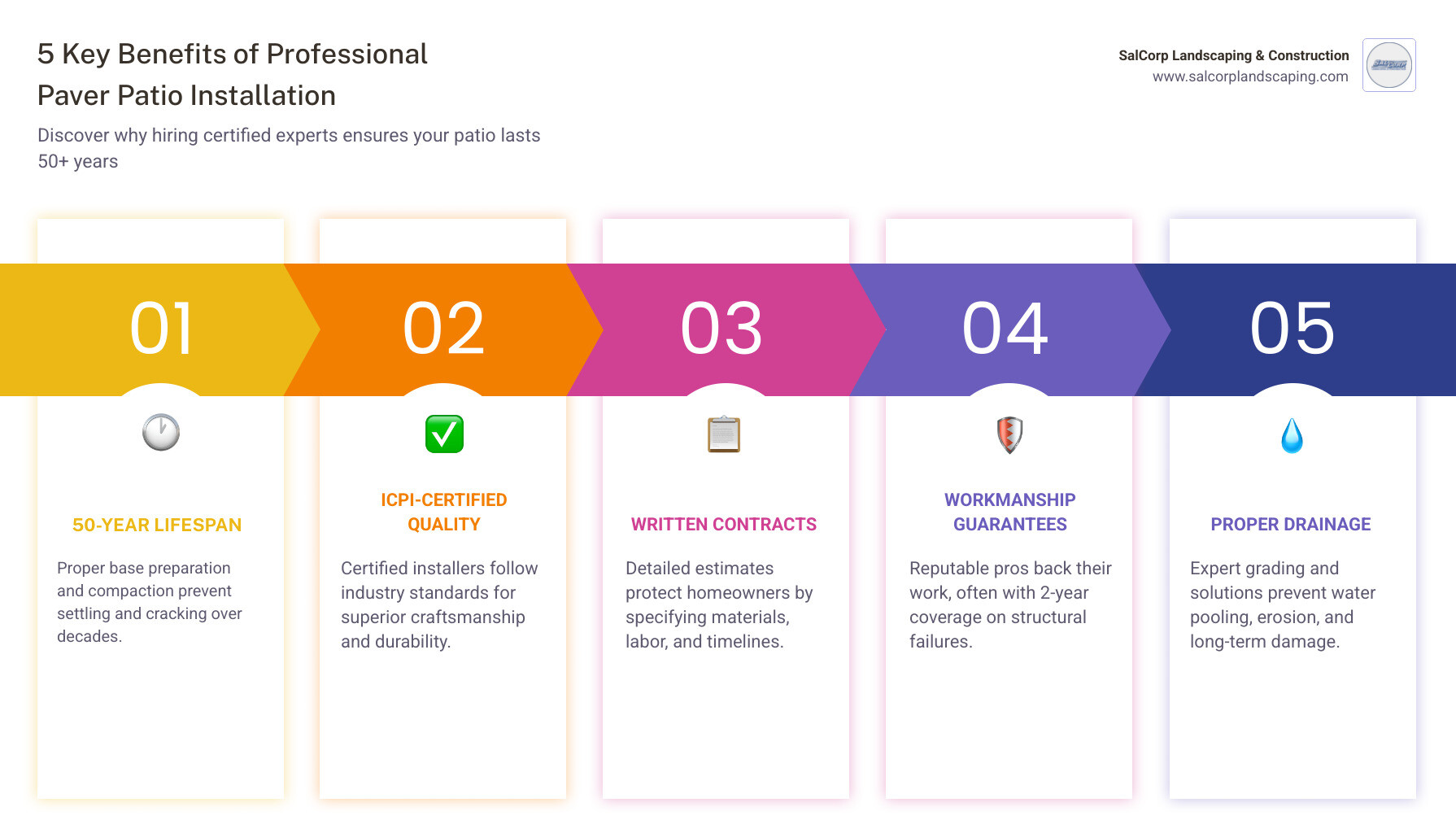
- Valid liability insurance and workers’ compensation – protects you if anything goes wrong on your property
- ICPI certification – a voluntary but meaningful credential that signals real expertise
- Written estimates and contracts – covers materials, labor, and timeline in detail
- Portfolio and references – verified proof of past work quality
- Workmanship guarantee – reputable contractors back their work; some manufacturer-authorized installers offer two-year guarantees on structural failures
A well-installed paver patio can last 50 years or more. A poorly installed one can fail in just a few seasons. The difference almost always comes down to who you hire.
Paver patios are one of the most popular hardscape upgrades for Massachusetts homeowners and property managers. They boost curb appeal, expand usable outdoor space, and add lasting property value. But the installation process – excavation, base compaction, drainage, joint stabilization – is complex. It demands skill, the right equipment, and real-world experience.
Choosing the wrong contractor is one of the most common and costly mistakes homeowners make.
I’m Sal Musto, owner of SalCorp Landscaping & Construction, and with over two decades of hands-on experience working with paver patio installation contractors and leading hardscape projects across Massachusetts, I know exactly what separates a great installation from an expensive headache. In the sections below, I’ll walk you through everything you need to hire confidently and get a patio built to last.
Relevant articles related to paver patio installation contractors:
Choosing the Right Paver Patio Installation Contractors
Finding the right team to handle your backyard transformation is about more than just picking the first name that pops up in a search. In Massachusetts, our climate presents unique challenges—from the heavy snows in Newton and Needham to the humid summers in Quincy and Braintree. You need a team that understands how local soil conditions and freeze-thaw cycles affect hardscaping.

The Vetting Process
When you begin your search for paver patio installation contractors, your first step should be verifying their credentials. A “guy with a truck” might offer a lower price, but without proper backing, you are assuming all the risk.
We always recommend looking for the following:
- Liability Insurance and Workers’ Comp: This is non-negotiable. If a worker is injured on your property or a machine hits your house, you don’t want to be the one footed with the bill.
- ICPI Certification: The Interlocking Concrete Pavement Institute (ICPI) provides the industry standard for paver installation. A contractor with this certification has invested the time to learn the science of soil compaction, base thickness, and drainage.
- Local Experience: Contractors familiar with the “Walpole blue” clay or the sandy soils of the South Shore will know exactly how to prep your base so it doesn’t sink in three years.
More info about patio contractor near me
Workmanship Guarantees
Reputable contractors stand behind their work. While materials often come with a manufacturer’s warranty, the labor—the actual “putting it together”—is covered by a workmanship guarantee. For instance, many authorized installers for major brands like Unilock offer a two-year workmanship guarantee. This gives you peace of mind that if a stone settles unevenly or a border shifts, the contractor will come back to fix it.
Essential Questions for Paver Patio Installation Contractors
Before you sign on the dotted line, you need to interview your potential partners. Don’t be shy! A professional contractor will welcome these questions because they show you value quality work.
- How long have you been in business? Experience matters. At SalCorp, we’ve been serving Massachusetts for over 20 years, and that history means we’ve seen (and solved) every site challenge imaginable.
- How many projects like mine have you completed? Installing a small garden path is very different from building a multi-level raised patio with a fire pit.
- Can you provide a written estimate? This should be a detailed breakdown, not a number scribbled on a napkin. It should include excavation depth, base material type, paver brand, and labor.
- Who will be on-site? Some companies sub-contract their work to crews you’ve never met. We prefer the owner-operated model where the person you talk to is the one overseeing the machinery.
- What is the projected timeline? While weather in places like Boston or Framingham can be unpredictable, a pro should give you a clear window for start and completion.
Hardscapers – Find Professional Paver Contractors Near You
More info about paver company near me
Understanding the Professional Installation Process
If you’ve ever seen a patio that looks like a roller coaster after a few winters, the problem started underground. Professional paver patio installation contractors follow a strict multi-step process to ensure structural integrity.
Site Excavation and Subgrade Compaction
The process begins with digging. For a standard patio, we typically excavate 7 to 12 inches deep. This allows room for the base, the bedding sand, and the pavers themselves. Once the dirt is removed, we compact the “subgrade” (the native soil). If the soil is loose, the whole patio will eventually sink.
Base Preparation: The Foundation of Success
The base is the most critical part of the project. We use layers of crushed stone (often called “¾-inch minus”) and compact it in 2-to-3-inch “lifts.” This creates a solid, stable foundation that still allows water to drain away. In Massachusetts, we often go a little deeper with our base to account for the frost line.
Bedding Sand and Paver Placement
Once the base is perfectly leveled and pitched for drainage (usually a 1-inch drop for every 8 feet of length), a 1-inch layer of concrete sand is spread. This is the “cushion” the pavers sit on. The pavers are then laid in your chosen pattern—whether it’s a classic herringbone, a running bond, or a complex random layout.
Polymeric Sand and Final Compaction
After the stones are set and the edges are restrained with professional-grade edging, we sweep polymeric sand into the joints. This isn’t regular sand; it contains a binding agent that hardens when misted with water. It keeps weeds out, resists washouts, and prevents ants from making your patio their new home. Finally, we run a plate compactor over the top of the pavers to “set” them into the sand.
Comparing Materials with Your Paver Patio Installation Contractors
Choosing the right material is a balance of aesthetics, durability, and budget. Here is a quick look at the most common options we install for homeowners in areas like Wellesley and Concord.
[TABLE] Comparing Patio Materials
| Feature | Concrete Pavers | Clay Brick | Natural Stone (Flagstone) |
|---|---|---|---|
| Durability | Extremely High | High | High (varies by stone) |
| Maintenance | Low (occasional sealing) | Moderate | Moderate |
| Color Options | Nearly Infinite | Traditional Reds/Browns | Natural Earth Tones |
| Cost | Cost-Effective | Mid-Range | High-End |
| Install Speed | Fast | Moderate | Slow (custom fitting) |
Concrete Pavers
Modern concrete pavers are engineered to be incredibly strong. They can mimic the look of natural stone or old-world cobblestone but at a fraction of the price. They are also uniform in thickness, which makes for a perfectly flat surface for patio furniture.
Clay Brick
For a historic look in towns like Dedham or Milton, nothing beats genuine clay brick. It’s naturally slip-resistant and the color never fades because it’s baked into the clay. However, it can be 15-20% more expensive in materials and takes longer to install due to slight variations in brick sizes.
Permeable Pavers
If you have drainage issues or local “green” building codes to follow, permeable pavers are a fantastic choice. They have slightly wider joints filled with small stones, allowing rainwater to soak directly into the ground rather than running off into your basement or the street.
More info about brick paver patio
Costs, Maintenance, and Long-Term Value
Investing in a professional patio is an investment in your home’s equity. While the initial cost is higher than a simple poured concrete slab, the long-term value is much greater because pavers don’t crack and are easily repaired.
Budgeting for Your New Patio
Note: These figures are average costs based on internet data and not actual costs for SalCorp Landscaping.
When planning your budget, it is helpful to look at general industry data. Most homeowners across the country spend between $3,750 and $8,500 on a standard installation, with a typical average of around $5,600. However, for high-end custom designs, large outdoor kitchens, or complex multi-level structures, costs can easily reach $28,000 or more.
What drives the cost?
- Labor Rates: Professional labor typically ranges from $5 to $10 per square foot.
- Site Prep: If we have to remove an old concrete deck or clear a forest of stumps, that adds to the time.
- Accessibility: Can we get our heavy machinery into the backyard easily, or do we have to move tons of stone by hand?
- Materials: Natural bluestone costs significantly more than standard concrete pavers.
More info about cost to install a brick paver patio
More info about cost to install concrete paver patio
Maintenance and Durability for a 50-Year Lifespan
One of the best things about a paver patio is that it is “flexible.” Unlike concrete, which cracks when the ground moves, pavers can shift slightly and be reset if necessary. With minimal care, your patio can easily last 50 years.
Sealing Your Investment
We recommend applying a penetrating sealer every 3 to 5 years. This does three things:
- Protects against stains: Spilled red wine or grill grease won’t soak into the stone.
- Prevents fading: It acts like sunscreen for your pavers, keeping the colors vibrant.
- Stabilizes joints: It helps keep the polymeric sand hard and in place.
Cleaning and Repairs
Standard maintenance involves blowing off leaves and the occasional power wash. Expert Tip: When power washing, keep the nozzle at an angle and don’t get too close to the joints, or you might blast out the sand! If a single paver ever breaks (which is rare), you don’t have to replace the whole patio—you just pop out that one stone and put in a new one.
Unilock Authorized Contractors
More info about patio design
Why Professional Expertise Beats DIY
We get it—the DIY shows make it look easy. A couple of weekends, some bags of sand, and a few stones, right? Unfortunately, the reality is often back-breaking labor that ends in a sunken, weed-filled mess.
The SalCorp Advantage
As an owner-operated business based in Walpole, we don’t just “show up.” We bring over 20 years of Massachusetts-specific experience to every job. We own our own heavy machinery, which means we can excavate deeper, compact harder, and finish faster than a homeowner with a rented shovel.
Why go pro?
- Proper Machinery: We use industrial plate compactors that exert thousands of pounds of force. A hand tamper just won’t cut it for a 50-year patio.
- Climate Adaptation: We know how to design for New England. We ensure your patio pitches away from your foundation to keep your basement dry during the spring thaw.
- Design Eye: We don’t just lay stones; we help you choose colors and patterns that complement your home’s architecture, whether you’re in a historic Brookline brownstone or a modern home in Foxborough.
If you’re ready to stop dreaming about that perfect outdoor space and start building it, we’re here to help. From the first consultation to the final sweep of sand, our team is dedicated to giving you a patio you’ll love for decades.
More info about paver patio installation contractors
Ready to transform your backyard?
Contact SalCorp Landscaping & Construction for a Free Consultation
