Retaining wall slope stability: Master 4 Failures
Why Slope Stability is the Bedrock of a Lasting Retaining Wall
Retaining wall slope stability is the critical engineering principle that determines whether your wall will stand strong for decades or become a costly failure. Understanding this concept can save property owners thousands of dollars in repairs and prevent dangerous slope failures.
Key factors affecting retaining wall slope stability:
- Soil conditions – Clay expands when wet, sand drains well, both affect stability differently
- Water management – Poor drainage causes 90% of retaining wall failures
- Wall design – Must resist overturning, sliding, and bearing capacity failure
- Factor of Safety – Minimum 1.5 required by most municipalities
- Professional assessment – Geotechnical analysis needed for walls over 4 feet or on slopes
A retaining wall is more than a landscape feature – it’s a critical structural defense against gravity. The difference between a beautiful, lasting wall and a catastrophic failure lies in understanding and mastering slope stability.
As one case study revealed, “a 10-meter-high gentle slope failed mid-construction, where finite element modeling later showed the slope’s factor of safety dropped to 1.35 when water and soft clay were included.” This highlights why proper analysis is essential before construction begins.
Water is often called a slope’s worst enemy because it increases soil weight, reduces shear strength, and creates hydrostatic pressure that can push walls over. Even gentle slopes can become unstable when water conditions change.
I’m Sal Musto, and with over two decades of experience in Massachusetts landscaping and construction, I’ve seen how proper retaining wall slope stability analysis prevents costly failures and protects properties. My team at SalCorp works closely with geotechnical engineers to ensure every wall we build meets the highest safety standards.
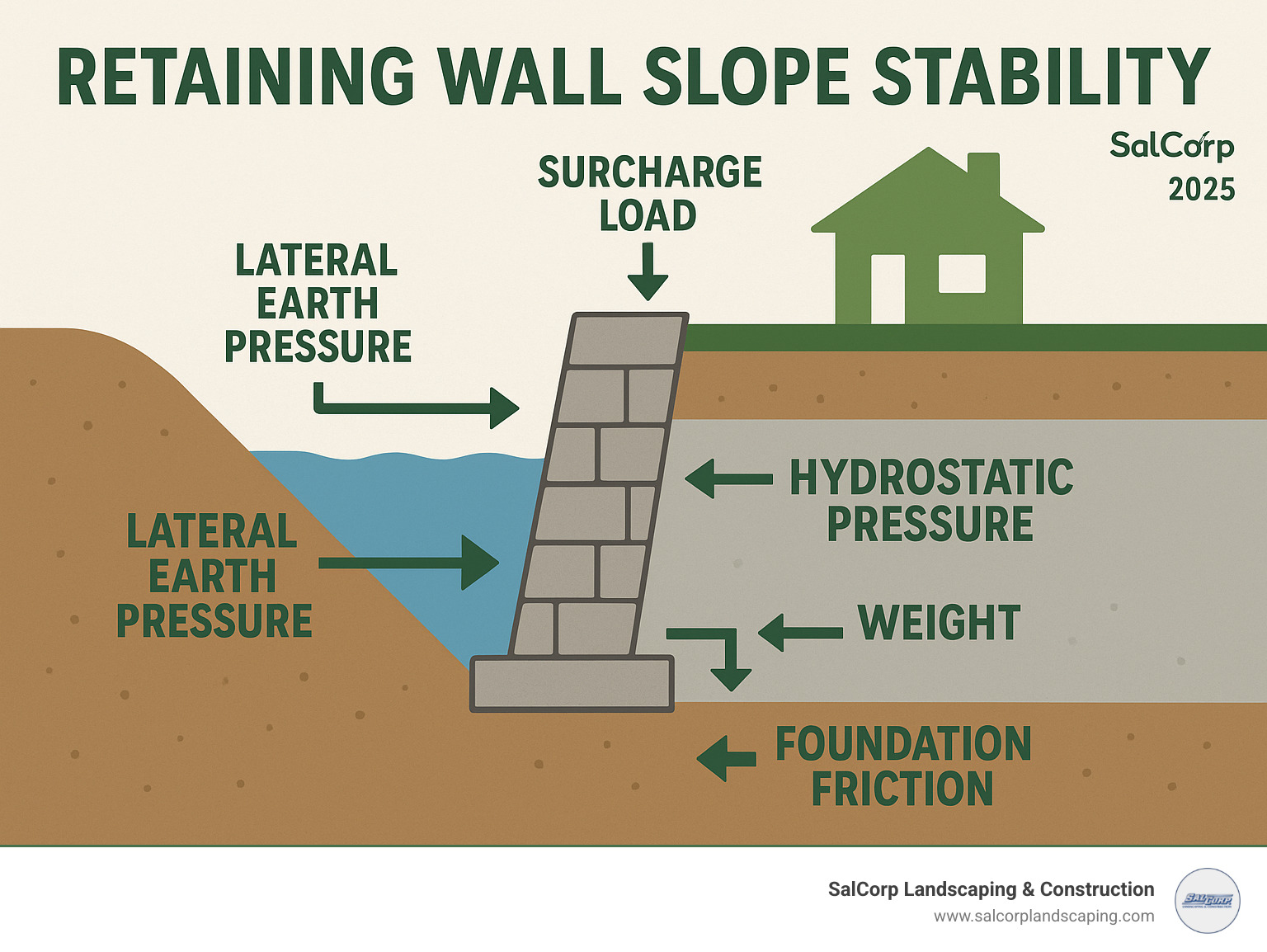
Quick Retaining wall slope stability terms:
Understanding the Science: Key Factors Influencing Retaining Wall Slope Stability
This section digs into the fundamental forces that every property owner should understand before breaking ground.
The Critical Role of Soil and Water
Soil mechanics may sound intimidating, but the idea is simple: different soils behave differently.
- Granular soils (sand, gravel) drain well and rely on internal friction. They’re generally stable, yet still need to be compacted correctly.
- Cohesive soils (clay, silt) hold water, expand when wet, and shrink when dry—adding stress to any wall.
Groundwater changes everything. Saturated soil gets heavier, loses shear strength, and builds hydrostatic pressure that pushes on your wall. Even a small four-foot wall could be resisting 20 tons of wet soil. In Massachusetts, freeze–thaw cycles amplify the risk, so drainage must be part of every design.
The Four Modes of Wall Failure
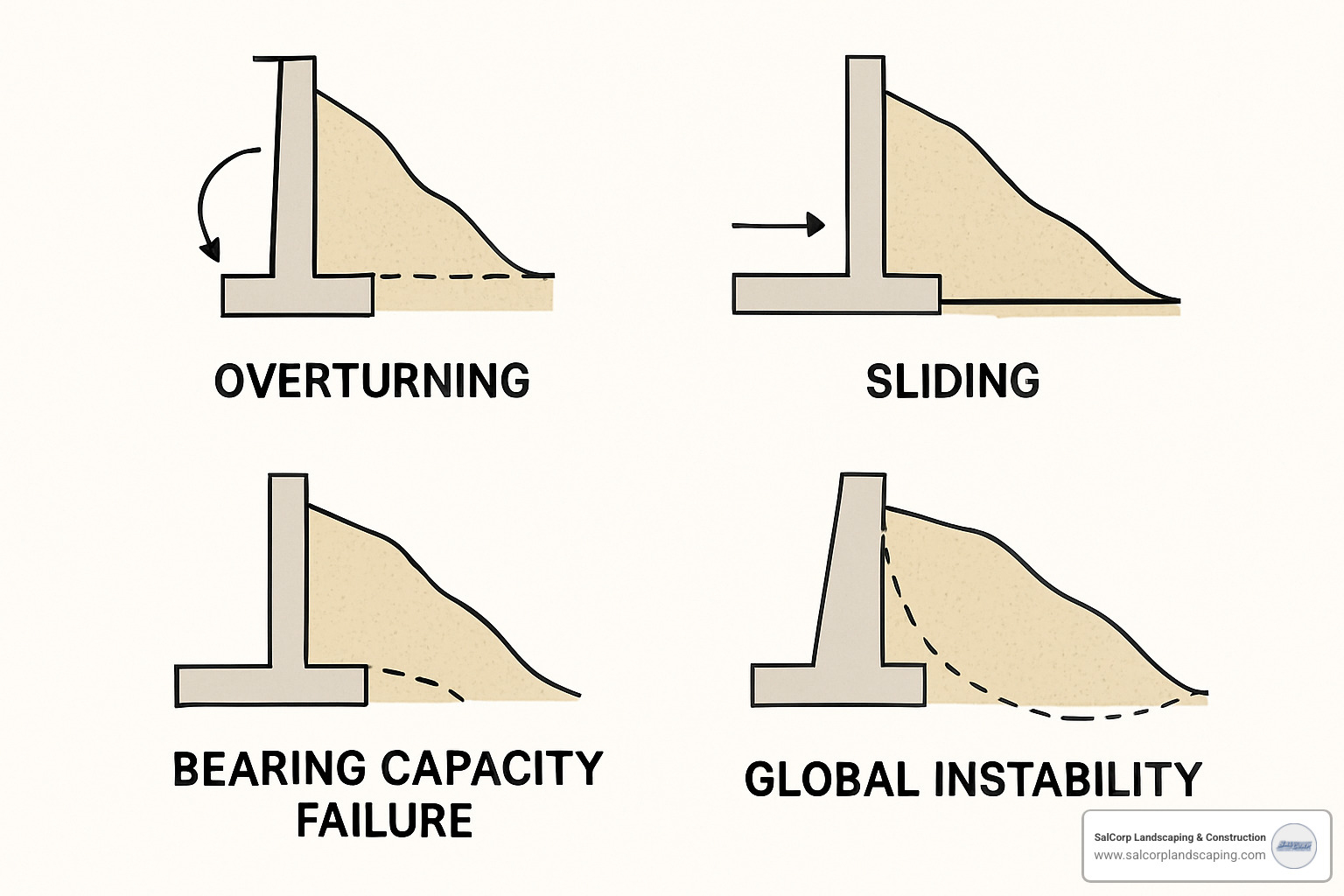
- Overturning – wall tips backward when lateral forces exceed its stabilizing weight. Minimum FoS ≈ 2.0.
- Sliding – wall moves forward if soil thrust beats base friction. FoS ≈ 2.0.
- Bearing failure – soil beneath the footing can’t support loads, causing settlement.
- Global instability – wall and retained soil rotate together along a deep slip surface; the most severe scenario.
Decoding the Factor of Safety (FoS)
The FoS is the ratio of resisting to driving forces. Municipalities usually want 1.5 or greater. Anything below 1.3 means high risk. FoS can drop over time as groundwater rises, loads change, or materials degrade—yet another reason to design conservatively.
For more on construction that respects these principles, visit our hardscape construction page.
The Professional Assessment: When and How to Analyze Slope Stability
A stable retaining wall starts with a professional look at your site—before the first shovel hits the ground.
Do You Need a Geotechnical Assessment?
You almost certainly do if any of these apply:
- Wall height exceeds 4 ft (code trigger in most towns)
- Wall sits on a slope or is tiered
- Wall supports driveways, patios, or other surcharge loads
- Site has high groundwater or is near wetlands
DIY fixes often cost more later; rebuilding a failed slope can run into six figures.
What a Slope Stability Analysis Involves
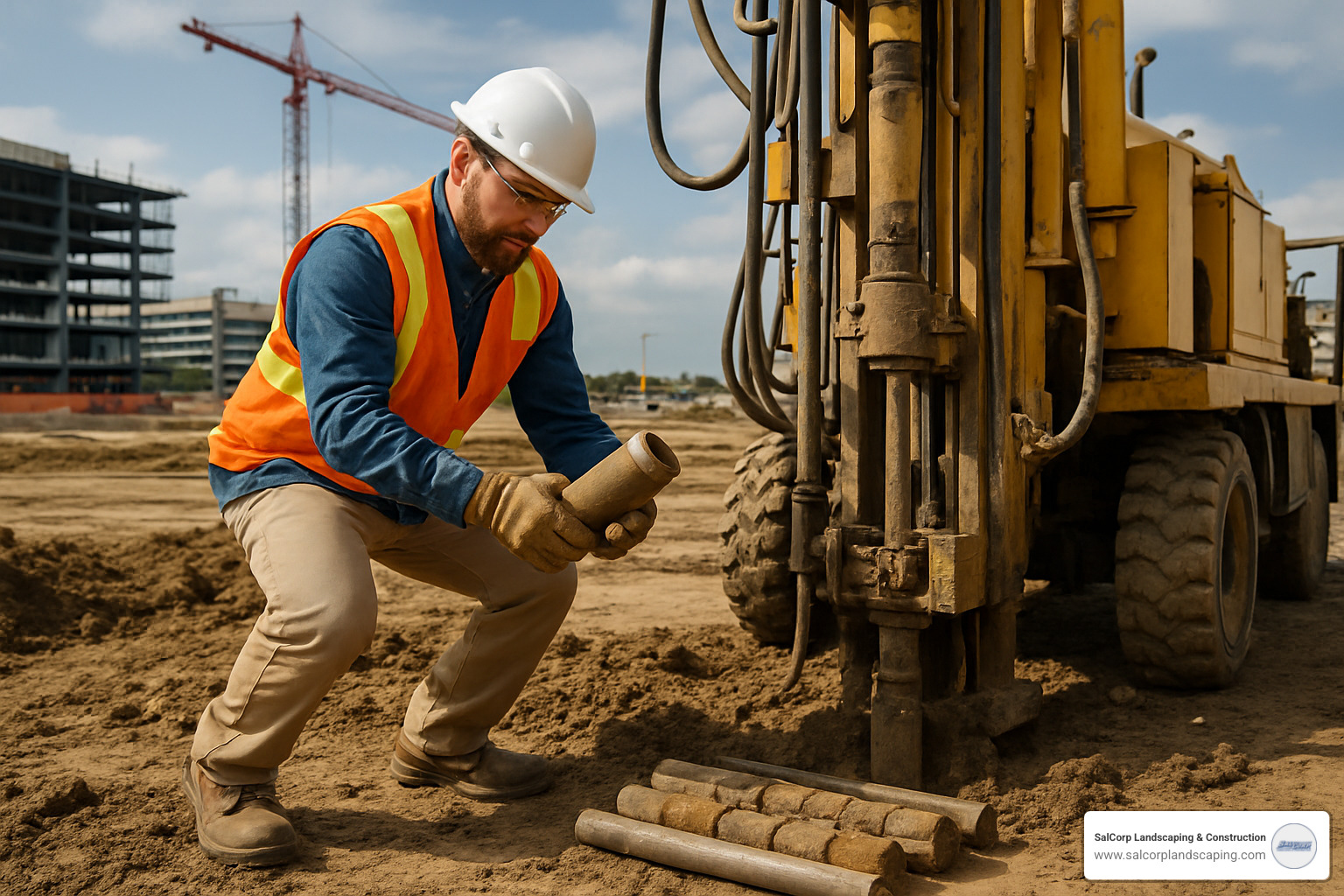
- Topographic survey – maps grades and drainage paths.
- Boreholes & soil tests – reveal strength, density, and drainage characteristics.
- Finite-element modeling – simulates loads, water rise, even earthquakes.
- Stamped report – provides design parameters for safe retaining wall design.
At SalCorp we partner with seasoned geotechnical engineers so every wall begins with data, not guesswork.
Designing for Durability: Wall Types and Construction Best Practices
Choosing the Right Wall for Your Slope
| Wall Type | Typical Height | Key Advantage | Limitation |
|---|---|---|---|
| Gravity (concrete, stone, gabion) | ≤ 25 ft | Simple, massive | Needs large footprint |
| Cantilever (reinforced concrete) | ≤ 35 ft | Uses soil weight for strength | Requires skilled forming & steel |
| Segmental block + geogrid | ≤ 20 ft | Modular, good looks | Engineering needed for tall walls |
| Anchored (tiebacks) | 50 ft + | Works in tight spaces | Specialized installation |
See more options on our retaining walls page.
Non-Negotiable Elements of a Stable Retaining Wall

- Foundation below frost line (≈ 4 ft in Massachusetts)
- 4-in perforated drainpipe at base, daylighted away from wall
- Free-draining gravel backfill; filter fabric to stop fines
- Compaction in lifts to prevent settlement
- Batter: lean wall 1 in per 12 in of height for extra stability
Skip any one of these and failure becomes a matter of time.
Recognizing and Rectifying Problems: Warning Signs and Repair Solutions
Red Flags to Watch For
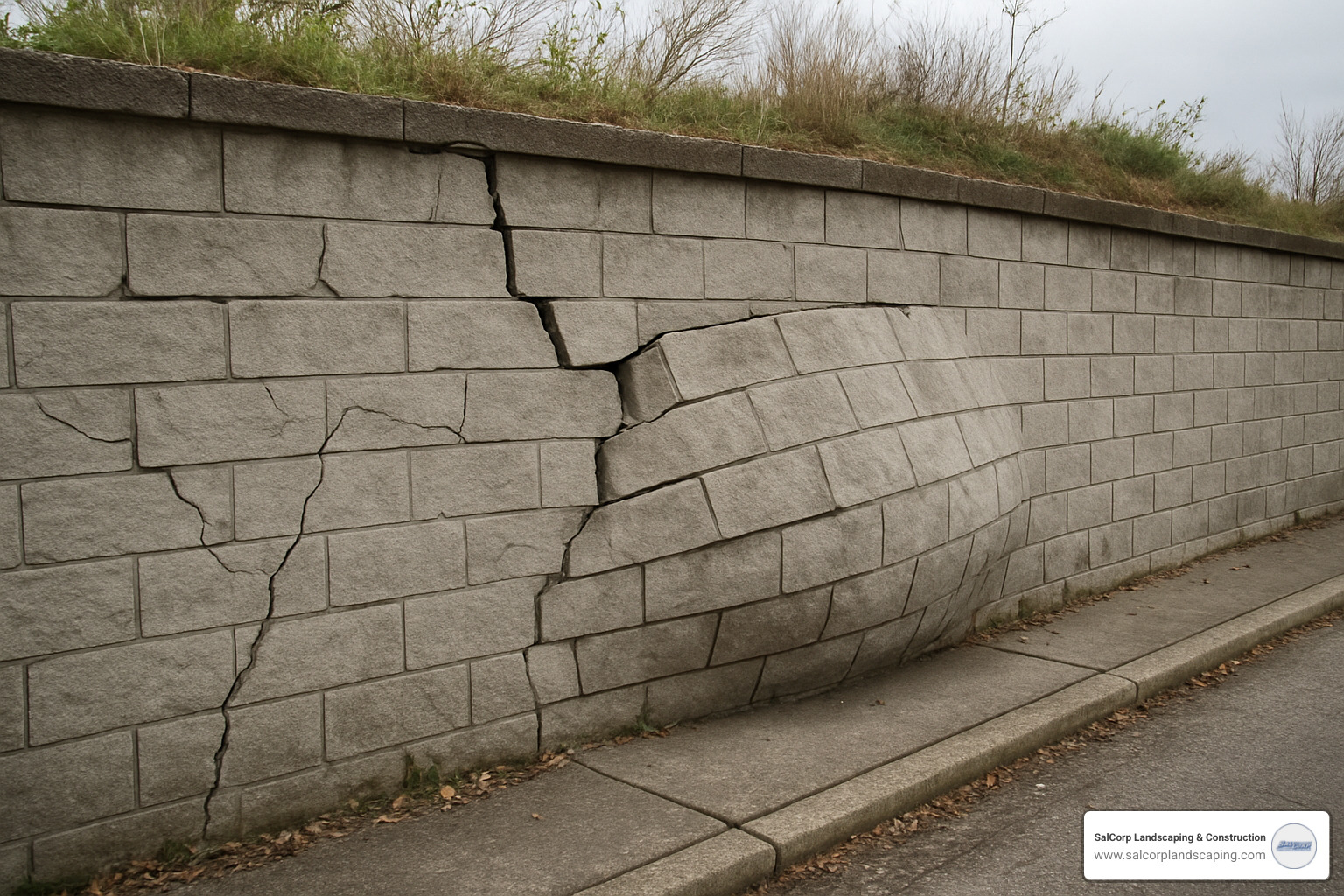
- Wall leaning or bulging
- Horizontal/step cracks in masonry
- Clogged weep holes or pooled water
- Ground cracks or slumping above the wall
- Trees or fences that suddenly tilt
Inspect twice a year and after big storms.
Proven Repair Techniques
- Helical anchors / tiebacks – add resistance to overturning
- Improve drainage – new pipes, clean weep holes, add gravel
- Underpinning – deepen or widen footings for better bearing
- Shotcrete or soil nailing – add strength to faces or slopes
A professional evaluation decides whether repair or full rebuild is most economical. Our hardscape contractors can guide you.
Frequently Asked Questions about Retaining Wall Slope Stability
What is the most common reason retaining walls fail?
Poor drainage is hands down the biggest culprit behind retaining wall failures. When water gets trapped behind your wall with nowhere to go, it creates hydrostatic pressure that can be absolutely devastating. Think of it like a dam holding back water – except your wall wasn’t designed to be a dam.
The numbers tell the story clearly: 90% of retaining wall failures stem from drainage problems. When soil becomes saturated, it doesn’t just get heavier – it actually loses strength and pushes harder against your wall. Research shows that a slope’s factor of safety can drop to a dangerous 1.35 when water and soft clay conditions are factored in.
Here’s what happens when water wreaks havoc on retaining wall slope stability:
Water dramatically increases the weight of soil pressing against your wall. Saturated soil can weigh nearly twice as much as dry soil, creating loads your wall may not have been designed to handle.
Soil shear strength decreases when water fills the spaces between soil particles. This makes the soil more likely to slide and creates additional pressure on the wall.
Hydrostatic pressure builds up like water behind a dam. This constant pressure pushes outward on your wall 24/7, eventually causing bulging, cracking, or complete failure.
In Massachusetts, frost heave adds another layer of complexity. When trapped water freezes, it expands and can literally push your wall apart from the inside.
This is exactly why proper drainage design – including weep holes, perforated pipes, and free-draining gravel backfill – isn’t optional. It’s the difference between a wall that lasts decades and one that fails within a few years.
How high can a retaining wall be before I need an engineer?
The magic number most people hear is four feet, but honestly, that’s just the beginning of the conversation. While most Massachusetts building codes require professional engineering for walls over 4 feet, height alone doesn’t tell the whole story.
Here’s the reality: any wall on a slope deserves professional attention, regardless of height. I’ve seen 3-foot walls fail spectacularly because they were built on unstable slopes without proper analysis. The research backs this up – even “gentle slopes” can be deceptively unstable when you factor in soil conditions and water.
You definitely need an engineer when:
Your wall is supporting critical loads like driveways, patios, or structures. These additional loads can push even a shorter wall beyond its limits.
The wall is near water or in flood-prone areas. Changing water conditions create complex engineering challenges that require professional analysis.
Soil conditions are questionable. If you’re dealing with clay, fill dirt, or soils that seem unstable, professional assessment is essential.
You’re building tiered walls or multiple wall levels. The interaction between walls creates complex stress patterns that aren’t obvious to the untrained eye.
Even for shorter walls, I always recommend professional consultation when you’re dealing with slopes steeper than 3:1 or when there are existing structures nearby. The cost of professional analysis upfront is minimal compared to the potential cost of failure.
As the research clearly states: rebuilding a failed slope can easily cost millions of dollars. Getting it right the first time with professional help is always the smarter investment.
How much does building a retaining wall cost?
Retaining wall costs vary dramatically based on materials, height, site conditions, and complexity. Based on national internet data, homeowners can expect costs ranging from $30 to over $100 per square face foot. Please note, these are average costs from online sources and not actual pricing for SalCorp Landscaping.
Material choice makes a huge difference in cost. Timber walls typically run $15-45 per square foot, while natural stone can range from $20-100 per square foot. Interlocking blocks show the widest range, from $45-270 per square foot depending on the specific system and height requirements.
Height drives cost exponentially, not just because you need more materials, but because taller walls require more engineering, stronger foundations, and more complex drainage systems. A 6-foot wall doesn’t cost twice as much as a 3-foot wall – it often costs three or four times more.
Site conditions can make or break your budget. Easy access with good soil conditions keeps costs reasonable. But if we need to bring equipment down a steep slope or deal with poor soil that requires special foundations, costs increase significantly.
Proper drainage systems add to initial costs but prevent expensive failures down the road. The drainage components – perforated pipes, gravel backfill, and filter fabric – might add 15-20% to your initial cost but can save you thousands in repairs later.
Engineering and permits are additional costs that vary by location and project complexity. While these add to upfront expenses, they ensure your wall meets safety standards and local codes.
Retaining wall slope stability isn’t the place to cut corners. Proper initial construction costs more upfront but is far less expensive than dealing with a failed wall that needs complete reconstruction. The cheapest wall is the one that never fails.
Conclusion: Partnering with Professionals for a Safe and Secure Landscape
After two decades of building retaining walls across Massachusetts, I’ve learned one crucial truth: retaining wall slope stability isn’t something you can wing. It’s a complex engineering challenge that requires deep understanding of soil mechanics, water management, and structural design.
The stakes are simply too high to take shortcuts. We’ve seen what happens when walls fail – property damage, safety hazards, and repair costs that can reach into the millions. The research throughout this article makes it clear: proper analysis and professional design aren’t luxuries, they’re necessities.
Every successful retaining wall project requires teamwork. Geotechnical engineers analyze your soil conditions and calculate safety factors. Structural designers create walls that can handle the forces involved. Experienced contractors like our team at SalCorp bring those engineered plans to life with precision and attention to detail.
As an owner-operated Block Wall Builder serving Massachusetts for over 20 years, I’ve seen how proper planning creates walls that stand strong for decades. We’ve also witnessed the costly aftermath when corners are cut or drainage is ignored.
What makes the difference? It starts with respecting the science. Understanding how water affects soil stability. Knowing when a geotechnical assessment is needed. Choosing the right wall type for your specific conditions. Following proven construction techniques that account for Massachusetts’ unique climate challenges.
Our comprehensive approach means we work hand-in-hand with qualified engineers from the start. We use proper materials, install effective drainage systems, and follow construction best practices that have been proven over decades of successful projects.
Whether you’re dealing with a challenging slope in Newton, planning terraced gardens in Wellesley, or need a retaining wall for your Walpole property, we understand the soil conditions and weather patterns that make Massachusetts unique. Our own machinery and experienced crew ensure every project gets the personal attention it deserves.
A retaining wall is more than a landscape feature – it’s an investment in your property’s safety and value. The difference between a beautiful, lasting wall and an expensive failure lies in understanding and respecting the principles of retaining wall slope stability.
The choice is yours: invest in proper engineering and construction now, or risk much higher costs later when problems inevitably arise. Having seen both outcomes countless times, I know which path leads to peace of mind.
Ready to ensure your landscape is both beautiful and secure? Contact us to discuss your project with an expert retaining wall contractor.