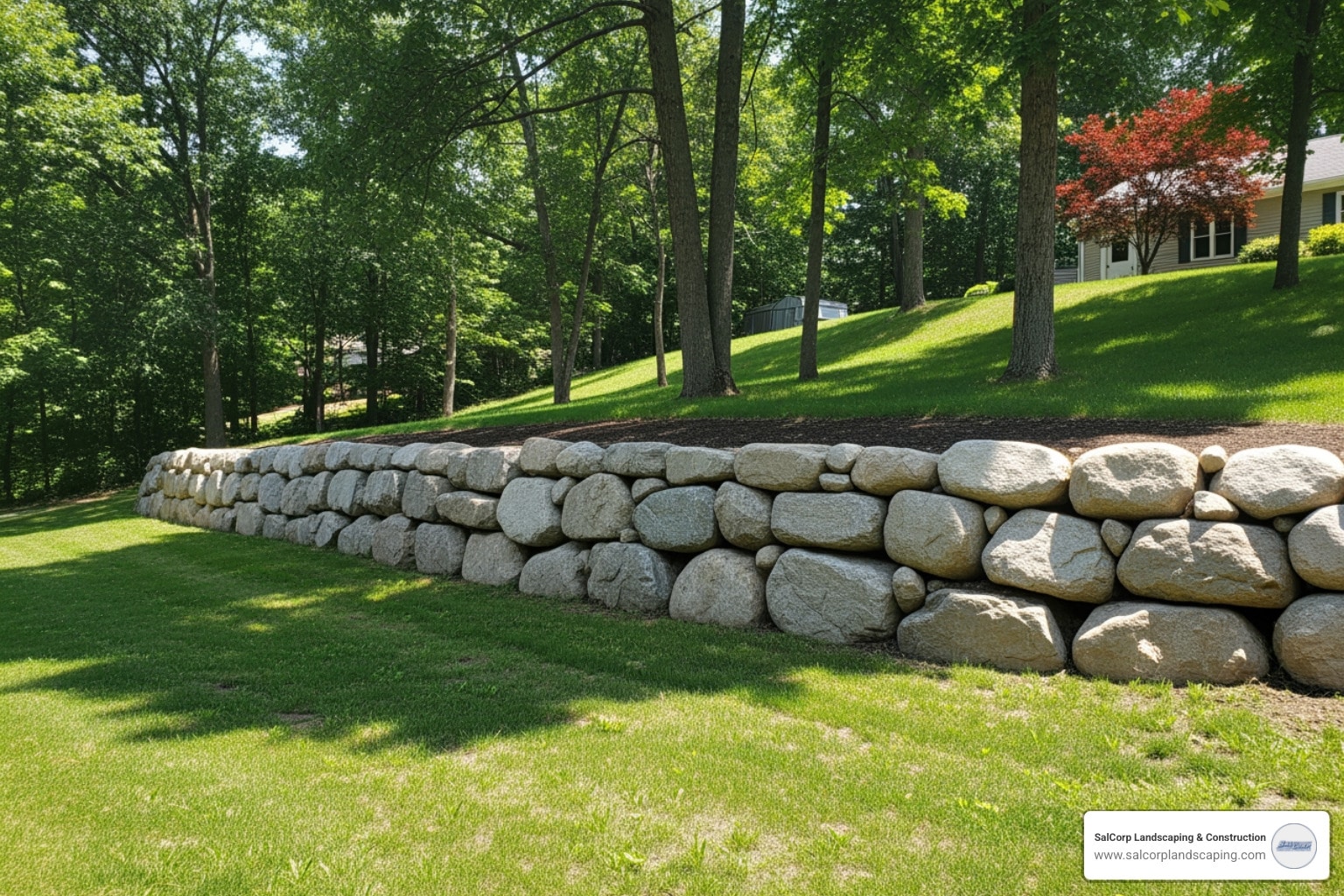
Why Boulder Retaining Walls Transform Massachusetts Properties
A boulder retaining wall is a landscape structure built with large natural stones (typically 10 inches or more in diameter) designed to hold back soil, prevent erosion, and create usable space on sloped terrain. Here’s what you need to know:
Key Functions:
- Soil Stabilization – Holds back earth on slopes and prevents sliding
- Erosion Control – Stops water runoff from washing away soil
- Space Creation – Turns steep grades into level patios, gardens, or walkways
- Aesthetic Appeal – Provides a natural, timeless look that blends with landscapes
Construction Essentials:
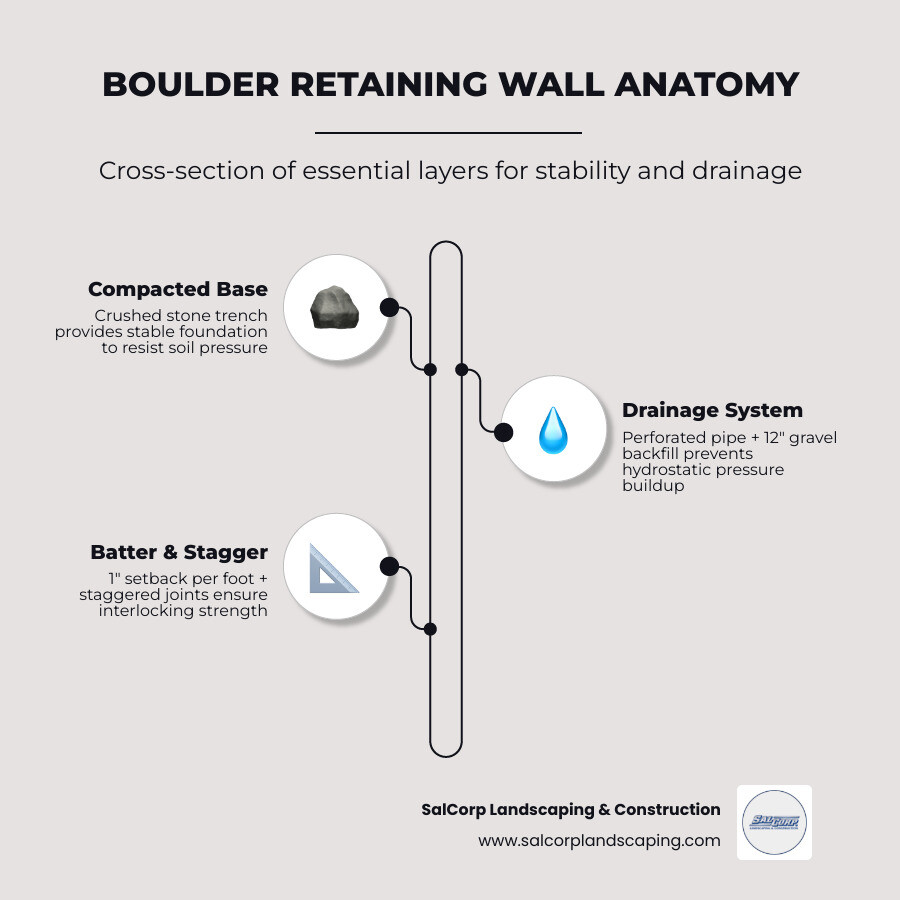
- Proper foundation with compacted crushed stone base
- Backward lean (batter) of 1 inch per foot of height
- Drainage system with perforated pipe and gravel backfill
- Largest boulders at the base, staggered joints throughout
When to Consider Professional Help:
- Walls over 4 feet tall (typically require permits and engineering in Massachusetts)
- Heavy equipment needed for boulder placement (1-7 tons each)
- Complex slopes or poor soil conditions
- Areas with high water table or drainage issues
Built correctly, a boulder retaining wall can last 50 to 200 years with minimal maintenance. Built incorrectly, it can fail within years due to poor drainage or inadequate foundation—leading to costly repairs and potential property damage.
Massachusetts properties face unique challenges that make boulder retaining walls especially valuable. Our freeze-thaw cycles, heavy spring runoff, and varied terrain from coastal plains to rocky hills demand retaining solutions that can withstand extreme conditions. Unlike timber walls that rot or concrete blocks that crack, natural boulders have already survived centuries of weathering. They handle our climate naturally.
The combination of function and beauty makes boulder walls ideal for both residential yards and commercial properties. A well-designed wall doesn’t just hold back soil—it creates outdoor living spaces, defines property boundaries, and adds significant curb appeal. For property managers dealing with parking lot slopes or homeowners wanting a terraced garden, the investment pays off in usability and longevity.
I’m Sal Musto, and through two decades of building boulder retaining walls across the Greater Boston area, I’ve seen how proper construction transforms challenging slopes into valuable property features. At SalCorp Landscaping & Construction, we approach every wall project with the same hands-on commitment—whether it’s a small garden terrace in Walpole or a commercial installation in Newton.
Essential boulder retaining wall terms:
Designing and Building a Durable Boulder Retaining Wall
Designing a boulder retaining wall is part science, part art, and a whole lot of heavy lifting. In Massachusetts, where our soil ranges from dense clay to rocky fill, a wall must be more than just a pile of rocks; it must be a cohesive gravity mass. Before the first stone is set, a comprehensive site assessment is mandatory. We look at the “global stability” of your slope—essentially, how the soil behaves above and below where the wall will sit.
The primary enemies of any retaining wall are soil pressure and hydrostatic pressure (water weight). Water trapped behind a wall can exert thousands of pounds of force, pushing even massive boulders out of alignment. This is why we follow best practices for SRW walls to ensure the structure can breathe and drain. A successful retaining wall design accounts for the “internal friction angle” of the soil—sandy soils drain well and exert less pressure, while the heavy clays often found in areas like Milton or Braintree require much more robust reinforcement.

When we begin how to build a stone retaining wall, we start by clearing all organic matter. You can’t build a 50-year wall on top of grass or loose topsoil. We excavate down to a solid subgrade, ensuring the foundation is level and ready to support stones that can weigh as much as a small car.
Selecting the Right Stones for Your Boulder Retaining Wall
Not all rocks are created equal. When choosing materials, you need to consider both the structural requirements and the “vibe” of your New England home. Our retaining wall stone options guide highlights the most popular choices:
- Fieldstone Boulders: These are natural, weathered stones often “harvested” from the surface. They offer a classic, rustic look with rounded edges and varied colors that fit perfectly in historic towns like Concord or Dover.
- Quarry Boulders: Blasted from deep within the earth, these stones have more angular faces. Angular stones are often easier to stack securely because their flat surfaces interlock like puzzle pieces.
- Granite: A Massachusetts staple. It is incredibly dense, chemically inert, and virtually impervious to our harsh winter salts.
- Limestone: Valued for its strength and unique light coloring, though it may weather differently over decades than granite.
- River Rock: These are water-eroded and very rounded. While beautiful for accents or dry creek beds, they are the most challenging to use in a structural boulder retaining wall because they tend to “roll” unless expertly placed.
We recommend choosing boulders that are frost-resistant. In our climate, porous stones can soak up water, which then freezes and expands, causing the stone to flake or crack (a process called spalling). Stick with dense, local New England stone for the best results.
Critical Steps for Foundation and Drainage
If you take away one thing from this guide, let it be this: The most important part of the wall is the part you can’t see.
A solid foundation starts with a trench, typically at least 6 to 12 inches deep and twice as wide as your largest boulders. We fill this with 4 to 6 inches of crushed gravel or “road base,” compacting it in 2-inch lifts with a plate compactor. This creates a stable, non-shifting platform.
Next comes the drainage—the lifeblood of a long-lasting wall. Without it, you’re just building a dam, and nature always wins against dams eventually.
- Geotextile Fabric: We line the back of the wall with heavy-duty landscape fabric. This prevents fine soil particles from washing into your drainage stone and clogging it.
- Perforated Pipe: A 4-inch perforated drainage pipe is installed behind the first course of boulders. This pipe must be sloped to “daylight” (an exit point) or connected to a storm drain.
- Clean Gravel Backfill: We place at least 12 inches of clean, washed drainage gravel (not soil!) directly behind the boulders. This allows water to drop straight down to the pipe rather than pressing against the stones.
Understanding what is a retaining wall means understanding that it is a drainage management system first and a decorative feature second.
Professional Techniques for Stacking and Batter
Stacking boulders isn’t just about moving heavy things; it’s about physics. To ensure your boulder retaining wall stands the test of time, we use several key techniques:
- The Base Course: We always use our largest, flattest boulders for the bottom layer. At least 12 inches of the base course should be buried (mass embedment). This “toe” prevents the bottom of the wall from kicking out under the weight of the soil.
- The Batter: A professional wall never stands perfectly vertical. We build in a “batter,” or a slight backward lean, of about 1 inch for every vertical foot of height. This uses gravity to push the wall into the slope rather than away from it.
- Interlocking and Staggering: Just like bricklaying, you must stagger the joints. Never have a vertical seam that runs through multiple layers; this creates a weak point. Each stone should bridge the gap between the two stones below it.
- Filling the Gaps: As we stack, we use smaller “chinking” stones to fill voids between large boulders. This prevents soil from weeping through the face of the wall and adds additional interlocking stability.
These natural stone retaining walls rely on their sheer mass. When you have stones weighing 1 to 7 tons each, the wall becomes an immovable force—provided the stacking is done with precision.
Costs, Regulations, and Long-Term Maintenance
When comparing a boulder retaining wall to other options like concrete blocks or timber, boulders often come out on top for longevity. While a timber wall might rot in 15 years, a boulder wall is a “legacy” structure.
| Feature | Boulder Retaining Wall | Segmental Concrete Block | Timber Wall |
|---|---|---|---|
| Lifespan | 50 – 200 Years | 30 – 70 Years | 10 – 20 Years |
| Maintenance | Very Low | Low | High (Staining/Replacing) |
| Aesthetic | Natural/Rustic | Uniform/Modern | Warm/Traditional |
| Climate Fit | Excellent (Freeze-Thaw) | Good | Poor (Moisture Rot) |
In Massachusetts, we also have to navigate specific regulations. For example, if your project is near a septic system, we must follow Massachusetts Title 5 guidelines. These often require impervious barriers if a wall or slope is within 15 feet of a soil absorption system. Furthermore, most towns in our service area—from Walpole to Brookline—require a building permit for any wall exceeding 4 feet in height. These taller walls also require a structural engineer’s stamp to ensure they won’t slide or overturn.
Check out some landscape retaining wall ideas to see how multi-tiered walls can solve steep slope issues while staying within height regulations.
Understanding the Investment in a Boulder Retaining Wall
When planning your budget, keep in mind that these figures are average costs based on internet data and not actual costs for SalCorp Landscaping. Every site in Massachusetts is different—a rocky backyard in Weymouth presents different challenges than a sandy lot in Bourne.
On average, homeowners might see project totals ranging from $2,000 to $10,000 for smaller decorative walls, while large-scale, engineered commercial or residential projects can range from $15,000 to $60,000+.
Factors that influence your final investment:
- Tonnage: Boulders are sold by the ton. Depending on the stone type (premium granite vs. local fieldstone), prices can range from $100 to $600 per ton.
- Labor and Machinery: This isn’t a “flip-flop friendly” DIY project. Moving 3,000-lb stones requires 15-20 ton excavators and skilled operators. Labor costs typically fall between $10 and $100 per square foot depending on the complexity.
- Site Access: Can we get a tri-axle dump truck and an excavator into your backyard? If we have to use smaller equipment or hand-carry materials, the timeline and cost increase.
- Surcharges: If the wall is supporting a driveway, a pool, or a house foundation, it requires significantly more engineering and geogrid reinforcement.
For an accurate quote tailored to your specific Massachusetts property, it’s best to contact stone retaining wall contractors near me who understand local soil and permit laws.
When to Hire a Professional for Structural Stability
While a 2-foot garden border can be a fun weekend DIY project, anything larger demands professional expertise. Why? Because a failing wall is a massive liability.
A professional builder retaining wall ensures that the “Safety Factors” are met. Engineers look for:
- Sliding (Safety Factor > 1.5): Ensuring the whole wall doesn’t just slide forward on the mud.
- Overturning (Safety Factor > 2.0): Ensuring the wall doesn’t tip over like a deck of cards.
- Global Stability (Safety Factor > 1.3): Ensuring the entire hillside doesn’t collapse, taking the wall with it.
We use our own heavy machinery to ensure the base is compacted to 95% Standard Proctor density. We also know how to handle the “freeze-thaw” heave. In towns like Needham and Newton, the ground can move significantly in January. A professional knows how to build “flexibility” into a dry-stack boulder wall so it can move slightly with the frost without losing structural integrity.
Maintenance and Eco-Friendly Finishing Touches
The beauty of a boulder retaining wall is that it requires very little maintenance. However, we recommend a visual inspection once a year and after major New England storms. Look for “weeping” (soil coming through the cracks), which indicates a drainage clog, or any significant shifting of the stones.
To finish the look and stay eco-friendly, consider these tips:
- Native Plantings: Integrate shallow-rooted plants like creeping thyme or native ferns into the joints of the boulders. This softens the look and helps with erosion.
- Local Sourcing: We prioritize sourcing boulders from New England quarries to reduce the carbon footprint of transportation.
- Sustainable Drainage: Use permeable gravel and ensure water is directed to rain gardens or natural swales to replenish the local water table in your community.
At SalCorp Landscaping & Construction, we take pride in being an owner-operated business. When you hire us, you’re getting over 20 years of experience and a team that uses its own machinery to get the job done right. Whether you’re in Walpole, Foxborough, or anywhere in the Greater Boston area, we’re ready to help you reclaim your yard.
Ready to transform your slope into a stunning landscape feature? More info about retaining wall services is just a click away. Let’s build a wall that your grandkids will still be admiring 50 years from now.