

Installing sprinkler system in flower bed: Smart 2025
Why Your Flower Beds Need a Proper Irrigation System
Installing sprinkler system in flower bed is one of the best investments you can make for your landscape. A dedicated sprinkler system solves the problem of inconsistent watering by delivering the right amount of water exactly where your plants need it.
Quick Installation Overview:
- Choose System: Drip irrigation or micro-sprayers are best for flowers.
- Test Water Pressure: Ensure you have 30-60 PSI.
- Connect to Source: Install a backflow preventer, timer, and pressure regulator.
- Lay Main Lines: Bury ½” tubing 6-12 inches deep.
- Install Emitters: Place drip emitters or micro-sprayers at plant bases.
- Program & Test: Set the watering schedule and check for proper coverage.
The benefits are clear: automated watering saves time, prevents root-killing overwatering, and can save up to 80% more water compared to traditional hoses. Your flowers get consistent moisture for healthier growth, and you avoid the daily chore of dragging hoses around.
I’m Sal Musto, and with two decades in landscaping, I’ve seen how proper irrigation transforms struggling flower beds into thriving displays. My experience installing sprinkler systems in flower beds across Massachusetts has taught me that the right system makes all the difference.
Installing sprinkler system in flower bed vocabulary:
- installing irrigation system for garden
- designing underground sprinkler system
- installing new sprinkler system
Why Your Flower Beds Deserve a Dedicated Sprinkler System
You pour your heart into your flower beds, but inconsistent watering can lead to struggling plants. A dedicated irrigation system changes your beautiful beds from a chore into a joy by providing the consistent care flowers crave.
An automated system ensures consistent moisture, which is key to happy plants. A steady, reliable water supply encourages stronger roots and more vibrant blooms. This precision also prevents both overwatering and underwatering. Too much water causes root rot, while too little leads to wilting. A well-designed system delivers the right amount, keeping flowers healthy from the roots up.
Another perk is reduced weed growth. By delivering water directly to plant roots, especially with drip irrigation, you minimize wetting the soil surface between plants. This means fewer opportunities for weed seeds to germinate, which translates to less weeding for you.
Of course, a dedicated system saves precious time. Reclaim the hours spent dragging hoses and moving sprinklers. With an automated system, you set it and forget it, freeing you up to relax and admire your garden.
This leads to a major benefit: water efficiency. Drip irrigation systems can save up to 80% more water compared to traditional methods. Water goes straight to the root zone, minimizing evaporation and wasteful runoff. When you’re installing a sprinkler system in your flower bed, you’re making an eco-friendly choice.
Finally, a good system promotes healthier root systems and protects foliage from fungal disease. Deep, infrequent watering encourages roots to grow deeper, making plants more resilient. Drip irrigation keeps leaves dry, significantly reducing the risk of common ailments like powdery mildew.
Ready to give your flower beds the care they deserve? For more information, check out our irrigation sprinkler system services.
More info about our irrigation sprinkler system services.
Planning Your Flower Bed Irrigation Project
A solid plan is your best friend for an efficient and effective irrigation project. This crucial step involves understanding your flower bed’s unique needs and designing a system that caters to them.
Choosing the Right System for Your Flowers
For flower beds, we recommend more precise methods than traditional lawn sprinklers, which can block water distribution and wet leaves.
- Drip Irrigation: Our top recommendation. It applies water slowly and directly to the soil, minimizing evaporation and keeping foliage dry. Emitter spacing depends on soil type: 12 inches for sandy, 18 for loamy, and 24 for clay.
- Soaker Hoses: These porous hoses weep water along their length. They are easy to install but may not offer the precision of emitters and can clog over time.
- Micro-Sprayers: Miniature spray heads that provide a fine, gentle spray over a small area. They are excellent for dense groundcover or closely planted annuals.
- Bubblers: These deliver a slow, bubbling stream of water to the base of individual shrubs or larger plants.
Here’s a quick comparison:
| Feature | Drip Irrigation | Micro-Sprayers |
|---|---|---|
| Water Efficiency | Excellent (delivers water directly to roots, minimal evaporation). Can save up to 80% water. | Very Good (low volume, targeted spray). |
| Installation Ease | Moderate (requires planning, punching holes, connecting emitters). Can be a simple DIY project. | Moderate (similar to drip, but with heads instead of emitters). |
| Cost | Generally affordable, especially DIY kits. | Similar to drip, slightly more complex heads can add cost. |
| Best Use Cases | Individual plants, rows, vegetable gardens, dense plantings, areas where foliage should stay dry, sloped areas. | Dense groundcover, closely spaced annuals, areas needing broader gentle coverage, small shrubs. |
| Maintenance | Low (check for clogs, occasional flushing). | Low (check for clogs, occasional flushing). |
| Precision | Very High (water custom to individual plants). | High (targeted spray pattern). |
| Foliage Wetting | None (water goes to soil). | Minimal to light (gentle spray). |
Essential Pre-Installation Checks: Water Pressure and Flow Rate
Before digging, you must understand your home’s water supply by measuring water pressure and flow rate.

- Water Pressure (PSI): Sprinkler systems need 30 to 60 PSI. To measure, attach a pressure gauge to an outdoor spigot and turn it on fully (with all other water off).
- Flow Rate (GPM): This determines how many emitters you can run at once. To measure, time how long it takes to fill a 5-gallon bucket from a spigot. The calculation is: (5 / Time in seconds) x 60 = GPM.
Designing Your System Layout
With your water stats, it’s time to design the system.
- Sketch Your Yard: Draw your property, marking the house, walkways, and flower beds. Note the spigot location.
- Assess Your Landscape: Note sun/shade areas, plant types, and slopes to inform your zoning.
- Create Zones: Group plants with similar water needs into separate zones. For example, annuals may need more frequent watering than established perennials.
- Head/Emitter Placement: For drip systems, run ½” tubing along the bed with ¼” lines to individual plants. Place emitters at the root ball. For micro-sprayers, ensure their spray patterns overlap for full coverage.
- Manifold Placement: Plan an accessible location for your valve manifold.
A detailed plan will save you headaches. We can also assist with professional landscape design services.
Creating a rough sketch of your yard; More info about our landscape design services.
Gathering Your Tools and Materials
Having all your materials ready will make the installation process smoother.
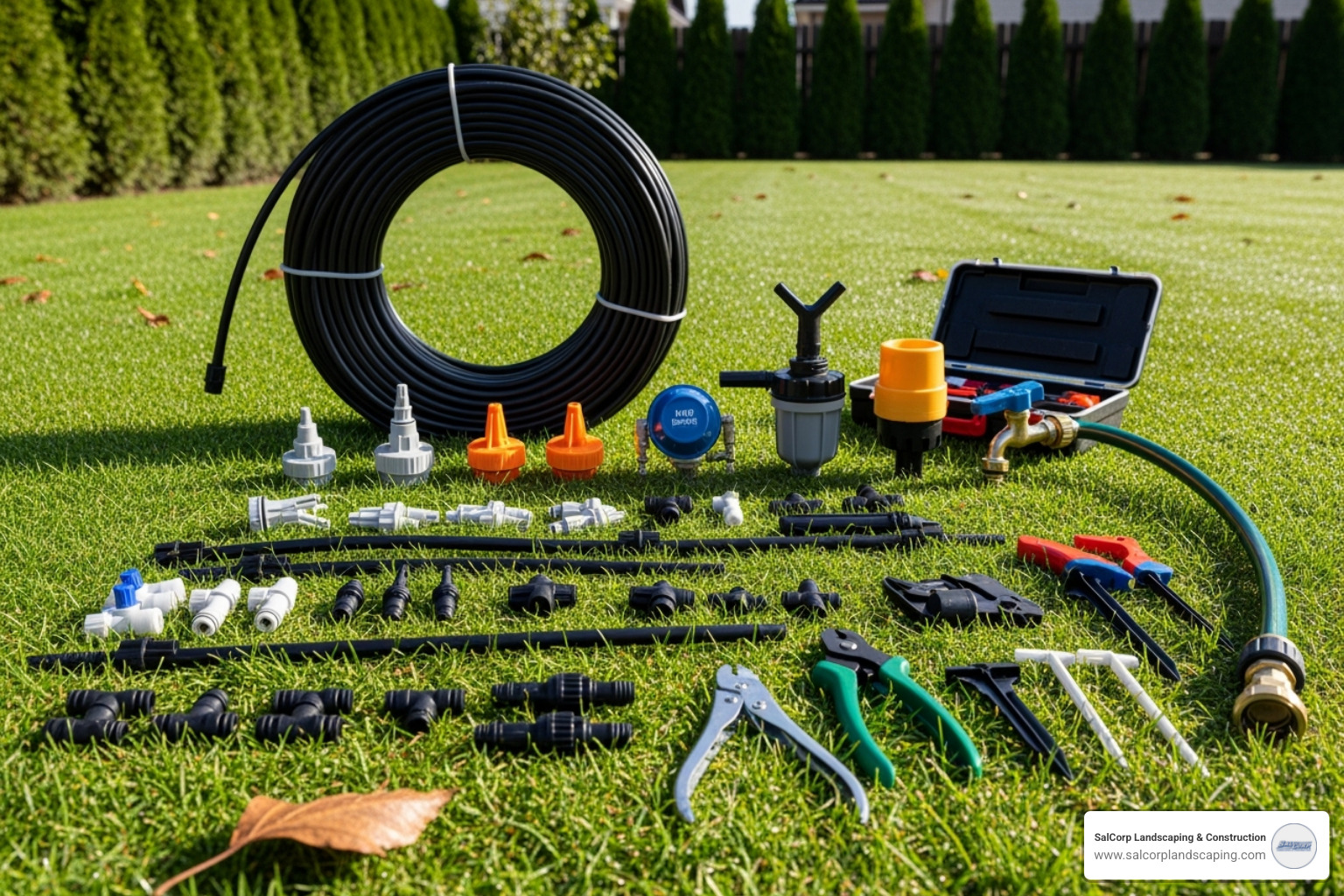
- Core Components: Drip irrigation kit, ½” and ¼” tubing, emitters/sprayers, connectors, and fittings.
- Head Assembly: Backflow preventer (essential for safety), pressure regulator (to protect drip components), automatic timer, and a hose adapter.
- Tools: Tubing cutter, hole punch tool, shovel, measuring tape, landscape staples, and plumber’s tape.
- Recommended: Bark mulch (at least 4 inches deep) to cover tubing and conserve moisture.
Step-by-Step Guide to Installing Sprinkler System in Flower Bed
Now it’s time for the hands-on work of installing sprinkler system in flower bed. This guide focuses on drip irrigation, which is ideal for flower beds.
Safety First: Call 811 a few days before you dig to have underground utility lines marked. This is a free and essential service. Also, check with your local Massachusetts municipality about any required permits for irrigation installations.
For those interested in traditional sprinkler installations, you can view a detailed installation guide from a manufacturer.
Step 1: Connecting to the Water Source
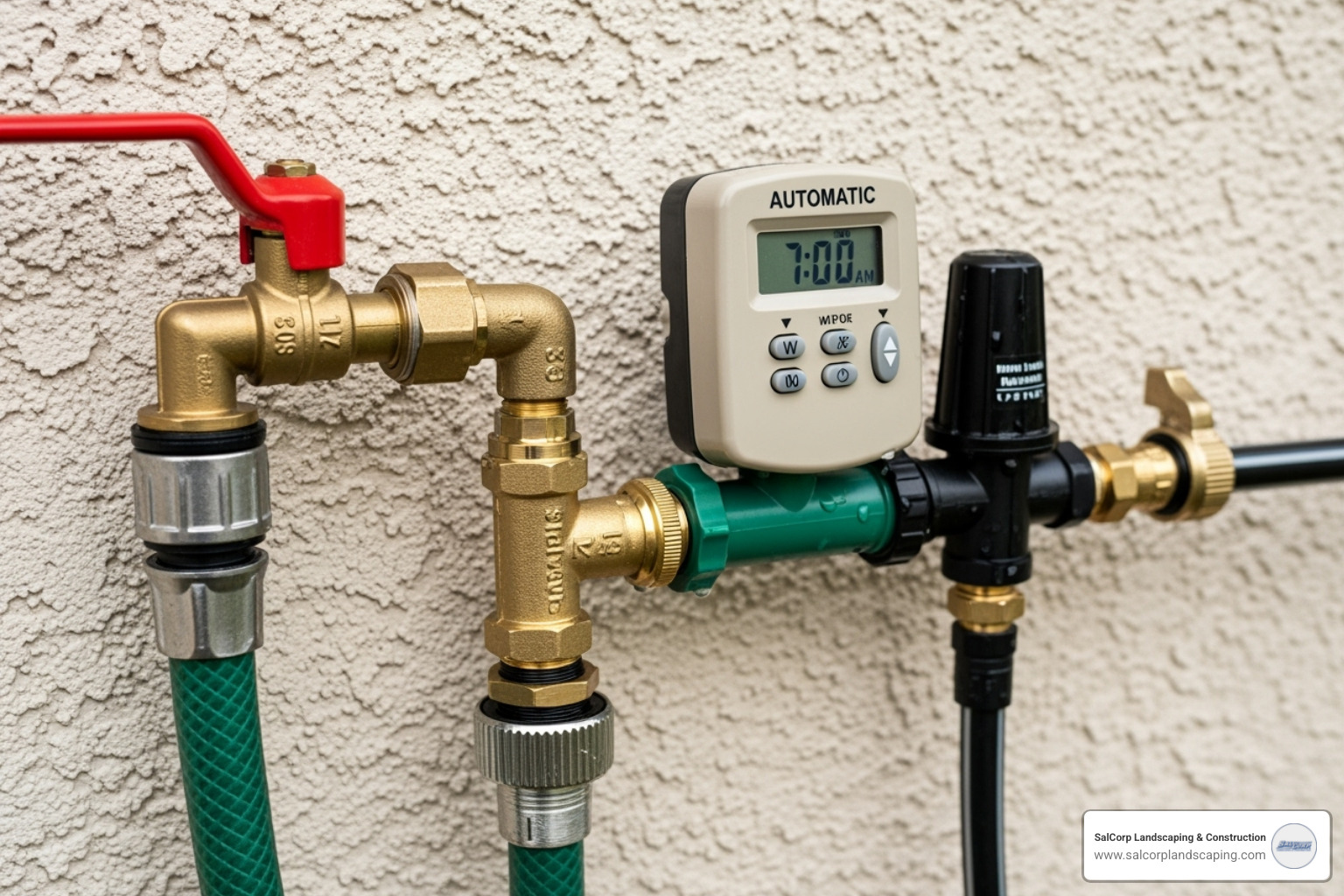
This is the heart of your system. Start by attaching a Y-splitter to your outdoor spigot if you want to maintain hose access. Next, connect the following components in order, using plumber’s tape on all threaded connections to prevent leaks:
- Backflow Preventer: Prevents irrigation water from contaminating your home’s drinking water. This is a critical safety device.
- Automatic Timer: Automates your watering schedule, saving you time and effort.
- Pressure Regulator: Reduces household water pressure (30-60 PSI) to the lower pressure required for drip systems (15-30 PSI). This prevents damage to your emitters.
- Hose Adapter: Connects the head assembly to your main ½” poly tubing.
Step 2: Laying the Main Line and Trenching
Now it’s time to lay out the tubing according to your design.
Dig trenches 6 to 12 inches deep to protect the tubing from shovels and sun damage. Unroll the ½” poly tubing along your planned route, avoiding kinks. If the tubing is stiff, let it warm in the sun to become more flexible.
Use landscape staples every few feet to secure the tubing, especially around curves. This prevents it from popping up through the mulch later. Once the tubing is in place, cover it with at least 4 inches of mulch to hide it, protect it, and conserve soil moisture.
Step 3: Installing Emitters for a Drip System
This step requires precision for optimal plant health.
Use a hole punch tool to make clean holes in the main ½” line for your connectors. Push barbed connectors firmly into these holes. Keep goof plugs handy to seal any misplaced holes.
Attach ¼” tubing to the barbed connectors, running these smaller lines to your plants. A pro tip: dip the end of the ¼” tubing in hot water to soften it, making it easier to push onto the connector for a tight seal.
Emitter placement depends on soil type: space them every 12 inches in sandy soil, 18 inches in loamy soil, and 24 inches in clay soil. Position each emitter directly over the plant’s root ball. Finally, cap all line ends to maintain pressure in the system.
For more guidance on plant placement, check out our planting services.
Step 4: Connecting the Controller and Testing the System
This is the final step to bring your system to life.
If using a multi-zone controller, connect each zone’s main line to the correct valve. Before attaching the final emitters, flush the system by running water through the lines for a few minutes to clear out any debris.
Program your timer for early morning watering (before 9 AM) to reduce evaporation. Most flower beds need about one inch of water per week, which for drip systems often means running for 30-90 minutes, 2-3 times per week.
Finally, test the system. Run each zone and walk through your garden, checking for leaks, ensuring emitters are dripping correctly, and verifying that micro-sprayers have even coverage. Adjust as needed, then backfill your trenches and enjoy your new automated system.
Pro Tips for Efficiency and Long-Term Success
Now that you’ve completed the hard work of installing sprinkler system in flower bed, a few smart habits will keep it running beautifully for years. These simple adjustments can dramatically improve water savings and plant health.
For specific guidance on maintaining your system in the Norfolk, MA area, check out our irrigation systems services.
More info about our irrigation systems in Norfolk MA.
Maximizing Water Efficiency and Coverage
- Water in the Early Morning: Set your timer for before 9 AM. Cooler temperatures and calmer winds mean less evaporation, and foliage has time to dry, preventing fungal diseases.
- Install a Rain Sensor: This device automatically shuts off your system when it rains, saving water and money. Smart controllers can even adjust schedules based on weather forecasts.
- Mulch Your Flower Beds: A 4-inch layer of organic mulch can reduce the need for watering by up to 40% by retaining soil moisture. It also hides and protects your drip tubing.
- Use Head-to-Head Coverage: If using micro-sprayers, ensure the spray from one head reaches the next. This overlap eliminates dry spots.
- Group Plants by Water Needs: Create separate zones for plants with different watering requirements (e.g., drought-tolerant vs. water-loving) to avoid waste.
Learn more about water efficiency from the EPA.
Learn about water efficiency from the EPA.
Common Mistakes to Avoid When Installing Sprinkler System in Flower Bed
These common and easily avoidable mistakes can save you a lot of trouble.
- Mixing Head Types: Never put drip emitters and pop-up sprinklers on the same zone. They have different pressure and flow rate needs.
- Skipping the Pressure Regulator: Drip systems require low pressure. Without a regulator, you risk blowing out your emitters.
- Incorrect Spacing: Emitters spaced too far apart create dry spots, while those too close waste water. Follow the guidelines: 12″ for sandy soil, 18″ for loamy, and 24″ for clay.
- Forgetting to Flush: Always flush the lines with water before attaching emitters to clear out debris that can cause clogs.
- Ignoring Local Codes: Check with your municipality for permit and backflow prevention requirements to avoid costly redos.
- Not Calling 811: Always call 811 before digging to locate underground utility lines. It’s a free service that prevents dangerous and expensive accidents.
Maintaining Your Flower Bed Sprinkler System
Consistent maintenance will ensure your system lasts for years.
- Seasonal Maintenance: In Massachusetts, winterization is critical. Water left in lines will freeze and crack components. Shut off the water and drain the lines. For multi-zone systems, blowing out the lines with an air compressor is the best way to ensure all water is removed.
- Spring Startup: In spring, turn the water back on slowly, check for any damage, clean components, and reprogram your timer for the growing season.
- Regular Checks: Periodically clean filters to prevent clogs. While the system is running, inspect for leaks, such as soggy spots or geysers. Check that emitters are working correctly.
- Replace Timer Batteries: Change the batteries in your timer every six to twelve months to ensure it operates without interruption.
Frequently Asked Questions about Flower Bed Sprinklers
After two decades of helping Massachusetts homeowners, I’ve found these questions come up most often. Here are the answers to help you make the best decisions for your flower beds.
What is the best irrigation system for flower beds?
For most flower beds, drip irrigation is the superior choice. It delivers water directly to the plant’s roots, which can save up to 80% more water compared to overhead sprinklers. This precision also keeps foliage dry, significantly reducing the risk of fungal diseases like powdery mildew.
Micro-sprayers are a good alternative for dense groundcover or tightly packed annuals where broader, gentle coverage is needed. However, for most layouts with individual plants, drip irrigation provides the best results.
How long should I run sprinklers in my flower beds?
The ideal watering time depends on your system, soil type, and plants. The general goal is to provide about one inch of water per week.
For a drip system, this often translates to running for 30-90 minutes, 2-3 times per week. Adjust this based on your soil: sandy soil needs shorter, more frequent watering, while clay soil can handle longer, less frequent sessions.
The best method is to check the soil yourself. It should be moist, but not soggy, 4-6 inches deep. Deep, infrequent watering encourages stronger, more resilient root systems.
Can I add a flower bed zone to my existing lawn sprinkler system?
Yes, adding a dedicated flower bed zone to an existing system is a great upgrade. To do it correctly, you must follow three key rules:
- Use a Separate Valve: Your flower bed zone must have its own valve, as flowers and lawns have very different watering needs.
- Install a Pressure Regulator: Lawn sprinklers use high pressure (30-60 PSI), while drip systems need low pressure (15-30 PSI). A pressure regulator for the flower bed zone is essential to prevent damage.
- Don’t Mix Head Types: Never run traditional lawn sprinklers and drip emitters on the same valve. Their different flow rates mean neither will work properly.
Conclusion
There’s nothing more satisfying than a vibrant, healthy flower bed. With a well-designed sprinkler system, that beauty becomes effortless, allowing you to conserve water and reclaim your valuable time.
Whether you take on the rewarding DIY challenge of installing sprinkler system in flower bed or prefer the peace of mind that comes with professional expertise, the benefits are clear. Your flowers will thank you with more abundant blooms for seasons to come.
If you’re in the Walpole, MA area and looking for expert design and seamless in-ground sprinkler installation, you’ve found the right team. At SalCorp Landscaping & Construction, we’re an owner-operated business with over two decades of hands-on experience and all the specialized equipment needed to craft the perfect irrigation solution for your unique landscape.
We’re proud to help gardens flourish across Massachusetts, serving communities like Avon, Barnstable, Boston, Canton, Dedham, Franklin, Hingham, Medfield, Milton, Natick, Needham, Newton, Norwood, Quincy, Sharon, Stoughton, Sudbury, Taunton, Wellesley, West Roxbury, Westwood, and Weymouth, to name just a few. Let us help your flower beds not just survive, but truly thrive!
